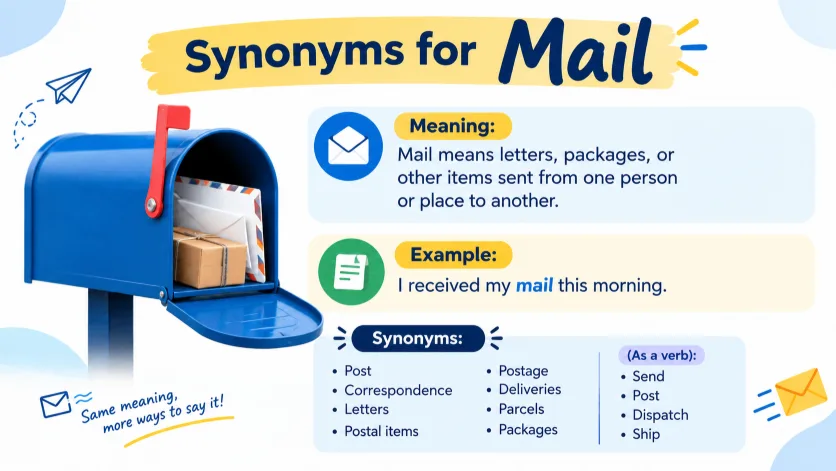
Common synonyms for mail include post, correspondence, letter, message, email, dispatch, shipment, delivery, and communication. The best choice depends on the meaning of “mail” in the sentence.
When you need to send a letter, package, or message, the word mail is a common choice. But English has many other words that fit different situations. You might say post for letters and packages, correspondence for formal written communication, or email for electronic messages.
Learning synonyms for mail helps students, writers, and English learners choose words that fit the context. Some alternatives are formal. Others sound natural in daily speech. A few describe the action of sending something instead of the thing being sent.
This guide explains the meaning, pronunciation, history, formality, and practical use of these words. You will also find examples, categories, antonyms, a quiz, and simple usage tips.
Meaning of Mail and Its Synonyms
Definition
Mail (noun/verb): Mail means letters, packages, or messages sent from one person or place to another. As a verb, it means to send something through a postal service or electronic system.
Examples
- I checked the mail after breakfast.
- Please mail the documents before Friday.
Connotative Meaning
- Positive tone: Mail can suggest useful communication, news, or a thoughtful letter.
- Negative tone: A large amount of mail can suggest paperwork or extra work.
- Neutral tone: In most situations, mail simply refers to something sent from one place to another.
(Connotation means the feeling or idea a word suggests beyond its basic meaning.)
Etymology
- Origin: “Mail” comes through Middle English from Old French male, referring to a traveling bag or pack.
- Old English: The modern word was not used in its current postal sense in Old English.
- Middle English: Forms related to male referred to a traveling bag used for carrying goods or letters.
- Modern English: The word developed its familiar meaning of letters and packages carried by a postal system.
Pronunciation (US & UK – IPA)
US: /meɪl/
UK: /meɪl/
Syllables
mail — one syllable
Affixation Pattern of Mail
- Root: mail
- Prefix: none
- Suffix: none
- Word formation:
- mail — noun/verb
- mailed — verb
- mailing — noun/verb
- mailer — noun
- mailbox — noun
- mailroom — noun
Related Concepts
Mail belongs to the broader fields of communication, correspondence, postal services, and digital communication. Its meaning changes slightly depending on the context. Physical mail usually involves letters or packages, while electronic mail refers to messages sent through digital systems.
Complete List of Synonyms for Mail
| Synonym | Meaning | Formality Level |
| Post | Letters and packages sent through a postal system | Neutral |
| Correspondence | Written communication between people | Formal |
| Letter | A written message sent to someone | Neutral |
| Message | Information sent to another person | Neutral |
| A digital message sent electronically | Neutral | |
| Communication | Exchange of information | Formal/Neutral |
| Dispatch | Something sent to a person or place | Formal |
| Delivery | The act of bringing something to a destination | Neutral |
| Shipment | Goods sent from one place to another | Neutral/Formal |
| Consignment | Goods sent to someone for delivery or sale | Formal |
| Package | An item prepared for sending | Neutral |
| Parcel | A package sent through a postal service | Neutral |
| Notice | Written information given to someone | Formal |
| Memo | A short written message used at work | Formal |
| Missive | A formal written letter or message | Formal |
| Note | A short written message | Neutral |
| Circular | A written message sent to many people | Formal |
| Bulletin | An official short announcement | Formal |
| Communication | Information exchanged between people | Formal/Neutral |
| E-message | A message sent electronically | Neutral |
| Electronic message | A digital message | Formal/Neutral |
| Written communication | Communication in written form | Formal |
| Postal communication | Communication sent through postal services | Formal |
| Mailing | The act or process of sending mail | Neutral |
| Outreach | Communication sent to a group or audience | Formal/Neutral |
Formality Comparison for Mail Synonyms
| Formal | Neutral | Informal |
| Correspondence | Post | Note |
| Communication | Letter | Message |
| Dispatch | ||
| Consignment | Package | E-message |
| Missive | Parcel | — |
| Postal communication | Delivery | — |
| Written communication | Shipment | — |
| Circular | Mailing | — |
25 Synonyms for Mail With Examples
1. Post (Noun/Verb)
US: /poʊst/ | UK: /pəʊst/
Meaning: Letters and packages handled by a postal service, or the act of sending them.
Formality: Neutral
Examples:
- Formal: Please send the signed form by post.
- Informal: I got your post this morning.
2. Correspondence (Noun)
US: /ˌkɔːrəˈspɑːndəns/ | UK: /ˌkɒrəˈspɒndəns/
Meaning: Written communication exchanged between people or organizations.
Formality: Formal
Examples:
- Formal: All correspondence should be sent to the main office.
- Informal: We kept our correspondence for years.
3. Letter (Noun)
US: /ˈletər/ | UK: /ˈletə/
Meaning: A written message sent to another person.
Formality: Neutral
Examples:
- Formal: She sent a letter to the school principal.
- Informal: I received a letter from my friend.
4. Message (Noun)
US: /ˈmesɪdʒ/ | UK: /ˈmesɪdʒ/
Meaning: Information sent from one person to another.
Formality: Neutral
Examples:
- Formal: The office sent a message to all employees.
- Informal: I left you a message.
5. Email (Noun/Verb)
US: /ˈiːmeɪl/ | UK: /ˈiːmeɪl/
Meaning: A digital message sent through an electronic communication system.
Formality: Neutral
Examples:
- Formal: Please email the completed form to our office.
- Informal: I’ll email you the details tonight.
6. Communication (Noun)
US: /kəˌmjuːnɪˈkeɪʃən/ | UK: /kəˌmjuːnɪˈkeɪʃən/
Meaning: The sharing or exchange of information between people.
Formality: Formal/Neutral
Examples:
- Formal: Written communication must be kept for company records.
- Informal: Good communication makes work easier.
7. Dispatch (Noun/Verb)
US: /dɪˈspætʃ/ | UK: /dɪˈspætʃ/
Meaning: Something sent to a particular person or place, or the act of sending it.
Formality: Formal
Examples:
- Formal: The documents were dispatched to the regional office.
- Informal: We dispatched the package this morning.
8. Delivery (Noun)
US: /dɪˈlɪvəri/ | UK: /dɪˈlɪvəri/
Meaning: The act of taking something to the person or place where it is wanted.
Formality: Neutral
Examples:
- Formal: Delivery of the documents is expected by Monday.
- Informal: Your delivery arrived early.
9. Shipment (Noun)
US: /ˈʃɪpmənt/ | UK: /ˈʃɪpmənt/
Meaning: Goods or items sent from one place to another.
Formality: Neutral/Formal
Examples:
- Formal: The shipment was sent to the customer yesterday.
- Informal: Our shipment finally arrived.
10. Consignment (Noun)
US: /kənˈsaɪnmənt/ | UK: /kənˈsaɪnmənt/
Meaning: A group of goods sent to another person or place.
Formality: Formal
Examples:
- Formal: The consignment was delivered to the warehouse.
- Informal: The store is waiting for a new consignment.
11. Package (Noun)
US: /ˈpækɪdʒ/ | UK: /ˈpækɪdʒ/
Meaning: An object wrapped or packed for sending.
Formality: Neutral
Examples:
- Formal: The package was sent to the registered address.
- Informal: Your package is here.
12. Parcel (Noun)
US: /ˈpɑːrsəl/ | UK: /ˈpɑːsəl/
Meaning: A package that is sent through a postal or delivery service.
Formality: Neutral
Examples:
- Formal: The parcel was delivered within three working days.
- Informal: I’m waiting for a parcel.
13. Notice (Noun)
US: /ˈnoʊtɪs/ | UK: /ˈnəʊtɪs/
Meaning: Written information given to people about something important.
Formality: Formal
Examples:
- Formal: The company mailed a notice to all customers.
- Informal: I got a notice about the meeting.
14. Memo (Noun)
US: /ˈmemoʊ/ | UK: /ˈmeməʊ/
Meaning: A short written message used mainly in a workplace.
Formality: Formal
Examples:
- Formal: The manager sent a memo to all staff members.
- Informal: I got a memo about the new schedule.
15. Missive (Noun)
US: /ˈmɪsɪv/ | UK: /ˈmɪsɪv/
Meaning: A written letter or message, especially a formal one.
Formality: Formal
Examples:
- Formal: The ambassador sent a formal missive to the minister.
- Informal: His long missive arrived yesterday.
16. Note (Noun)
US: /noʊt/ | UK: /nəʊt/
Meaning: A short written message.
Formality: Neutral
Examples:
- Formal: The office sent a note confirming the appointment.
- Informal: She left me a note on the table.
17. Circular (Noun)
US: /ˈsɜːrkjələr/ | UK: /ˈsɜːkjʊlə/
Meaning: A written message sent to many people, usually for information.
Formality: Formal
Examples:
- Formal: The school sent a circular to all parents.
- Informal: We received a circular about the event.
18. Bulletin (Noun)
US: /ˈbʊlətɪn/ | UK: /ˈbʊlətɪn/
Meaning: A short official announcement or piece of information.
Formality: Formal
Examples:
- Formal: A bulletin was mailed to every member.
- Informal: I read the latest bulletin this morning.
19. Electronic Message (Noun)
US: /ɪˌlekˈtrɑːnɪk ˈmesɪdʒ/ | UK: /ɪˌlekˈtrɒnɪk ˈmesɪdʒ/
Meaning: A message sent through an electronic communication system.
Formality: Formal/Neutral
Examples:
- Formal: The electronic message contained the required information.
- Informal: I sent an electronic message before lunch.
20. E-message (Noun)
US: /ˈiː ˌmesɪdʒ/ | UK: /ˈiː ˌmesɪdʒ/
Meaning: A message sent electronically.
Formality: Neutral
Examples:
- Formal: The company sent an e-message to its customers.
- Informal: I got your e-message.
21. Written Communication (Noun Phrase)
US: /ˈrɪtn kəˌmjuːnɪˈkeɪʃən/ | UK: /ˈrɪtn kəˌmjuːnɪˈkeɪʃən/
Meaning: Information shared through written words.
Formality: Formal
Examples:
- Formal: Written communication should remain clear and professional.
- Informal: We use written communication every day.
22. Postal Communication (Noun Phrase)
US: /ˈpoʊstəl kəˌmjuːnɪˈkeɪʃən/ | UK: /ˈpəʊstəl kəˌmjuːnɪˈkeɪʃən/
Meaning: Communication sent through a postal service.
Formality: Formal
Examples:
- Formal: Postal communication remains useful for official documents.
- Informal: Some people still prefer postal communication.
23. Mailing (Noun)
US: /ˈmeɪlɪŋ/ | UK: /ˈmeɪlɪŋ/
Meaning: The act or process of sending letters or other items.
Formality: Neutral
Examples:
- Formal: The mailing of the notices began on Monday.
- Informal: I finished the mailing this afternoon.
24. Outreach (Noun)
US: /ˈaʊtriːtʃ/ | UK: /ˈaʊtriːtʃ/
Meaning: An organized effort to communicate with or reach a group of people.
Formality: Formal/Neutral
Examples:
- Formal: The organization used direct mail for community outreach.
- Informal: The team started an outreach campaign.
25. Letter Mail (Noun Phrase)
US: /ˈletər meɪl/ | UK: /ˈletə meɪl/
Meaning: Mail made up mainly of letters rather than packages.
Formality: Neutral/Formal
Examples:
- Formal: Letter mail should be addressed clearly.
- Informal: Most of my letter mail comes from family.
Mail Synonyms: Prototype Meaning and Common Uses
The most typical meaning of mail is something sent from one person or place to another through a postal system. In American English, “mail” commonly refers to letters and packages. In British English, post is often the more natural term.
The word can also refer to electronic communication in phrases such as email. For this reason, context matters. A “package” is a physical item, while an “email” is digital communication.
Synonyms for Mail by Category
Physical Mail
Post, letter, package, parcel, shipment, delivery, and mailing are useful for physical items.
Written Communication
Letter, correspondence, note, memo, missive, and written communication focus on the message rather than the delivery process.
Digital Communication
Email, e-message, electronic message, and communication fit digital contexts.
Formal Communication
Correspondence, dispatch, consignment, circular, bulletin, and postal communication are more suitable for official or professional writing.
Audience Communication
Outreach, communication, bulletin, and circular work when information is sent to a group of people.
Grouping synonyms this way helps you choose the right word quickly. A package is not the same as a letter, and correspondence is not always a physical item.
Antonyms of Mail
Mail does not have one exact opposite in every context. The closest opposites describe keeping, receiving, or withholding communication.
- Receive: To get something sent by another person.
- Keep: To hold something instead of sending it.
- Withhold: To stop information from being given or sent.
- Retain: To continue to keep something.
- Collect: To take something that has arrived.
- Hold: To keep something back from delivery.
Quiz: Test Your Knowledge of Mail Synonyms
Q1. Which word is a common synonym for mail in British English?
a) Post
b) Keep
c) Hold
d) Store
Answer: a) Post
Q2. Which word means written communication between people?
a) Package
b) Correspondence
c) Shipment
d) Delivery
Answer: b) Correspondence
Q3. Which word best describes a digital message?
a) Parcel
b) Consignment
c) Email
d) Dispatch
Answer: c) Email
Q4. Which word is more formal than “letter”?
a) Missive
b) Package
c) Parcel
d) Note
Answer: a) Missive
Q5. Which word refers to goods sent from one place to another?
a) Shipment
b) Memo
c) Note
d) Bulletin
Answer: a) Shipment
Q6. Which word best fits an official message sent to many people?
a) Circular
b) Parcel
c) Package
d) Shipment
Answer: a) Circular
Q7. Which word describes an organized effort to reach a group?
a) Outreach
b) Parcel
c) Letter
d) Mailing
Answer: a) Outreach
Answer Key
- a) Post
- b) Correspondence
- c) Email
- a) Missive
- a) Shipment
- a) Circular
- a) Outreach
Usage Tips for Mail Synonyms
- Use post when talking about the postal system, especially in British English.
- Choose correspondence for formal written communication between people or organizations.
- Use email only for electronic messages.
- Choose package or parcel for physical items sent to someone.
- Use shipment when discussing goods sent as part of business or trade.
- In formal writing, dispatch, missive, and postal communication can fit specific contexts, but they may sound too formal for casual conversation.
- Do not treat every related word as an exact replacement. For example, delivery describes the process of bringing something to a destination, while mail can refer to the item itself.
- For IELTS and other English exams, use precise vocabulary instead of replacing “mail” with a difficult word that does not fit the sentence.
Frequently Asked Questions About Synonyms for Mail
What does mail mean?
Mail means letters, packages, or other messages sent from one person or place to another. It can also be used as a verb meaning to send something.
What is another word for mail?
Common alternatives include post, correspondence, letter, message, email, dispatch, parcel, package, and shipment. The best choice depends on the context.
Is “post” a synonym for mail?
Yes. Post is commonly used for mail sent through a postal system, especially in British English.
Is email a synonym for mail?
Email can be a synonym when mail means electronic communication. It is not a synonym for physical postal mail.
What is a formal synonym for mail?
Correspondence is a useful formal alternative when you mean written communication. Dispatch and postal communication can also fit formal contexts.
What is another word for a piece of mail?
Depending on the item, you can use letter, package, parcel, notice, message, or correspondence.
What is the difference between mail and post?
In American English, mail is the common term for letters and packages sent through the postal system. In British English, post is often used instead.
What is the difference between mail and correspondence?
Mail can refer to physical letters, packages, or the process of sending them. Correspondence usually focuses on written communication exchanged between people or organizations.
Conclusion: Choosing the Right Synonyms for Mail
Learning synonyms for mail gives you more control over your English. Instead of using “mail” in every sentence, you can choose a word that shows the exact meaning.
Use post for postal services, letter for a written message, and package or parcel for physical items. Choose correspondence for formal written communication and email for digital messages. Words such as dispatch, shipment, and consignment work well in specific professional settings.
The key is not to use the hardest word. Use the word that fits the meaning. Regular practice with examples will help you write with more variety and speak with greater confidence.
Discover More Articles:

Hi, I’m Emma Wilson, an English vocabulary writer helping learners improve their word skills with synonyms, meanings, examples, and quizzes. I create simple resources to make English learning easier.