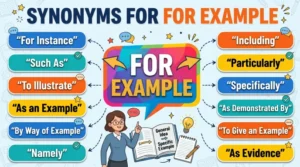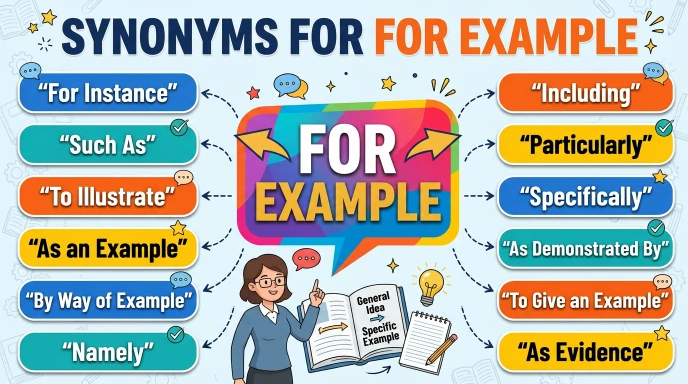
Synonyms for for example include for instance, such as, like, namely, to illustrate, as an illustration, by way of example, and specifically.
These expressions help introduce examples, explain ideas, and make writing easier to understand. Some alternatives work best in formal writing, while others sound more natural in everyday conversations.
Learning different ways to say for example can improve your vocabulary and make your sentences more interesting. Students, bloggers, content writers, and English learners can use these expressions in essays, emails, reports, and daily conversations. This guide explains their meanings, pronunciation, formality, and correct usage with simple examples.
Meaning of For Example
Definition
For example is a phrase used to introduce something that helps explain or support a general statement. It gives readers or listeners a specific case that makes an idea easier to understand.
Examples
- Many fruits contain vitamins. For example, oranges are rich in vitamin C.
- You can learn new skills online, for example, by watching educational videos.
Connotative Meaning
The phrase for example has a neutral and informative tone. It introduces a specific detail to make a general point clearer. It does not usually express emotion or personal opinion.
Etymology
The phrase combines for, a preposition, with example, a word that came into English through Old French from Latin exemplum, meaning a sample, model, or pattern.
Pronunciation
- US IPA: /fɔːr ɪɡˈzæmpəl/
- UK IPA: /fər ɪɡˈzɑːmpəl/
Syllables
- For: 1 syllable
- Example: 3 syllables (ex am ple)
- Total: 4 syllables
Affixation Pattern
For example is a two word phrase, not a single word formed through prefix or suffix addition. The word example is a base noun.
Related Concepts
- Illustration: A detail that makes an idea clearer.
- Evidence: Information that supports a statement.
- Instance: A particular case of something.
- Sample: A small part that represents a larger group.
- Explanation: Information that makes something easier to understand.
Complete Synonyms List for For Example
The following alternatives can introduce examples or provide specific details. Some are close replacements, while others fit particular sentence structures.
| Synonym | Meaning | Formality Level |
| 1. For instance | A particular example | Neutral |
| 2. Such as | Introduces examples in a list | Neutral |
| 3. Like | Introduces similar examples | Informal |
| 4. To illustrate | Shows an idea through an example | Formal |
| 5. As an illustration | Gives an example to explain something | Formal |
| 6. By way of example | Introduces an example | Formal |
| 7. Namely | Identifies specific items | Formal |
| 8. Specifically | Gives exact details | Neutral |
| 9. In particular | Points to one specific case | Neutral |
| 10. Including | Names something as part of a group | Neutral |
| 11. To give an example | Introduces a particular case | Neutral |
| 12. As an example | Presents something as an example | Neutral |
| 13. Take … for example | Uses something to explain a point | Neutral |
| 14. Consider | Invites someone to think about a case | Neutral |
| 15. Suppose | Introduces a possible situation | Neutral |
| 16. Say | Introduces a possible example or situation | Informal |
| 17. In this case | Refers to a particular situation | Neutral |
| 18. As seen in | Points to an example that can be observed | Formal |
| 19. A case in point | Refers to a relevant example | Formal |
| 20. One example is | Introduces one specific example | Neutral |
| 21. Among others | Indicates examples within a larger group | Neutral |
| 22. To name a few | Introduces a short selection | Informal |
| 23. For one | Gives one supporting reason or example | Informal |
| 24. As demonstrated by | Introduces supporting evidence or an example | Formal |
| 25. In the case of | Refers to a particular person or situation | Neutral |
Formality Comparison of For Example Synonyms
Different alternatives to for example suit different writing situations. Use formal expressions in academic papers and professional reports. Choose conversational expressions for everyday speech.
| Formality | Best Alternatives | Common Use |
| Formal | To illustrate, as an illustration, by way of example, namely | Academic writing and reports |
| Neutral | For instance, such as, specifically, in particular | General writing and conversation |
| Informal | Like, say, to name a few, for one | Casual conversations and messages |
Writing tip: Use for instance in place of for example when introducing a complete example sentence. Use such as when introducing examples within a sentence.
Detailed Synonyms for For Example
1. For Instance
Part of Speech: Introductory phrase
US IPA: /fɔːr ˈɪnstəns/
UK IPA: /fər ˈɪnstəns/
Meaning: Introduces a particular example that explains a general statement.
Formality: Neutral
Formal Example: Several countries have invested in renewable energy; for instance, Denmark has developed a strong wind power industry.
Informal Example: I enjoy outdoor activities, for instance, hiking and cycling.
2. Such As
Part of Speech: Prepositional phrase
US IPA: /sʌtʃ æz/
UK IPA: /sʌtʃ æz/
Meaning: Introduces one or more examples of a larger group.
Formality: Neutral
Formal Example: Essential nutrients such as protein and calcium support healthy growth.
Informal Example: I enjoy snacks such as popcorn and nuts.
3. Like
Part of Speech: Preposition
US IPA: /laɪk/
UK IPA: /laɪk/
Meaning: Introduces examples that are similar to the thing being discussed.
Formality: Informal in example giving use
Formal Example: Certain activities, like swimming, can improve cardiovascular fitness.
Informal Example: I enjoy games like football and tennis.
4. To Illustrate
Part of Speech: Infinitive phrase
US IPA: /tuː ˈɪləˌstreɪt/
UK IPA: /tuː ˈɪləstreɪt/
Meaning: Introduces an example that helps explain an idea.
Formality: Formal
Formal Example: To illustrate, the survey showed that most students preferred online learning.
Informal Example: To illustrate, imagine trying to finish a project without a plan.
5. As an Illustration
Part of Speech: Introductory phrase
US IPA: /æz ən ˌɪləˈstreɪʃən/
UK IPA: /æz ən ˌɪləˈstreɪʃən/
Meaning: Introduces an example to make a point clearer.
Formality: Formal
Formal Example: As an illustration, the report highlights the benefits of regular exercise.
Informal Example: As an illustration, think about how a small habit can change your day.
6. By Way of Example
Part of Speech: Prepositional phrase
US IPA: /baɪ weɪ əv ɪɡˈzæmpəl/
UK IPA: /baɪ weɪ əv ɪɡˈzɑːmpəl/
Meaning: Introduces something specifically to demonstrate a point.
Formality: Formal
Formal Example: By way of example, the company offers flexible working hours to its employees.
Informal Example: By way of example, you can organize your desk before starting work.
7. Namely
Part of Speech: Adverb
US IPA: /ˈneɪmli/
UK IPA: /ˈneɪmli/
Meaning: Introduces exact details or identifies something more specifically.
Formality: Formal
Formal Example: The project has one main objective, namely, improving access to education.
Informal Example: I need two things, namely, a notebook and a pen.
8. Specifically
Part of Speech: Adverb
US IPA: /spəˈsɪfɪkli/
UK IPA: /spəˈsɪfɪkli/
Meaning: Introduces exact information or a particular detail.
Formality: Neutral
Formal Example: The study focuses specifically on the effects of sleep deprivation.
Informal Example: I want to visit Italy, specifically Rome.
9. In Particular
Part of Speech: Adverbial phrase
US IPA: /ɪn pərˈtɪkjələr/
UK IPA: /ɪn pəˈtɪkjələ/
Meaning: Highlights one specific person, thing, or example.
Formality: Neutral
Formal Example: The research examines environmental problems, in particular, air pollution.
Informal Example: I enjoy reading, in particular, mystery novels.
10. Including
Part of Speech: Preposition
US IPA: /ɪnˈkluːdɪŋ/
UK IPA: /ɪnˈkluːdɪŋ/
Meaning: Introduces one or more things that belong to a larger group.
Formality: Neutral
Formal Example: The course covers several subjects, including mathematics and science.
Informal Example: I bought some groceries, including bread and milk.
11. To Give an Example
Part of Speech: Infinitive phrase
US IPA: /tə ɡɪv ən ɪɡˈzæmpəl/
UK IPA: /tə ɡɪv ən ɪɡˈzɑːmpəl/
Meaning: Directly introduces a particular example.
Formality: Neutral
Formal Example: To give an example, regular feedback can improve employee performance.
Informal Example: To give an example, my brother studies for an hour every evening.
12. As an Example
Part of Speech: Introductory phrase
US IPA: /æz ən ɪɡˈzæmpəl/
UK IPA: /æz ən ɪɡˈzɑːmpəl/
Meaning: Presents something as a specific example of a general point.
Formality: Neutral
Formal Example: As an example, the university provides free academic support to students.
Informal Example: As an example, you can use a calendar to manage your tasks.
13. Take … for Example
Part of Speech: Imperative phrase
US IPA: /teɪk … fər ɪɡˈzæmpəl/
UK IPA: /teɪk … fər ɪɡˈzɑːmpəl/
Meaning: Uses a particular person or thing to explain a general idea.
Formality: Neutral
Formal Example: Take renewable energy for example; solar power can reduce dependence on fossil fuels.
Informal Example: Take my sister for example; she reads every night before bed.
14. Consider
Part of Speech: Verb
US IPA: /kənˈsɪdər/
UK IPA: /kənˈsɪdə/
Meaning: Invites someone to think about a particular case or situation.
Formality: Neutral
Formal Example: Consider a company that invests in employee training and development.
Informal Example: Consider my friend, who learned English by watching films.
15. Suppose
Part of Speech: Verb
US IPA: /səˈpoʊz/
UK IPA: /səˈpəʊz/
Meaning: Introduces an imagined or possible situation for explanation.
Formality: Neutral
Formal Example: Suppose a business reduces its costs by improving efficiency.
Informal Example: Suppose you lose your phone; how would you contact your family?
16. Say
Part of Speech: Verb
US IPA: /seɪ/
UK IPA: /seɪ/
Meaning: Introduces a possible example or imagined situation.
Formality: Informal
Formal Example: Assume, say, that the annual growth rate remains constant.
Informal Example: Imagine you have, say, fifty dollars to spend.
17. In This Case
Part of Speech: Prepositional phrase
US IPA: /ɪn ðɪs keɪs/
UK IPA: /ɪn ðɪs keɪs/
Meaning: Refers to a particular situation being discussed.
Formality: Neutral
Formal Example: The applicant meets all the requirements; in this case, approval is appropriate.
Informal Example: You forgot your umbrella, so in this case, take mine.
18. As Seen In
Part of Speech: Introductory phrase
US IPA: /æz siːn ɪn/
UK IPA: /æz siːn ɪn/
Meaning: Points to an example or situation that can be observed in a particular source or place.
Formality: Formal
Formal Example: As seen in recent research, regular exercise supports mental well being.
Informal Example: As seen in this picture, the garden looks much better after cleaning.
19. A Case in Point
Part of Speech: Noun phrase
US IPA: /ə keɪs ɪn pɔɪnt/
UK IPA: /ə keɪs ɪn pɔɪnt/
Meaning: A particular example that clearly supports a statement.
Formality: Formal
Formal Example: Many small businesses succeed through innovation; this company is a case in point.
Informal Example: Good planning saves time, and our recent trip is a case in point.
20. One Example Is
Part of Speech: Introductory phrase
US IPA: /wʌn ɪɡˈzæmpəl ɪz/
UK IPA: /wʌn ɪɡˈzɑːmpəl ɪz/
Meaning: Introduces one specific example from a larger group.
Formality: Neutral
Formal Example: Several renewable energy sources are available; one example is solar power.
Informal Example: I enjoy outdoor hobbies; one example is cycling.
21. Among Others
Part of Speech: Prepositional phrase
US IPA: /əˈmʌŋ ˈʌðərz/
UK IPA: /əˈmʌŋ ˈʌðəz/
Meaning: Indicates that the named items are part of a larger group.
Formality: Neutral
Formal Example: The program supports teachers, researchers, and students, among others.
Informal Example: I invited my cousins and neighbors, among others.
22. To Name a Few
Part of Speech: Infinitive phrase
US IPA: /tə neɪm ə fjuː/
UK IPA: /tə neɪm ə fjuː/
Meaning: Introduces a small selection from a larger group.
Formality: Informal
Formal Example: The organization supports several causes, including education and healthcare, to name a few.
Informal Example: I enjoy many sports, such as football and cricket, to name a few.
23. For One
Part of Speech: Introductory phrase
US IPA: /fɔːr wʌn/
UK IPA: /fə wʌn/
Meaning: Introduces one reason or example that supports a statement.
Formality: Informal
Formal Example: The proposal has several advantages; for one, it reduces operating costs.
Informal Example: I like this phone; for one, its battery lasts all day.
24. As Demonstrated By
Part of Speech: Introductory phrase
US IPA: /æz ˈdɛmənˌstreɪtɪd baɪ/
UK IPA: /æz ˈdɛmənstreɪtɪd baɪ/
Meaning: Introduces evidence or an example that shows something clearly.
Formality: Formal
Formal Example: The treatment improved patient outcomes, as demonstrated by the clinical results.
Informal Example: The new method works well, as demonstrated by our successful project.
25. In the Case Of
Part of Speech: Prepositional phrase
US IPA: /ɪn ðə keɪs əv/
UK IPA: /ɪn ðə keɪs əv/
Meaning: Refers to a particular person, thing, or situation.
Formality: Neutral
Formal Example: In the case of young learners, visual materials can support understanding.
Informal Example: In the case of my brother, practice helped him become a better swimmer.
Prototype Meaning of For Example
The prototype meaning of for example is to introduce a specific instance that makes a general statement easier to understand.
For instance, consider this sentence:
General statement: Many animals live in forests.
Example: For example, bears, deer, and foxes live in forest habitats.
Here, the phrase connects a broad idea with specific examples. This is its most common function in everyday English and academic writing.
Synonyms for For Example by Category
Different alternatives work in different situations. These categories can help you choose the right expression.
Formal Alternatives
- To illustrate
- As an illustration
- By way of example
- Namely
- As demonstrated by
Informal Alternatives
- Like
- Say
- To name a few
- For one
Academic Writing Alternatives
- For instance
- Specifically
- In particular
- A case in point
- As seen in
Alternatives for Introducing Lists
- Such as
- Including
- Among others
- To name a few
Alternatives for Imagined Situations
- Suppose
- Consider
- Say
- Take … for example
Antonyms of For Example
For example is an introductory phrase, so it does not have exact one word antonyms. However, some expressions perform an opposite or contrasting function.
| Opposite Expression | Meaning |
| In general | Refers to something broadly rather than giving a specific example |
| Generally speaking | Discusses a general idea |
| Overall | Summarizes a complete situation |
| Without specifics | Avoids giving exact details |
| In abstract terms | Discusses an idea without a concrete example |
Example:
- With an example: Many animals are friendly. For example, dogs often enjoy human company.
- Without an example: In general, many animals can form bonds with humans.
Quiz: Test Your Knowledge of For Example Synonyms
Choose the best answer for each question.
1. Which phrase is a common synonym for for example?
A. In general
B. For instance
C. As a result
D. In conclusion
2. Which expression is best for introducing examples in a list?
A. Such as
B. Therefore
C. However
D. Instead
3. Which phrase is more suitable for formal writing?
A. Say
B. Like
C. By way of example
D. For one
4. What does namely usually introduce?
A. A question
B. Exact details
C. An opposite idea
D. A conclusion
5. Which phrase means a relevant example that supports a statement?
A. A case in point
B. In general
C. On the contrary
D. At first
6. Which phrase can introduce an imagined situation?
A. Suppose
B. Including
C. Namely
D. Among others
Answer Key
- B. For instance
- A. Such as
- C. By way of example
- B. Exact details
- A. A case in point
- A. Suppose
Usage Tips for For Example Synonyms
Use these practical tips to make your writing clearer and more natural.
- Use “for instance” when introducing a complete example sentence.
- Use “such as” before examples within a sentence.
- Choose “to illustrate” when explaining an idea in formal writing.
- Use “namely” when identifying exact details rather than giving a broad selection.
- Choose “like” for casual conversations and informal writing.
- Use “specifically” when you want to highlight an exact detail.
- Avoid unnecessary repetition. Do not use the same introductory phrase in every paragraph.
- Check sentence structure. Some alternatives, such as “such as” and “including,” cannot always replace “for example” at the beginning of a sentence.
Important: Synonyms do not always have identical grammar. Choose an alternative that fits the structure and meaning of your sentence.
FAQs About Synonyms for For Example
1. What are the best synonyms for for example?
Some of the best alternatives are for instance, such as, to illustrate, as an illustration, and by way of example. These expressions help introduce specific details and make explanations clearer.
2. What is a formal way to say for example?
You can use to illustrate, by way of example, as an illustration, or as demonstrated by. These expressions are useful in academic papers, professional reports, and formal presentations.
3. Can I use such as instead of for example?
Yes, but the sentence structure may need to change. Such as usually introduces examples within a sentence, while for example can introduce a complete sentence.
4. Is like a synonym for for example?
Yes, like can introduce examples in informal English. For instance, you can say, “I enjoy outdoor activities like hiking and cycling.”
5. What is the difference between for example and for instance?
Both phrases introduce specific examples and often have the same meaning. For instance can make your writing sound slightly more varied, but both are suitable for general and formal communication.
6. How can I avoid repeating for example in an essay?
Use alternatives such as for instance, to illustrate, specifically, and in particular. You can also change your sentence structure to introduce examples naturally.
7. Is namely the same as for example?
Not exactly. Namely introduces specific details or identifies something precisely, while for example introduces one or more possible examples. They are interchangeable only in certain contexts.
Conclusion
Learning synonyms for for example can make your English writing more natural, clear, and engaging. Expressions such as for instance, such as, to illustrate, specifically, and by way of example help you introduce examples without repeating the same phrase.
Each alternative has its own purpose and sentence structure. Some work better in academic writing, while others are more suitable for everyday conversations. Remember to choose words that match your tone and meaning.
Practice using these expressions in essays, emails, reports, and daily conversations. With regular practice, you can build stronger vocabulary and explain your ideas with greater confidence.
Discover More Articles:

Hi, I’m Emma Collins, and I enjoy creating simple English vocabulary resources that make learning easier for everyone. I write about synonyms, antonyms, word meanings, vocabulary lists, and writing tips using clear, everyday language. My goal is to help students, writers, teachers, and English learners build their vocabulary, improve their writing, and feel more confident using English. I take time to research every article carefully so the information is accurate, practical, and easy to understand.