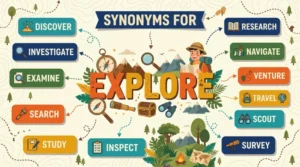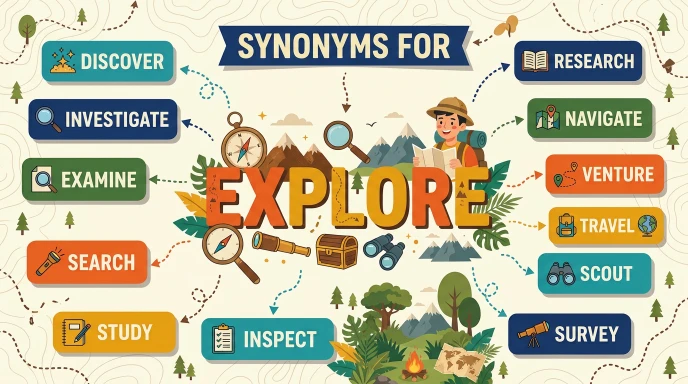
Synonyms for explore include investigate, examine, discover, study, inspect, research, survey, and investigate.
These words describe different ways of learning about a place, subject, idea, or situation. Some suggest careful research, while others mean traveling to new places or finding something unknown. Learning these alternatives helps students and English learners improve their vocabulary and avoid repeating the same word.
In this guide, you will find 25 useful synonyms for explore with simple meanings, pronunciation, and examples. You will also learn how to use them in formal writing, everyday conversations, and different contexts.
Synonyms for Explore
Common synonyms for explore include investigate, examine, discover, inspect, research, study, survey, probe, analyze, and venture into. These words describe searching, learning, or examining something carefully. The best alternative depends on if you are exploring a place, an idea, a subject, or a problem.
Meaning of Explore
Definition
Explore is a verb that means to travel through an unfamiliar place, examine something carefully, or learn more about a subject, idea, or possibility.
Examples
- We decided to explore the old city during our vacation.
- Students explore new ideas through classroom activities.
Connotative Meaning
The word explore often suggests curiosity, discovery, learning, and adventure. It can describe physical travel or the process of examining ideas and information.
Etymology
The word explore comes from Latin explorare, meaning to investigate, search out, or examine. It entered English through French.
Pronunciation
- US IPA: /ɪkˈsplɔːr/
- UK IPA: /ɪkˈsplɔː/
Syllables
Explore has two syllables: ex plore.
Affixation Pattern
Explore is a base verb. It has no productive prefix or suffix in its basic form.
Related Concepts
- Discovery: Finding something previously unknown.
- Investigation: A careful search for information.
- Research: Detailed study of a subject.
- Adventure: An exciting or unusual experience.
- Curiosity: A strong desire to learn or know something.
Complete List of 25 Synonyms for Explore
| Synonym | Simple Meaning | Formality Level |
| 1. Investigate | Examine something carefully | Formal |
| 2. Examine | Look at something closely | Neutral |
| 3. Discover | Find something new or unknown | Neutral |
| 4. Inspect | Check something carefully | Formal |
| 5. Research | Study a subject in detail | Formal |
| 6. Study | Learn about something carefully | Neutral |
| 7. Survey | Examine or review a place or subject | Formal |
| 8. Probe | Investigate deeply | Formal |
| 9. Analyze | Examine details to understand something | Formal |
| 10. Search | Look for something | Neutral |
| 11. Seek | Try to find or obtain something | Neutral |
| 12. Look into | Investigate a matter | Informal |
| 13. Delve into | Examine a subject deeply | Neutral |
| 14. Scrutinize | Examine very carefully | Formal |
| 15. Scout | Search an area for information or opportunities | Neutral |
| 16. Traverse | Travel across an area | Formal |
| 17. Roam | Travel around freely | Neutral |
| 18. Wander | Move around without a fixed direction | Neutral |
| 19. Navigate | Find or follow a route | Neutral |
| 20. Tour | Visit places for enjoyment or learning | Neutral |
| 21. Venture | Go somewhere unfamiliar or risky | Neutral |
| 22. Range | Travel across a wide area | Neutral |
| 23. Consider | Think carefully about an idea | Neutral |
| 24. Assess | Judge or evaluate something | Formal |
| 25. Review | Examine something again or carefully | Neutral |
Note: These alternatives fit different meanings of explore. For example, investigate works well for a problem, while roam and wander are more suitable for moving around a place.
Formality Comparison of Explore Synonyms
| Synonym | Formality | Best Use |
| Investigate | Formal | Problems and situations |
| Examine | Neutral | Objects, ideas, and details |
| Discover | Neutral | New information or places |
| Inspect | Formal | Checking quality or condition |
| Research | Formal | Academic and professional work |
| Study | Neutral | Learning and education |
| Probe | Formal | Deep investigation |
| Analyze | Formal | Detailed examination |
| Look into | Informal | Everyday conversations |
| Delve into | Neutral | Detailed study |
| Scrutinize | Formal | Close examination |
| Roam | Neutral | Traveling freely |
| Wander | Neutral | Moving without a fixed route |
| Tour | Neutral | Visiting places |
| Venture | Neutral | Entering unfamiliar situations |
Detailed Synonyms for Explore
1. Investigate
Part of Speech: Verb
US IPA: /ɪnˈvestɪɡeɪt/
UK IPA: /ɪnˈvestɪɡeɪt/
Meaning: To examine something carefully to discover facts or information.
Formality: Formal
Formal Example: The researchers will investigate the causes of the problem.
Informal Example: The police need to investigate that strange noise.
2. Examine
Part of Speech: Verb
US IPA: /ɪɡˈzæmɪn/
UK IPA: /ɪɡˈzæmɪn/
Meaning: To look at or study something carefully.
Formality: Neutral
Formal Example: The committee will examine the proposed changes.
Informal Example: Let’s examine this picture more closely.
3. Discover
Part of Speech: Verb
US IPA: /dɪˈskʌvər/
UK IPA: /dɪˈskʌvə/
Meaning: To find something new or learn something that was previously unknown.
Formality: Neutral
Formal Example: Scientists hope to discover new treatments.
Informal Example: We discovered a beautiful beach during our trip.
4. Inspect
Part of Speech: Verb
US IPA: /ɪnˈspekt/
UK IPA: /ɪnˈspekt/
Meaning: To check something carefully to understand its condition.
Formality: Formal
Formal Example: Engineers will inspect the bridge for damage.
Informal Example: Let’s inspect the room before we leave.
5. Research
Part of Speech: Verb
US IPA: /ˈriːsɜːrtʃ/
UK IPA: /rɪˈsɜːtʃ/
Meaning: To study a subject carefully to collect information.
Formality: Formal
Formal Example: The students will research climate change for their project.
Informal Example: I need to research this topic before buying a laptop.
6. Study
Part of Speech: Verb
US IPA: /ˈstʌdi/
UK IPA: /ˈstʌdi/
Meaning: To spend time learning about or examining something.
Formality: Neutral
Formal Example: The team will study the effects of the new policy.
Informal Example: I want to study the history of this town.
7. Survey
Part of Speech: Verb
US IPA: /ˈsɜːrveɪ/
UK IPA: /səˈveɪ/
Meaning: To examine or look over an area, group, or subject.
Formality: Formal
Formal Example: The researchers will survey the local population.
Informal Example: We stopped on the hill to survey the landscape.
8. Probe
Part of Speech: Verb
US IPA: /proʊb/
UK IPA: /prəʊb/
Meaning: To investigate something deeply or ask questions to find information.
Formality: Formal
Formal Example: The inquiry will probe the reasons behind the decision.
Informal Example: The reporter continued to probe for answers.
9. Analyze
Part of Speech: Verb
US IPA: /ˈænəˌlaɪz/
UK IPA: /ˈænəlaɪz/
Meaning: To examine information or details carefully to understand them.
Formality: Formal
Formal Example: The scientists will analyze the collected data.
Informal Example: Let’s analyze what went wrong.
10. Search
Part of Speech: Verb
US IPA: /sɜːrtʃ/
UK IPA: /sɜːtʃ/
Meaning: To look carefully for something or someone.
Formality: Neutral
Formal Example: The rescue team will search the surrounding area.
Informal Example: We should search the old building.
11. Seek
Part of Speech: Verb
US IPA: /siːk/
UK IPA: /siːk/
Meaning: To try to find or obtain something.
Formality: Neutral
Formal Example: The organization will seek new solutions to the issue.
Informal Example: I want to seek new opportunities.
12. Look Into
Part of Speech: Phrasal Verb
US IPA: /lʊk ˈɪntuː/
UK IPA: /lʊk ˈɪntuː/
Meaning: To investigate or find out more about something.
Formality: Informal
Formal Example: The department will investigate the complaint.
Informal Example: I’ll look into the problem tomorrow.
13. Delve Into
Part of Speech: Verb Phrase
US IPA: /delv ˈɪntuː/
UK IPA: /delv ˈɪntuː/
Meaning: To study or investigate a subject in great detail.
Formality: Neutral
Formal Example: The report will delve into the causes of unemployment.
Informal Example: Let’s delve into the details of this story.
14. Scrutinize
Part of Speech: Verb
US IPA: /ˈskruːtəˌnaɪz/
UK IPA: /ˈskruːtɪnaɪz/
Meaning: To examine something very carefully and critically.
Formality: Formal
Formal Example: Auditors will scrutinize the company’s financial records.
Informal Example: I scrutinized the menu before ordering.
15. Scout
Part of Speech: Verb
US IPA: /skaʊt/
UK IPA: /skaʊt/
Meaning: To search an area for information, people, or opportunities.
Formality: Neutral
Formal Example: The team will scout possible locations for the project.
Informal Example: We went ahead to scout the campsite.
16. Traverse
Part of Speech: Verb
US IPA: /trəˈvɜːrs/
UK IPA: /trəˈvɜːs/
Meaning: To travel across or through an area.
Formality: Formal
Formal Example: The expedition will traverse the mountain range.
Informal Example: We traversed the forest to reach the lake.
17. Roam
Part of Speech: Verb
US IPA: /roʊm/
UK IPA: /rəʊm/
Meaning: To travel around freely without a fixed destination.
Formality: Neutral
Formal Example: The animals roam freely across the protected land.
Informal Example: We spent the afternoon roaming around the city.
18. Wander
Part of Speech: Verb
US IPA: /ˈwɑːndər/
UK IPA: /ˈwɒndə/
Meaning: To move around without a clear plan or direction.
Formality: Neutral
Formal Example: Visitors can wander through the historic gardens.
Informal Example: We wandered around the market all morning.
19. Navigate
Part of Speech: Verb
US IPA: /ˈnævɪˌɡeɪt/
UK IPA: /ˈnævɪɡeɪt/
Meaning: To find or follow a route through an area.
Formality: Neutral
Formal Example: The crew used advanced equipment to navigate the waters.
Informal Example: I used my phone to navigate through the city.
20. Tour
Part of Speech: Verb
US IPA: /tʊr/
UK IPA: /tʊə/
Meaning: To visit and travel around a place, often for enjoyment or information.
Formality: Neutral
Formal Example: The students will tour the historical museum.
Informal Example: We plan to tour the old town tomorrow.
21. Venture
Part of Speech: Verb
US IPA: /ˈventʃər/
UK IPA: /ˈventʃə/
Meaning: To go somewhere unfamiliar or take a risk by doing something new.
Formality: Neutral
Formal Example: The researchers will venture into unexplored territory.
Informal Example: We decided to venture into the forest.
22. Range
Part of Speech: Verb
US IPA: /reɪndʒ/
UK IPA: /reɪndʒ/
Meaning: To travel or move across a wide area.
Formality: Neutral
Formal Example: The wildlife population ranges across several regions.
Informal Example: We ranged across the hills looking for a good view.
23. Consider
Part of Speech: Verb
US IPA: /kənˈsɪdər/
UK IPA: /kənˈsɪdə/
Meaning: To think carefully about an idea, choice, or possibility.
Formality: Neutral
Formal Example: The committee will consider several possible solutions.
Informal Example: Let’s consider another way to solve this problem.
24. Assess
Part of Speech: Verb
US IPA: /əˈses/
UK IPA: /əˈses/
Meaning: To examine or judge the value, quality, or importance of something.
Formality: Formal
Formal Example: The experts will assess the environmental impact of the project.
Informal Example: We need to assess our options before deciding.
25. Review
Part of Speech: Verb
US IPA: /rɪˈvjuː/
UK IPA: /rɪˈvjuː/
Meaning: To examine or consider something carefully.
Formality: Neutral
Formal Example: The board will review the research findings.
Informal Example: Let’s review the plan before we start.
Prototype Meaning of Explore
A prototype is a typical example that represents the main meaning of a word. For explore, imagine a traveler walking through an unfamiliar forest to discover new paths, plants, and places.
The word also applies to learning. For example, a student may explore a scientific topic by reading books, asking questions, and studying information. In both situations, explore involves curiosity and a desire to learn something new.
Synonyms for Explore by Category
Research and Investigation
- Investigate
- Research
- Examine
- Analyze
- Probe
- Scrutinize
- Inspect
Learning and Discovery
- Discover
- Study
- Seek
- Consider
- Review
- Assess
Travel and Adventure
- Roam
- Wander
- Traverse
- Navigate
- Tour
- Venture
- Range
- Scout
Informal Expressions
- Look into
- Delve into
Antonyms of Explore
Antonyms are words with opposite meanings. The best opposite of explore depends on the context.
| Antonym | Meaning |
| Ignore | Pay no attention to something |
| Overlook | Fail to notice or consider something |
| Neglect | Fail to give proper attention |
| Avoid | Stay away from something |
| Abandon | Leave something behind |
| Disregard | Refuse to consider something |
| Stay | Remain in one place |
| Settle | Stay in a particular place |
| Retreat | Move away from a place |
| Withdraw | Move back or leave |
Quiz: Test Your Knowledge of Explore Synonyms
1. Which word means to examine something carefully to find facts?
A. Ignore
B. Investigate
C. Abandon
D. Avoid
2. Which synonym means to travel around freely without a fixed destination?
A. Analyze
B. Inspect
C. Roam
D. Assess
3. Which word means to study a subject in great detail?
A. Delve into
B. Retreat
C. Neglect
D. Ignore
4. Which synonym means to examine something very carefully and critically?
A. Wander
B. Scrutinize
C. Settle
D. Avoid
5. Which word means to travel across an area?
A. Consider
B. Review
C. Traverse
D. Disregard
6. Which phrase means to investigate a problem or situation?
A. Look into
B. Stay away
C. Give up
D. Walk out
Answer Key
- B. Investigate
- C. Roam
- A. Delve into
- B. Scrutinize
- C. Traverse
- A. Look into
Usage Tips: How to Use Explore Synonyms
- Use investigate when searching for facts about a problem or situation.
- Choose discover when finding something new or previously unknown.
- Use research for detailed academic or professional study.
- Choose roam when describing free movement around a place.
- Use scrutinize when examining something very closely.
- Choose delve into when discussing a subject in depth.
- Use tour when visiting places for enjoyment or learning.
- Choose assess when examining the value or quality of something.
Remember: Explore has both physical and intellectual meanings. Select a synonym that matches the activity you are describing.
FAQs About Synonyms for Explore
1. What are the most common synonyms for explore?
Common synonyms include investigate, examine, discover, inspect, research, study, and search. They describe different ways of learning about or examining something.
2. What is a formal synonym for explore?
Investigate, scrutinize, analyze, assess, and research are useful formal alternatives. They are common in academic, professional, and technical writing.
3. What is another word for explore a place?
You can use roam, wander, tour, traverse, or venture into when describing travel through a place. The best choice depends on how you move around and what you want to express.
4. What is another word for explore an idea?
Useful alternatives include examine, consider, analyze, investigate, and delve into. These words describe thinking about or studying an idea carefully.
5. What is the difference between explore and investigate?
Explore can mean traveling through a place or learning about a subject. Investigate usually means examining a matter carefully to discover facts or answers.
6. What is the opposite of explore?
Possible opposites include ignore, avoid, neglect, disregard, and overlook. For physical travel, stay or retreat may express an opposite idea.
7. Can discover be used as a synonym for explore?
Yes, discover can be related to explore when the activity leads to finding something new. However, explore describes the process of searching, while discover describes finding or learning something.
Conclusion
Learning synonyms for explore gives you more ways to describe travel, research, discovery, and careful examination. Words such as investigate, examine, research, and analyze work well when discussing ideas or problems.
Alternatives like roam, wander, tour, and traverse are useful for describing movement through places. You can also use delve into when talking about studying a subject deeply. Remember that each synonym has its own meaning and works best in a particular context.
Practice these words in your conversations, school assignments, and everyday writing to build a stronger English vocabulary and communicate your ideas more clearly.
Discover More Articles:

Hi, I’m Emma Collins, and I enjoy creating simple English vocabulary resources that make learning easier for everyone. I write about synonyms, antonyms, word meanings, vocabulary lists, and writing tips using clear, everyday language. My goal is to help students, writers, teachers, and English learners build their vocabulary, improve their writing, and feel more confident using English. I take time to research every article carefully so the information is accurate, practical, and easy to understand.