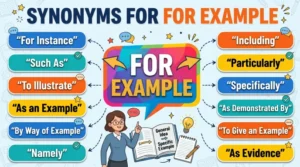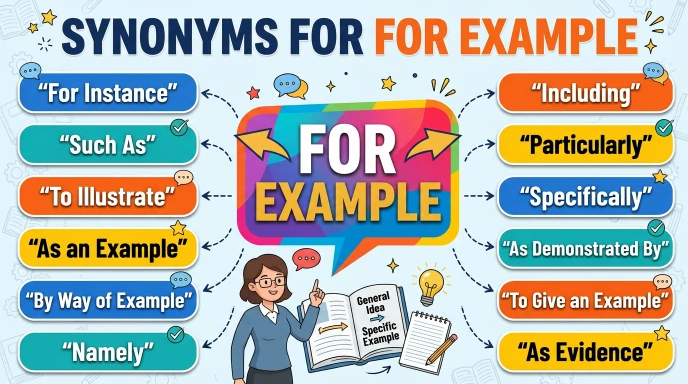
Synonyms for example include instance, illustration, sample, case, model, specimen, demonstration, and representation.
These words help explain an idea, show how something works, or describe a person or thing that others can follow. The best alternative depends on the context. For instance, instance refers to a particular occurrence, while model can describe someone worth following.
Learning these alternatives helps students and English learners improve their vocabulary and make their writing more varied. This guide covers 25 useful synonyms for example, with simple meanings, pronunciation, and natural sentences.
Synonyms for Example
Common synonyms for example include instance, illustration, sample, case, model, specimen, demonstration, and representation. These words can describe a particular situation, a sample of something, or a person or thing that shows how something should be done.
Meaning of Example
Definition
Example is a noun that means a person, thing, or situation used to explain, demonstrate, or represent a general idea. It can also mean someone or something that others may follow.
Examples
- The teacher gave an example to explain the lesson.
- Her honesty is an example for everyone.
Connotative Meaning
The word example usually has a neutral or positive meaning. It can make an idea easier to understand, provide evidence, or show a standard of behavior. In some situations, it can also refer to a warning or a negative case.
Etymology
The word example comes through Old French exemple from Latin exemplum, meaning a sample, pattern, or model.
Pronunciation
- US IPA: /ɪɡˈzæmpəl/
- UK IPA: /ɪɡˈzɑːmpəl/
Syllables
Example has three syllables: ex am ple.
Affixation Pattern
Example is a base noun. It does not have a productive prefix or suffix in its modern form.
Related Concepts
- Illustration: Something that makes an idea clearer.
- Evidence: Information that supports a claim.
- Model: A pattern or standard that others can follow.
- Sample: A small part representing a larger group.
- Demonstration: An act of showing how something works.
Complete List of 25 Synonyms for Example
| Synonym | Simple Meaning | Formality Level |
| 1. Instance | A particular occurrence | Neutral |
| 2. Illustration | Something that explains an idea | Neutral |
| 3. Sample | A small part representing a whole | Neutral |
| 4. Case | A particular situation or event | Neutral |
| 5. Model | A pattern worth following | Neutral |
| 6. Specimen | A sample used for study | Formal |
| 7. Demonstration | An act of showing how something works | Neutral |
| 8. Representation | Something that stands for another thing | Formal |
| 9. Exemplar | A person or thing serving as a model | Formal |
| 10. Prototype | An original model or first version | Formal |
| 11. Pattern | A form or standard that can be copied | Neutral |
| 12. Illustration | A clarifying example or explanation | Neutral |
| 13. Case study | A detailed examination of a particular case | Formal |
| 14. Scenario | A possible situation or sequence of events | Neutral |
| 15. Occurrence | Something that happens | Neutral |
| 16. Exhibit | Something shown as evidence or an illustration | Formal |
| 17. Sample case | A particular case used for explanation | Neutral |
| 18. Benchmark | A standard used for comparison | Formal |
| 19. Paradigm | A typical model or pattern | Formal |
| 20. Precedent | An earlier case used as a guide | Formal |
| 21. Proof | Evidence that supports a statement | Neutral |
| 22. Evidence | Facts or information supporting a claim | Neutral |
| 23. Demonstrative | Something that serves to show or explain | Formal |
| 24. Role model | A person whose behavior others may follow | Neutral |
| 25. Point of reference | Something used for comparison or guidance | Neutral |
Note: These alternatives have different uses. For example, proof and evidence support a claim, while role model describes a person worth following. They are not interchangeable in every sentence.
Formality Comparison of Example Synonyms
| Synonym | Formality | Best Use |
| Instance | Neutral | A particular event |
| Illustration | Neutral | Explaining an idea |
| Sample | Neutral | Showing part of a whole |
| Case | Neutral | A particular situation |
| Model | Neutral | A pattern to follow |
| Specimen | Formal | Scientific study |
| Demonstration | Neutral | Showing how something works |
| Exemplar | Formal | A perfect or typical model |
| Prototype | Formal | An original design |
| Case study | Formal | Academic or professional analysis |
| Benchmark | Formal | Comparison and evaluation |
| Paradigm | Formal | A general model or framework |
| Precedent | Formal | Legal or historical reference |
| Role model | Neutral | Personal behavior and inspiration |
| Point of reference | Neutral | Comparison or guidance |
Detailed Synonyms for Example
1. Instance
Part of Speech: Noun
US IPA: /ˈɪnstəns/
UK IPA: /ˈɪnstəns/
Meaning: A particular occurrence or situation.
Formality: Neutral
Formal Example: This is one instance of successful teamwork.
Informal Example: Can you give me an instance of what you mean?
2. Illustration
Part of Speech: Noun
US IPA: /ˌɪləˈstreɪʃən/
UK IPA: /ˌɪləˈstreɪʃən/
Meaning: Something that explains or makes an idea easier to understand.
Formality: Neutral
Formal Example: The report includes an illustration of the proposed process.
Informal Example: Let me give you an illustration of how it works.
3. Sample
Part of Speech: Noun
US IPA: /ˈsæmpəl/
UK IPA: /ˈsɑːmpəl/
Meaning: A small part used to represent a larger group or whole.
Formality: Neutral
Formal Example: The researcher collected a sample of the local population.
Informal Example: Try this sample before buying the product.
4. Case
Part of Speech: Noun
US IPA: /keɪs/
UK IPA: /keɪs/
Meaning: A particular situation, event, or set of circumstances.
Formality: Neutral
Formal Example: The report describes a case of successful business growth.
Informal Example: This is a good case to discuss in class.
5. Model
Part of Speech: Noun
US IPA: /ˈmɑːdəl/
UK IPA: /ˈmɒdəl/
Meaning: A person or thing that provides a pattern others can follow.
Formality: Neutral
Formal Example: The organization developed a model for effective leadership.
Informal Example: My older sister is a great model for me.
6. Specimen
Part of Speech: Noun
US IPA: /ˈspesəmən/
UK IPA: /ˈspesɪmən/
Meaning: A sample of something collected for examination or study.
Formality: Formal
Formal Example: The scientist examined a specimen under the microscope.
Informal Example: The museum displayed a rare specimen of a plant.
7. Demonstration
Part of Speech: Noun
US IPA: /ˌdemənˈstreɪʃən/
UK IPA: /ˌdemənˈstreɪʃən/
Meaning: An act of showing how something works or is done.
Formality: Neutral
Formal Example: The instructor gave a demonstration of the new equipment.
Informal Example: Can you give me a quick demonstration?
8. Representation
Part of Speech: Noun
US IPA: /ˌreprɪzenˈteɪʃən/
UK IPA: /ˌreprɪzenˈteɪʃən/
Meaning: Something that shows, describes, or stands for another thing.
Formality: Formal
Formal Example: The chart provides a representation of the survey results.
Informal Example: This drawing is a simple representation of our house.
9. Exemplar
Part of Speech: Noun
US IPA: /ɪɡˈzemplɑːr/
UK IPA: /ɪɡˈzemplɑː/
Meaning: A person or thing that represents a high standard or quality.
Formality: Formal
Formal Example: The organization recognized her as an exemplar of professional integrity.
Informal Example: He is an exemplar of good teamwork.
10. Prototype
Part of Speech: Noun
US IPA: /ˈproʊtəˌtaɪp/
UK IPA: /ˈprəʊtətaɪp/
Meaning: An original model used to develop or test something.
Formality: Formal
Formal Example: The engineers tested the first prototype of the device.
Informal Example: They showed us a prototype of their new app.
11. Pattern
Part of Speech: Noun
US IPA: /ˈpætərn/
UK IPA: /ˈpætən/
Meaning: A repeated form or standard that can be copied or followed.
Formality: Neutral
Formal Example: The study identified a pattern of successful behavior.
Informal Example: Follow this pattern to complete the design.
12. Case Study
Part of Speech: Noun Phrase
US IPA: /ˈkeɪs ˌstʌdi/
UK IPA: /ˈkeɪs ˌstʌdi/
Meaning: A detailed study of a particular person, group, event, or situation.
Formality: Formal
Formal Example: The professor assigned a case study about business management.
Informal Example: We read a case study about a successful startup.
13. Scenario
Part of Speech: Noun
US IPA: /səˈnerioʊ/
UK IPA: /səˈnɑːriəʊ/
Meaning: A possible situation or sequence of events.
Formality: Neutral
Formal Example: The training included a scenario involving workplace conflict.
Informal Example: Imagine this scenario: you miss your train.
14. Occurrence
Part of Speech: Noun
US IPA: /əˈkɜːrəns/
UK IPA: /əˈkʌrəns/
Meaning: An event or something that happens.
Formality: Neutral
Formal Example: The report describes an unusual occurrence in the area.
Informal Example: That was a strange occurrence.
15. Exhibit
Part of Speech: Noun
US IPA: /ɪɡˈzɪbɪt/
UK IPA: /ɪɡˈzɪbɪt/
Meaning: Something displayed or presented as evidence or an illustration.
Formality: Formal
Formal Example: The photograph served as an exhibit in the investigation.
Informal Example: The museum has an interesting exhibit about space.
16. Benchmark
Part of Speech: Noun
US IPA: /ˈbentʃmɑːrk/
UK IPA: /ˈbentʃmɑːk/
Meaning: A standard used to measure or compare performance.
Formality: Formal
Formal Example: The company uses customer satisfaction as a benchmark for success.
Informal Example: This phone is a good benchmark for comparing other models.
17. Paradigm
Part of Speech: Noun
US IPA: /ˈpærəˌdaɪm/
UK IPA: /ˈpærədaɪm/
Meaning: A typical model, pattern, or way of understanding something.
Formality: Formal
Formal Example: The research introduced a new paradigm for understanding social change.
Informal Example: This project is a useful paradigm for future work.
18. Precedent
Part of Speech: Noun
US IPA: /ˈpresɪdənt/
UK IPA: /ˈpresɪdənt/
Meaning: An earlier event or decision used as a guide for later situations.
Formality: Formal
Formal Example: The court used an earlier precedent to support its decision.
Informal Example: That success set a precedent for the rest of the team.
19. Proof
Part of Speech: Noun
US IPA: /pruːf/
UK IPA: /pruːf/
Meaning: Information or evidence that shows something is true.
Formality: Neutral
Formal Example: The experiment provided proof of the theory.
Informal Example: This picture is proof that we visited the place.
20. Evidence
Part of Speech: Noun
US IPA: /ˈevɪdəns/
UK IPA: /ˈevɪdəns/
Meaning: Facts or information that support a statement or conclusion.
Formality: Neutral
Formal Example: The researcher presented evidence to support the findings.
Informal Example: Do you have any evidence to show that?
21. Demonstrative
Part of Speech: Noun
US IPA: /dɪˈmɑːnstrətɪv/
UK IPA: /dɪˈmɒnstrətɪv/
Meaning: Something that serves to demonstrate or make a point clear.
Formality: Formal
Formal Example: The teacher used a demonstrative to clarify the concept.
Informal Example: The diagram was a useful demonstrative for the lesson.
22. Role Model
Part of Speech: Noun Phrase
US IPA: /ˈroʊl ˌmɑːdəl/
UK IPA: /ˈrəʊl ˌmɒdəl/
Meaning: A person whose behavior or qualities others admire and may follow.
Formality: Neutral
Formal Example: The athlete became a role model for young people.
Informal Example: My mother is my role model.
23. Point of Reference
Part of Speech: Noun Phrase
US IPA: /ˌpɔɪnt əv ˈrefərəns/
UK IPA: /ˌpɔɪnt əv ˈrefərəns/
Meaning: Something used as a basis for comparison or guidance.
Formality: Neutral
Formal Example: The earlier report provides a point of reference for the new study.
Informal Example: Use this picture as a point of reference.
24. Sample Case
Part of Speech: Noun Phrase
US IPA: /ˈsæmpəl keɪs/
UK IPA: /ˈsɑːmpəl keɪs/
Meaning: A particular situation used to demonstrate or explain a general point.
Formality: Neutral
Formal Example: The instructor presented a sample case to explain the procedure.
Informal Example: Let’s discuss a sample case before trying the exercise.
25. Illustration
Part of Speech: Noun
US IPA: /ˌɪləˈstreɪʃən/
UK IPA: /ˌɪləˈstreɪʃən/
Meaning: A specific example used to make an idea easier to understand.
Formality: Neutral
Formal Example: The author included an illustration to clarify the main argument.
Informal Example: Here’s an illustration of what I mean.
Prototype Meaning of Example
A prototype is a typical or original model that represents a particular idea or category. For the word example, imagine a teacher explaining a grammar rule by writing a sentence on the board.
That sentence is an example because it helps students understand how the rule works. Similarly, a successful person may serve as an example for others to follow. The word can therefore describe an explanation, a particular case, or a model of behavior.
Synonyms for Example by Category
Examples Used to Explain an Idea
- Instance
- Illustration
- Case
- Scenario
- Demonstration
Examples Used for Learning or Research
- Sample
- Specimen
- Case study
- Exhibit
- Prototype
Used as Standards
- Model
- Exemplar
- Pattern
- Benchmark
- Paradigm
Examples Used as Evidence
- Proof
- Evidence
- Precedent
- Representation
Used for Personal Inspiration
- Role model
- Exemplar
- Model
Antonyms of Example
There is no single exact antonym for example because its meaning changes with context. These words can express contrasting ideas.
| Antonym or Contrast | Meaning |
| Exception | Something that does not follow the general rule |
| Anomaly | Something that differs from what is usual |
| Opposite | Something completely different |
| Contrast | A clear difference between things |
| Counterexample | An example that disproves a general statement |
| Original | The first form rather than a copy |
| Generalization | A broad statement rather than a specific case |
| Abstraction | An idea without a specific concrete instance |
Quiz: Test Your Knowledge of Example Synonyms
1. Which word means a particular occurrence or situation?
A. Instance
B. Opposite
C. Exception
D. Contrast
2. Which synonym means a small part that represents a larger group?
A. Paradigm
B. Sample
C. Precedent
D. Benchmark
3. Which word describes a person others admire and follow?
A. Specimen
B. Scenario
C. Role model
D. Occurrence
4. Which word means an original model used to develop or test something?
A. Prototype
B. Evidence
C. Exception
D. Contrast
5. Which word means an earlier decision used as a guide for later cases?
A. Illustration
B. Precedent
C. Sample
D. Demonstration
6. Which word means a standard used to measure performance?
A. Benchmark
B. Instance
C. Scenario
D. Specimen
Answer Key
- A. Instance
- B. Sample
- C. Role model
- A. Prototype
- B. Precedent
- A. Benchmark
Usage Tips: How to Use Example Synonyms
- Use instance when referring to one particular event or situation.
- Choose illustration when explaining an idea or making a point clearer.
- Use sample when referring to a small part of a larger group.
- Choose model when describing something that others can follow.
- Use specimen in scientific or research contexts.
- Choose case study when discussing a detailed real life situation.
- Use benchmark when comparing performance or quality.
- Choose precedent when referring to an earlier decision or event that guides later actions.
Remember: The word example has several meanings. Always choose an alternative that matches the sentence rather than replacing it with a word that only has a related meaning.
FAQs About Synonyms for Example
1. What are the most common synonyms for example?
The most common synonyms include instance, illustration, sample, case, model, and demonstration. These words help explain ideas or describe particular situations.
2. What is a formal synonym for example?
Exemplar, specimen, paradigm, precedent, and benchmark are useful formal alternatives. They are often used in academic, scientific, legal, and professional writing.
3. What is another way to say for example?
You can use for instance, such as, to illustrate, or as an illustration. These expressions introduce information that supports or explains a point.
4. What is the difference between an example and an instance?
An example can explain a general idea or show a standard. An instance usually refers to one particular occurrence or case.
5. What is the difference between a sample and an example?
A sample is usually a small part representing a larger group or whole. An example is something used to explain or demonstrate an idea.
6. What is the opposite of example?
There is no exact opposite in every context. Words such as exception, anomaly, contrast, and counterexample can express contrasting meanings.
7. Can illustration be used as a synonym for example?
Yes. Illustration can mean a specific example that makes an idea easier to understand. It is especially useful in explanations, teaching, and writing.
Conclusion
Learning synonyms for example helps you explain ideas and express information in different ways. Words such as instance, illustration, sample, and case are useful when discussing particular situations.
Alternatives like model, exemplar, benchmark, and paradigm describe standards or patterns that others can follow. In academic and professional writing, specimen, precedent, and case study may be more suitable. Remember that these words have different meanings, so choose one that fits your sentence.
Practice using them in conversations, school assignments, and articles to improve your English vocabulary and make your writing clearer and more effective.
Discover More Articles:

Hi, I’m Emma Wilson, an English vocabulary writer helping learners improve their word skills with synonyms, meanings, examples, and quizzes. I create simple resources to make English learning easier.