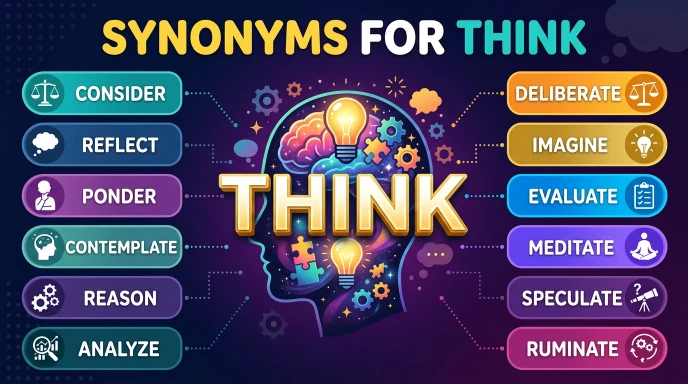
Synonyms for think include believe, consider, reflect, imagine, suppose, ponder, and reason.
These words help you express ideas, opinions, and thoughts in different ways. The word think is common in daily English, but using different synonyms can make your speaking and writing more clear and interesting. For example, you can say, “I think this plan will work,” or “I believe this plan will work.”
Both sentences express a similar idea, but the second sounds more confident. Learning synonyms for think can help students, English learners, bloggers, and writers choose the right word for each situation. This guide explains 25 useful alternatives with meanings, examples, pronunciation, and practical usage tips.
What Are Synonyms for Think?
Synonyms for think are words that express forming ideas, using your mind, considering choices, or holding an opinion. Common alternatives include believe, consider, reflect, imagine, suppose, ponder, reason, contemplate, and guess. The best synonym depends on the context and the meaning you want to express.
Meaning of Think
Definition
Think means to use your mind to form ideas, understand something, solve a problem, or have an opinion about a person or situation.
Examples
- I think this book is helpful.
- She needs time to think about her future.
Connotative Meaning
The word think is neutral and widely used. It can show an opinion, a careful decision, a memory, or an attempt to solve a problem. Some alternatives, such as ponder and contemplate, suggest deeper thought, while guess suggests uncertainty.
Etymology
The word think comes from Old English þencan, meaning to conceive in the mind, consider, or intend. It has been used for centuries to describe mental activity.
Pronunciation
- US IPA: /θɪŋk/
- UK IPA: /θɪŋk/
- Syllables: 1
- Part of speech: Verb; it can also function as a noun in expressions such as “a quick think.”
Affixation Pattern
- Think : base word
- Thinks : third person singular present
- Thinking : present participle or gerund
- Thought : past tense and past participle
- Thoughtful : adjective related to careful consideration
- Thoughtfully : adverb describing careful or considerate behavior
Related Concepts
Thinking is connected to reasoning, judgment, imagination, memory, belief, reflection, and decision making. These concepts overlap, but each describes a different part of mental activity.
Complete Synonyms List for Think
The following table gives 25 useful synonyms for think. Some express an opinion, while others describe careful thought, imagination, or logical reasoning.
| Synonym | Meaning | Formality Level |
| 1. Believe | Accept something as true | Neutral |
| 2. Consider | Give attention to an idea | Neutral |
| 3. Reflect | Think carefully about something | Neutral/Formal |
| 4. Imagine | Form a picture or idea in your mind | Neutral |
| 5. Suppose | Assume something may be true | Neutral |
| 6. Ponder | Think deeply about something | Formal |
| 7. Reason | Use logic to reach a conclusion | Formal |
| 8. Contemplate | Think deeply or for a long time | Formal |
| 9. Guess | Form an opinion without certainty | Informal/Neutral |
| 10. Wonder | Think with curiosity or uncertainty | Neutral |
| 11. Analyze | Examine something carefully | Formal |
| 12. Evaluate | Judge the value or quality of something | Formal |
| 13. Judge | Form an opinion or decision | Neutral |
| 14. Decide | Choose after considering options | Neutral |
| 15. Expect | Believe something is likely to happen | Neutral |
| 16. Suspect | Believe something may be true | Neutral |
| 17. Assume | Accept something as true without proof | Neutral |
| 18. Envision | Picture a possible future or outcome | Formal |
| 19. Muse | Think quietly or thoughtfully | Literary |
| 20. Deliberate | Carefully consider a decision | Formal |
| 21. Speculate | Form ideas without complete evidence | Formal |
| 22. Infer | Reach a conclusion from evidence | Formal |
| 23. Recall | Bring something back to mind | Neutral |
| 24. Remember | Keep or bring information to mind | Neutral |
| 25. Brainstorm | Generate many ideas | Neutral/Informal |
Formality Comparison of Synonyms for Think
Different synonyms for think suit different settings. Use common words in everyday conversation and more precise terms in academic or professional writing.
| Context | Suitable Synonyms | Example |
| Everyday conversation | Believe, guess, suppose | I guess we can leave now. |
| Academic writing | Analyze, infer, evaluate | Researchers analyzed the results. |
| Professional discussion | Consider, deliberate, assess | We should consider the proposal. |
| Deep reflection | Ponder, contemplate, reflect | He reflected on his decision. |
| Creative thinking | Imagine, envision, brainstorm | Let’s brainstorm some new ideas. |
| Memory | Recall, remember | I remember that conversation. |
Detailed Synonyms for Think
1. Believe
- Part of speech: Verb
- US IPA: /bɪˈliːv/
- UK IPA: /bɪˈliːv/
- Meaning: To accept something as true or feel confident that it is true.
- Formality: Neutral
- Formal example: We believe the evidence supports this conclusion.
- Informal example: I believe you can do it.
2. Consider
- Part of speech: Verb
- US IPA: /kənˈsɪdər/
- UK IPA: /kənˈsɪdə/
- Meaning: To give attention to an idea or possible action before making a decision.
- Formality: Neutral
- Formal example: The committee will consider the new proposal.
- Informal example: Consider taking a short break.
3. Reflect
- Part of speech: Verb
- US IPA: /rɪˈflɛkt/
- UK IPA: /rɪˈflekt/
- Meaning: To think carefully about an experience, action, or idea.
- Formality: Neutral/Formal
- Formal example: The report reflects on the effects of the policy.
- Informal example: I need time to reflect on what happened.
4. Imagine
- Part of speech: Verb
- US IPA: /ɪˈmædʒɪn/
- UK IPA: /ɪˈmædʒɪn/
- Meaning: To form an idea or picture in your mind.
- Formality: Neutral
- Formal example: It is difficult to imagine the long term impact.
- Informal example: Imagine living by the sea!
5. Suppose
- Part of speech: Verb
- US IPA: /səˈpoʊz/
- UK IPA: /səˈpəʊz/
- Meaning: To believe something may be true or to make an assumption.
- Formality: Neutral
- Formal example: We suppose the figures are accurate.
- Informal example: I suppose you’re right.
6. Ponder
- Part of speech: Verb
- US IPA: /ˈpɑːndər/
- UK IPA: /ˈpɒndə/
- Meaning: To think deeply about a question or problem.
- Formality: Formal
- Formal example: The team pondered the possible consequences.
- Informal example: She sat quietly and pondered her next move.
7. Reason
- Part of speech: Verb
- US IPA: /ˈriːzən/
- UK IPA: /ˈriːzən/
- Meaning: To use logic to understand something or reach a conclusion.
- Formality: Formal
- Formal example: Scientists reason from evidence to conclusions.
- Informal example: Try to reason through the problem.
8. Contemplate
- Part of speech: Verb
- US IPA: /ˈkɑːntəmpleɪt/
- UK IPA: /ˈkɒntəmpleɪt/
- Meaning: To think deeply about something or consider a possible action.
- Formality: Formal
- Formal example: The board contemplated several options.
- Informal example: I’m contemplating a move to another city.
9. Guess
- Part of speech: Verb
- US IPA: /ɡɛs/
- UK IPA: /ɡɛs/
- Meaning: To form an answer or opinion without being certain.
- Formality: Informal/Neutral
- Formal example: We can only guess the cause at this stage.
- Informal example: I guess he’ll arrive soon.
10. Wonder
- Part of speech: Verb
- US IPA: /ˈwʌndər/
- UK IPA: /ˈwʌndə/
- Meaning: To think about something with curiosity, doubt, or uncertainty.
- Formality: Neutral
- Formal example: Researchers wondered why the results differed.
- Informal example: I wonder where my keys are.
11. Analyze
- Part of speech: Verb
- US IPA: /ˈænəlaɪz/
- UK IPA: /ˈænəlaɪz/
- Meaning: To examine information or a situation carefully.
- Formality: Formal
- Formal example: The researchers analyzed the survey data.
- Informal example: Let’s analyze what went wrong.
12. Evaluate
- Part of speech: Verb
- US IPA: /ɪˈvæljuˌeɪt/
- UK IPA: /ɪˈvæljueɪt/
- Meaning: To judge the quality, value, or importance of something.
- Formality: Formal
- Formal example: The panel evaluated each application.
- Informal example: Let’s evaluate our options before choosing.
13. Judge
- Part of speech: Verb
- US IPA: /dʒʌdʒ/
- UK IPA: /dʒʌdʒ/
- Meaning: To form an opinion or make a decision based on information.
- Formality: Neutral
- Formal example: The court must judge the case fairly.
- Informal example: Don’t judge a book by its cover.
14. Decide
- Part of speech: Verb
- US IPA: /dɪˈsaɪd/
- UK IPA: /dɪˈsaɪd/
- Meaning: To make a choice after thinking about available options.
- Formality: Neutral
- Formal example: The director decided to revise the plan.
- Informal example: I can’t decide what to eat.
15. Expect
- Part of speech: Verb
- US IPA: /ɪkˈspɛkt/
- UK IPA: /ɪkˈspekt/
- Meaning: To believe something is likely to happen.
- Formality: Neutral
- Formal example: Analysts expect demand to increase.
- Informal example: I expect she’ll call later.
16. Suspect
- Part of speech: Verb
- US IPA: /səˈspɛkt/
- UK IPA: /səˈspekt/
- Meaning: To believe something may be true without being certain.
- Formality: Neutral
- Formal example: Investigators suspect that the records are incomplete.
- Informal example: I suspect he’s already left.
17. Assume
- Part of speech: Verb
- US IPA: /əˈsuːm/
- UK IPA: /əˈsjuːm/
- Meaning: To accept something as true without having proof.
- Formality: Neutral
- Formal example: The model assumes that all other factors remain constant.
- Informal example: Don’t assume I’m free tomorrow.
18. Envision
- Part of speech: Verb
- US IPA: /ɪnˈvɪʒən/
- UK IPA: /ɪnˈvɪʒən/
- Meaning: To imagine a possible future, plan, or outcome.
- Formality: Formal
- Formal example: The team envisions a more efficient system.
- Informal example: I can envision us working together.
19. Muse
- Part of speech: Verb
- US IPA: /mjuːz/
- UK IPA: /mjuːz/
- Meaning: To think quietly or thoughtfully about something.
- Formality: Literary
- Formal example: The writer mused on the nature of memory.
- Informal example: I mused about what to do next.
20. Deliberate
- Part of speech: Verb
- US IPA: /dɪˈlɪbəˌreɪt/
- UK IPA: /dɪˈlɪbəreɪt/
- Meaning: To think carefully and discuss options before deciding.
- Formality: Formal
- Formal example: The jury deliberated before reaching a verdict.
- Informal example: We need to deliberate before making a choice.
21. Speculate
- Part of speech: Verb
- US IPA: /ˈspɛkjəˌleɪt/
- UK IPA: /ˈspekjʊleɪt/
- Meaning: To form ideas or opinions without having all the facts.
- Formality: Formal
- Formal example: Experts speculated about the causes of the change.
- Informal example: We can speculate, but we don’t know for sure.
22. Infer
- Part of speech: Verb
- US IPA: /ɪnˈfɜːr/
- UK IPA: /ɪnˈfɜː/
- Meaning: To reach a conclusion from clues or evidence.
- Formality: Formal
- Formal example: Readers can infer the character’s feelings from her actions.
- Informal example: I inferred that he wanted to leave.
23. Recall
- Part of speech: Verb
- US IPA: /rɪˈkɔːl/
- UK IPA: /rɪˈkɔːl/
- Meaning: To bring a memory or piece of information back to mind.
- Formality: Neutral
- Formal example: Participants recalled the events in detail.
- Informal example: I can’t recall his name.
24. Remember
- Part of speech: Verb
- US IPA: /rɪˈmɛmbər/
- UK IPA: /rɪˈmembə/
- Meaning: To keep information in your mind or bring it back to mind.
- Formality: Neutral
- Formal example: Please remember the key points from the meeting.
- Informal example: I remember that movie!
25. Brainstorm
- Part of speech: Verb
- US IPA: /ˈbreɪnˌstɔːrm/
- UK IPA: /ˈbreɪnˌstɔːm/
- Meaning: To produce many ideas, often with other people, before choosing one.
- Formality: Neutral/Informal
- Formal example: The team brainstormed possible solutions to the problem.
- Informal example: Let’s brainstorm some fun names for the project.
Prototype Meaning of Think
The central meaning of think is to use your mind to form an idea, consider information, or reach an opinion. For example, “I think this answer is correct” expresses a belief, while “I need to think about it” describes mental effort before a decision.
The best replacement depends on the intended meaning:
- Opinion: believe, suppose, suspect
- Careful thought: consider, ponder, contemplate
- Logical thought: reason, analyze, infer
- Imagination: imagine, envision
- Memory: recall, remember
These words are related, but they are not interchangeable in every sentence.
Synonyms for Think by Category
Having an Opinion
- Believe
- Suppose
- Suspect
- Guess
- Assume
Thinking Deeply
- Ponder
- Contemplate
- Reflect
- Muse
- Deliberate
Logical Thinking
- Reason
- Analyze
- Evaluate
- Infer
- Judge
Creative Thinking
- Imagine
- Envision
- Brainstorm
- Wonder
- Speculate
For Making a Decision
- Consider
- Decide
- Deliberate
- Evaluate
- Judge
Antonyms of Think
There is no single perfect antonym for think in every context. The opposite depends on the meaning of the sentence.
| Word or Phrase | Opposite Meaning | Example |
| Ignore | Pay no attention | He ignored the warning. |
| Disregard | Treat as unimportant | She disregarded the advice. |
| Forget | Fail to remember | I forgot his name. |
| Overlook | Fail to notice | We overlooked a small error. |
| Act impulsively | Act without careful thought | He acted impulsively and regretted it. |
Quiz: Test Your Knowledge of Synonyms for Think
Choose the best answer for each question.
1. Which word means to think deeply about something?
A. Forget
B. Ponder
C. Ignore
D. Shout
2. Which synonym means to accept something as true?
A. Believe
B. Disregard
C. Overlook
D. Forget
3. Which word means to examine information carefully?
A. Imagine
B. Guess
C. Analyze
D. Remember
4. Which word describes forming an idea without certainty?
A. Decide
B. Guess
C. Recall
D. Evaluate
5. Which synonym means to reach a conclusion from evidence?
A. Infer
B. Wonder
C. Envision
D. Muse
6. Which word means to generate many ideas?
A. Suspect
B. Deliberate
C. Brainstorm
D. Recall
Answer Key
- B : Ponder
- A : Believe
- C : Analyze
- B : Guess
- A : Infer
- C : Brainstorm
Usage Tips for Synonyms for Think
- Use “believe” when expressing an opinion or accepting something as true.
- Use “consider” when examining an idea before making a choice.
- Use “ponder” when describing deep or prolonged thought.
- Use “analyze” when examining details, evidence, or data.
- Use “guess” when you are uncertain about an answer.
- Use “imagine” when creating a picture or possibility in your mind.
- Use “infer” when reaching a conclusion from clues or evidence.
- Use “remember” or “recall” when talking about information from the past.
- Use “deliberate” when carefully discussing or weighing a decision.
- Check the sentence meaning before replacing think with another word. A synonym may fit one meaning but sound unnatural in another.
FAQs About Synonyms for Think
1. What are the most common synonyms for think?
Common synonyms for think include believe, consider, suppose, imagine, reflect, and guess. The best choice depends on the sentence.
2. What is a formal synonym for think?
Formal alternatives include contemplate, analyze, evaluate, deliberate, and infer. These words work well in academic and professional writing when their meanings fit the context.
3. What is another word for think deeply?
You can use ponder, contemplate, reflect, or muse. Ponder and contemplate often suggest sustained thought.
4. Is believe a synonym for think?
Yes, when think expresses an opinion or belief. For example, “I think she is right” can become “I believe she is right.”
5. What is a synonym for think in an essay?
Consider, analyze, evaluate, infer, and argue may work in essays, depending on the intended meaning. Choose a precise word instead of replacing think automatically.
6. What is the difference between think and assume?
Think is a broad term for mental activity or an opinion. Assume means to accept something as true without enough proof.
7. Can I use synonyms for think in everyday conversation?
Yes. Words such as believe, guess, suppose, wonder, and imagine are common in everyday English. More formal words, such as deliberate and contemplate, may sound too serious for casual situations.
Conclusion
Learning synonyms for think can help you express opinions, explain ideas, and describe mental activity more clearly. Words such as believe, consider, and suppose are useful in everyday conversation.
Ponder, contemplate, and reflect describe deeper thought, while analyze, evaluate, and infer are helpful for academic and professional writing. Other words, such as imagine and envision, help you describe ideas and future possibilities.
Remember that synonyms for think do not all have exactly the same meaning. Some express confidence, others show uncertainty, and some describe careful reasoning or memory. Read the full sentence before choosing an alternative.
With regular practice, you can use these 25 words to improve your vocabulary, write more naturally, and communicate your thoughts with greater precision.
Discover More Articles:

Hi, I’m Emma Collins, and I enjoy creating simple English vocabulary resources that make learning easier for everyone. I write about synonyms, antonyms, word meanings, vocabulary lists, and writing tips using clear, everyday language. My goal is to help students, writers, teachers, and English learners build their vocabulary, improve their writing, and feel more confident using English. I take time to research every article carefully so the information is accurate, practical, and easy to understand.