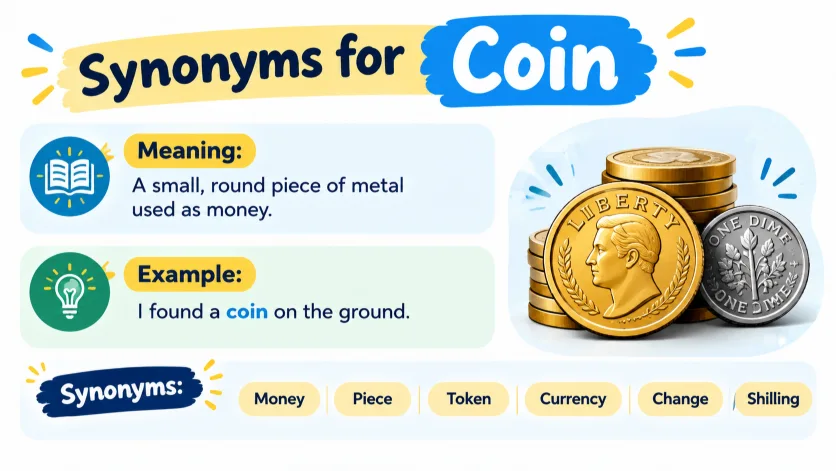
Synonyms for coin include money, cash, currency, change, specie, coinage, token, piece, and hard cash, depending on the context.
A coin is a small piece of metal used as money, but the word can connect to many other terms. For example, cash can include both coins and banknotes, while change often means small coins received after a payment. Token can describe an object used instead of money, and specie is a formal word for money in physical coin form. Learning synonyms for coin helps students, writers, and English learners choose more precise words. In this guide, you will learn 25 useful alternatives, their meanings, examples, formality levels, related terms, antonyms, and simple usage tips.
Common synonyms and related alternatives for coin include money, cash, currency, change, specie, coinage, token, piece, hard cash, metal money, and legal tender. The best word depends on whether you mean a physical coin, money in general, or something used as a substitute for money.
What Does Coin Mean?
A coin is a small piece of metal, usually round, that is issued as money. Coins normally have a specific value and may carry images, numbers, or words.
The word coin can also be used as a verb. To coin a word or phrase means to create or introduce a new expression.
Definition
As a noun, coin means a piece of metal used as money.
As a verb, coin means to create a new word, phrase, or expression.
Examples
- I found a coin under the table.
- The writer coined a new expression.
Connotative Meaning
Coin usually has a neutral meaning. It can suggest money, value, history, collecting, or trade. In phrases such as “two sides of the same coin,” it can also represent two connected aspects of one idea.
Etymology
The word coin comes from Old French coing, which referred to a wedge or die used for stamping. It became associated with stamped metal money.
Pronunciation
- US: /kɔɪn/
- UK: /kɔɪn/
Syllables
Coin has one syllable.
Affixation Pattern
Common forms include:
- Coin
- Coins
- Coined
- Coining
- Coinage
- Coin-operated
Related Concepts
- Money
- Currency
- Cash
- Change
- Mint
- Coinage
- Token
- Denomination
- Numismatics
- Collecting
Complete Synonyms for Coin
The following 25 words are useful synonyms, alternatives, or closely related terms for coin. They are not all interchangeable in every sentence, so the context matters.
| Synonym / Alternative | Simple Meaning | Formality Level |
| Money | Something used to buy goods and services | Neutral |
| Cash | Physical money | Neutral |
| Currency | Money used in a country or region | Formal |
| Change | Small money, often coins | Neutral |
| Specie | Money in physical coin form | Formal |
| Coinage | Coins collectively | Formal |
| Token | An object used instead of money | Neutral |
| Piece | An individual coin | Neutral |
| Hard Cash | Physical money | Informal |
| Metal Money | Money made from metal | Neutral |
| Legal Tender | Money legally accepted for payment | Formal |
| Small Change | Small coins or small amounts of money | Neutral |
| Round | An informal term for a coin | Informal |
| Counter | A token or substitute used in place of money | Formal |
| Chit | A small note or token representing value | Neutral |
| Medallion | A decorative metal piece similar to a coin | Neutral |
| Minted Piece | A metal piece produced by a mint | Formal |
| Denomination | The stated value of a coin | Formal |
| Penny | A low-value coin in some currencies | Neutral |
| Cent | A monetary unit equal to one hundredth of a dollar | Neutral |
| Nickel | A five-cent US coin | Neutral |
| Dime | A ten-cent US coin | Neutral |
| Quarter | A twenty-five-cent US coin | Neutral |
| Sovereign | A British gold coin, historically used as money | Formal |
| Numismatic Piece | A coin valued or studied as a collectible | Formal |
Formality Comparison of Coin Synonyms
Different synonyms for coin are suitable for different situations.
Formal
Use these terms in academic, financial, historical, or professional writing:
- Currency
- Specie
- Coinage
- Legal tender
- Counter
- Denomination
- Minted piece
- Numismatic piece
- Sovereign
Neutral
These are common in everyday English:
- Money
- Cash
- Change
- Token
- Piece
- Metal money
- Small change
- Chit
- Medallion
- Penny
- Cent
- Nickel
- Dime
- Quarter
Informal
These are more casual:
- Hard cash
- Round
Detailed Synonyms for Coin
1. Money
Part of Speech: Noun
US/UK IPA: /ˈmʌni/
Meaning: Something generally accepted for buying goods and services.
Formality: Neutral
Formal example:
The museum displayed ancient forms of money.
Informal example:
I need some money for the bus.
2. Cash
Part of Speech: Noun
US/UK IPA: /kæʃ/
Meaning: Money in physical form, including coins and banknotes.
Formality: Neutral
Formal example:
The customer paid the fee in cash.
Informal example:
Do you have any cash with you?
3. Currency
Part of Speech: Noun
US/UK IPA: /ˈkɜːrənsi/ : /ˈkʌrənsi/
Meaning: The money used in a particular country or region.
Formality: Formal
Formal example:
The country introduced a new currency.
Informal example:
I exchanged my currency before traveling.
4. Change
Part of Speech: Noun
US/UK IPA: /tʃeɪndʒ/
Meaning: Small amounts of money, especially coins received after payment.
Formality: Neutral
Formal example:
The cashier returned the correct change.
Informal example:
I have some change in my pocket.
5. Specie
Part of Speech: Noun
US/UK IPA: /ˈspiːʃiː/
Meaning: Money in the form of coins rather than paper money.
Formality: Formal
Formal example:
The historical record mentions payment in specie.
Informal example:
The old document refers to payment in specie.
6. Coinage
Part of Speech: Noun
US/UK IPA: /ˈkɔɪnɪdʒ/
Meaning: Coins collectively or the system of coins used as money.
Formality: Formal
Formal example:
The museum has an extensive collection of ancient coinage.
Informal example:
He enjoys studying old coinage.
7. Token
Part of Speech: Noun
US/UK IPA: /ˈtoʊkən/ : /ˈtəʊkən/
Meaning: An object used instead of money for a particular purpose.
Formality: Neutral
Formal example:
The system once required users to purchase tokens.
Informal example:
I found an old arcade token.
8. Piece
Part of Speech: Noun
US/UK IPA: /piːs/
Meaning: An individual coin, especially when its identity is clear from context.
Formality: Neutral
Formal example:
Each piece was examined by the collector.
Informal example:
He gave me an old piece for my collection.
9. Hard Cash
Part of Speech: Noun Phrase
US/UK IPA: /hɑːrd kæʃ/
Meaning: Physical money rather than money held electronically.
Formality: Informal
Formal example:
The seller requested payment in physical cash.
Informal example:
I like to keep some hard cash with me.
10. Metal Money
Part of Speech: Noun Phrase
US/UK IPA: /ˈmetl ˈmʌni/
Meaning: Money made from metal, especially coins.
Formality: Neutral
Formal example:
Metal money played an important role in ancient trade.
Informal example:
The box was full of old metal money.
11. Legal Tender
Part of Speech: Noun Phrase
US/UK IPA: /ˈliːɡəl ˈtendər/
Meaning: Money legally recognized as an acceptable form of payment.
Formality: Formal
Formal example:
The coins remain legal tender in the country.
Informal example:
These coins are still legal tender.
12. Small Change
Part of Speech: Noun Phrase
US/UK IPA: /smɔːl tʃeɪndʒ/
Meaning: Small coins or a small amount of money.
Formality: Neutral
Formal example:
The machine accepts small change only.
Informal example:
I keep my small change in a jar.
13. Round
Part of Speech: Noun
US/UK IPA: /raʊnd/
Meaning: An informal term sometimes used for a coin.
Formality: Informal
Formal example:
The historical source refers to a small round of metal.
Informal example:
He found a few old rounds in a drawer.
14. Counter
Part of Speech: Noun
US/UK IPA: /ˈkaʊntər/ : /ˈkaʊntə/
Meaning: A token or object used as a substitute for money or to represent value.
Formality: Formal
Formal example:
The historical game used counters to represent money.
Informal example:
The old shop used counters instead of coins.
15. Chit
Part of Speech: Noun
US/UK IPA: /tʃɪt/
Meaning: A small note, ticket, or token representing value or an obligation.
Formality: Neutral
Formal example:
The customer received a chit confirming the payment.
Informal example:
He gave me a chit for the item.
16. Medallion
Part of Speech: Noun
US/UK IPA: /məˈdæljən/
Meaning: A large decorative metal piece that may resemble a coin.
Formality: Neutral
Formal example:
The museum displayed a historic medallion.
Informal example:
She wore a silver medallion around her neck.
17. Minted Piece
Part of Speech: Noun Phrase
US/UK IPA: /ˈmɪntɪd piːs/
Meaning: A metal piece produced by a mint.
Formality: Formal
Formal example:
The minted piece carries the date of production.
Informal example:
He showed me a newly minted piece.
18. Denomination
Part of Speech: Noun
US/UK IPA: /dɪˌnɑːməˈneɪʃən/ : /dɪˌnɒmɪˈneɪʃən/
Meaning: The stated value of a coin or banknote.
Formality: Formal
Formal example:
The coin was issued in a higher denomination.
Informal example:
What denomination is this coin?
19. Penny
Part of Speech: Noun
US/UK IPA: /ˈpeni/
Meaning: A low-value coin, especially a one-cent US coin or one-penny British coin.
Formality: Neutral
Formal example:
The collection contains a rare historical penny.
Informal example:
I found a penny on the sidewalk.
20. Cent
Part of Speech: Noun
US/UK IPA: /sent/
Meaning: A monetary unit equal to one hundredth of a dollar or certain other currencies.
Formality: Neutral
Formal example:
The item costs fifty cents.
Informal example:
I only have a few cents left.
21. Nickel
Part of Speech: Noun
US/UK IPA: /ˈnɪkəl/
Meaning: A US five-cent coin.
Formality: Neutral
Formal example:
The collection contains an early US nickel.
Informal example:
I found a nickel in my pocket.
22. Dime
Part of Speech: Noun
US/UK IPA: /daɪm/
Meaning: A US coin worth ten cents.
Formality: Neutral
Formal example:
The historical collection includes a silver dime.
Informal example:
I found a dime under the chair.
23. Quarter
Part of Speech: Noun
US/UK IPA: /ˈkwɔːrtər/
Meaning: A US coin worth twenty-five cents.
Formality: Neutral
Formal example:
The vending machine accepts quarters.
Informal example:
I need a quarter for the machine.
24. Sovereign
Part of Speech: Noun
US/UK IPA: /ˈsɑːvrən/ : /ˈsɒvrɪn/
Meaning: A British gold coin that has been issued historically as money.
Formality: Formal
Formal example:
The museum displayed a nineteenth-century sovereign.
Informal example:
He bought an old sovereign for his collection.
25. Numismatic Piece
Part of Speech: Noun Phrase
US/UK IPA: /ˌnuːmɪzˈmætɪk piːs/
Meaning: A coin or similar object studied or collected for its historical, artistic, or monetary significance.
Formality: Formal
Formal example:
The auction included a rare numismatic piece.
Informal example:
The collector showed us an interesting numismatic piece.
Prototype Meaning of Coin
The prototype meaning of coin is a small metal object issued as money.
For example:
She put a coin into the vending machine.
This is the most familiar everyday meaning. A coin normally has a specific monetary value and may show a national symbol, person, date, or other design.
Coin can also be a verb. When someone coins a word, they create a new word or phrase.
For example:
The author coined a new term for the idea.
In this use, suitable alternatives include invent, create, devise, and introduce.
Synonyms for Coin by Category
Coin as Money
These words work when coin refers to money:
- Money
- Cash
- Currency
- Specie
- Coinage
- Legal tender
- Hard cash
Coin as Small Money
These terms are useful for small-value coins or amounts:
- Change
- Small change
- Penny
- Cent
- Nickel
- Dime
- Quarter
Coin as a Physical Object
These words describe a coin or something similar to a coin:
- Piece
- Token
- Counter
- Medallion
- Minted piece
- Numismatic piece
Coin in Historical Context
These terms are useful when discussing historical money:
- Specie
- Coinage
- Sovereign
- Penny
- Denomination
- Numismatic piece
Coin as a Verb
When coin means to create a new word or expression, useful alternatives include:
- Invent
- Create
- Devise
- Formulate
- Introduce
For example:
The writer coined a new phrase.
This can become:
The writer invented a new phrase.
Antonyms of Coin
Coin does not have one exact antonym in every context. The contrasting term depends on what you mean by coin.
- Banknote : paper money rather than a metal coin.
- Paper money : currency printed on paper or a similar material.
- Digital money : money represented and transferred electronically.
- Electronic payment : a payment made through an electronic system.
- Credit : money or purchasing power available through borrowing.
- Debt : money owed to another person or organization.
For example:
- Coin: He paid with a metal coin.
- Banknote: She paid with a paper banknote.
These are contrasting forms of money rather than exact dictionary antonyms.
Quiz: Synonyms for Coin
1. Which word is closest to coin when talking about money in general?
A. Money
B. Stone
C. Paper
D. Box
2. Which word means physical money?
A. Cash
B. Credit
C. Debt
D. Receipt
3. What does currency mean?
A. Money used in a country or region
B. A decorative object
C. A written message
D. A type of package
4. Which word describes an object used instead of money?
A. Token
B. Letter
C. Document
D. Notice
5. Which word refers to coins collectively?
A. Coinage
B. Delivery
C. Storage
D. Packaging
6. What does denomination mean?
A. The stated value of a coin or banknote
B. The shape of a coin
C. The weight of a package
D. The color of money
7. Which US coin is worth five cents?
A. Nickel
B. Dime
C. Quarter
D. Penny
Answer Key
- A : Money
- A : Cash
- A : Money used in a country or region
- A : Token
- A : Coinage
- A : The stated value of a coin or banknote
- A : Nickel
Usage Tips for Synonyms for Coin
- Use money when talking about finances in general.
- Use cash for physical money, including coins and banknotes.
- Use currency when discussing the money system of a country or region.
- Use change for small amounts of money, especially coins received after payment.
- Use specie in formal or historical writing about physical coin money.
- Use coinage when talking about coins collectively or a system of coins.
- Use token for an object that represents payment or gives access to a service.
- Use denomination when discussing the stated value of a coin.
- Use penny, cent, nickel, dime, and quarter for specific types of coins.
- Use medallion carefully because a medallion is not necessarily used as money.
- When coin is a verb meaning “create a new word,” use words such as invent, create, or devise.
Frequently Asked Questions About Synonyms for Coin
What is the most common synonym for coin?
Money is a common alternative when discussing money in general. Cash can also work when referring to physical money.
What is another word for coin?
Depending on the context, useful alternatives include money, cash, currency, change, specie, coinage, token, and piece.
What is a formal synonym for coin?
Specie and coinage are useful formal terms, especially in historical, financial, and academic contexts.
Is cash the same as coin?
No. Cash can include both coins and banknotes, while a coin normally refers to one physical piece of metal used as money.
What is the difference between coin and currency?
A coin is one physical form of money. Currency can refer to the money system used in a country or region.
What is a synonym for coin as a verb?
When coin means to create a new word or phrase, alternatives include invent, create, devise, formulate, and introduce.
What is coinage?
Coinage can mean coins collectively or the system and production of coins. It can also refer to the creation of a new word or phrase.
Is a token a coin?
A token can look like a coin and may represent money or access to a service, but it is not necessarily legal currency.
Conclusion
Learning synonyms for coin can help you describe money, coins, and related objects more accurately. Words such as money, cash, currency, change, specie, coinage, token, piece, and legal tender are useful in different contexts. Specific terms such as penny, cent, nickel, dime, quarter, and sovereign describe particular types of coins. Remember that not every related word can replace coin in every sentence. Choosing the right term depends on the meaning and context. By practicing these synonyms for coin with their meanings and examples, you can expand your vocabulary and make your English writing clearer and more precise.
Discover More Articles:

Hi, I’m Nabeel Hassan, an English vocabulary writer helping learners improve their word skills with easy synonyms, meanings, examples, and quizzes. I create simple resources to make English learning easier and more effective.