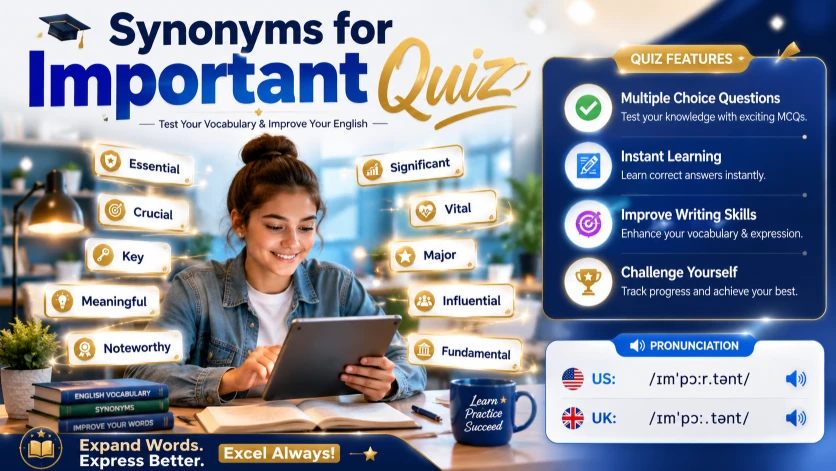
A synonyms for important quiz is a vocabulary test that helps you learn and practice words with the same or similar meaning as important.
Imagine you are writing an essay and keep using the word important in every paragraph. Instead of repeating it, you can choose words like essential, crucial, or significant. This makes your writing more engaging and professional.
Learning synonyms through an important quiz helps students, bloggers, content writers, and English learners improve their vocabulary. These words are useful for essays, emails, blog posts, presentations, and everyday conversations.
50 Synonyms for Important Quiz
1. Significant (Adjective)
US: /sɪɡˈnɪf.ə.kənt/ | UK: /sɪɡˈnɪf.ɪ.kənt/
Meaning: Having great value, meaning, or importance.
Examples:
- This test is significant for my final grade.
- We discussed a significant topic in class.
2. Essential (Adjective)
US: /ɪˈsen.ʃəl/ | UK: /ɪˈsen.ʃəl/
Meaning: Absolutely necessary or very important.
Examples:
- Water is essential for life.
- Reading is essential for learning.
3. Crucial (Adjective)
US: /ˈkruː.ʃəl/ | UK: /ˈkruː.ʃəl/
Meaning: Extremely important for success.
Examples:
- This quiz is crucial for the course.
- Good planning is crucial for success.
4. Vital (Adjective)
US: /ˈvaɪ.t̬əl/ | UK: /ˈvaɪ.təl/
Meaning: Necessary for life, success, or proper functioning.
Examples:
- Sleep is vital for students.
- Teamwork is vital in sports.
5. Key (Adjective)
US: /kiː/ | UK: /kiː/
Meaning: Having the greatest importance.
Examples:
- Practice is the key to improvement.
- She shared a key idea with us.
6. Major (Adjective)
US: /ˈmeɪ.dʒɚ/ | UK: /ˈmeɪ.dʒər/
Meaning: Very important or large in significance.
Examples:
- It was a major decision.
- The project reached a major milestone.
7. Critical (Adjective)
US: /ˈkrɪt̬.ɪ.kəl/ | UK: /ˈkrɪt.ɪ.kəl/
Meaning: Extremely important and requiring careful attention.
Examples:
- This is a critical part of the lesson.
- We solved a critical problem today.
8. Meaningful (Adjective)
US: /ˈmiː.nɪŋ.fəl/ | UK: /ˈmiː.nɪŋ.fəl/
Meaning: Having special value or purpose.
Examples:
- We had a meaningful discussion.
- Her gift was meaningful to me.
9. Valuable (Adjective)
US: /ˈvæl.jə.bəl/ | UK: /ˈvæl.ju.ə.bəl/
Meaning: Worth a lot or very useful.
Examples:
- The teacher gave valuable advice.
- This book contains valuable information.
10. Influential (Adjective)
US: /ˌɪn.fluˈen.ʃəl/ | UK: /ˌɪn.fluˈen.ʃəl/
Meaning: Having the power to influence people or events.
Examples:
- He is an influential leader.
- That article was very influential.
Did You Know?
Many people use important in every sentence, but English offers dozens of stronger alternatives. For example, essential means absolutely necessary, crucial highlights something that determines success, and significant emphasizes importance or meaning. Choosing the right synonym makes your writing more precise and engaging.
25. Relevant (Adjective)
US: /ˈrel.ə.vənt/ | UK: /ˈrel.ə.vənt/
Meaning:
Directly connected to the topic or situation.
Examples:
- The answer is relevant to the question.
- We used relevant examples in the lesson.
26. Pertinent (Adjective)
US: /ˈpɝː.t̬ən.ənt/ | UK: /ˈpɜː.tɪ.nənt/
Meaning:
Closely related and appropriate to the subject.
Examples:
- She asked a pertinent question.
- His comments were pertinent to the discussion.
27. Powerful (Adjective)
US: /ˈpaʊ.ɚ.fəl/ | UK: /ˈpaʊə.fəl/
Meaning:
Having a strong effect or influence.
Examples:
- It was a powerful speech.
- Books can be powerful tools for learning.
28. Impactful (Adjective)
US: /ɪmˈpækt.fəl/ | UK: /ɪmˈpækt.fəl/
Meaning:
Creating a strong or meaningful effect.
Examples:
- The lesson was impactful.
- His message had an impactful influence.
29. Outstanding (Adjective)
US: /aʊtˈstæn.dɪŋ/ | UK: /aʊtˈstæn.dɪŋ/
Meaning:
Exceptionally good or impressive.
Examples:
- She did an outstanding job.
- The report was outstanding.
30. Distinguished (Adjective)
US: /dɪˈstɪŋ.ɡwɪʃt/ | UK: /dɪˈstɪŋ.ɡwɪʃt/
Meaning:
Highly respected and admired.
Examples:
- He is a distinguished teacher.
- We welcomed a distinguished guest.

31. Eminent (Adjective)
US: /ˈem.ə.nənt/ | UK: /ˈem.ɪ.nənt/
Meaning:
Highly respected and well-known for achievements.
Examples:
- She is an eminent scientist.
- An eminent speaker joined the event.
32. Prestigious (Adjective)
US: /preˈstɪdʒ.əs/ | UK: /preˈstɪdʒ.əs/
Meaning:
Highly respected and admired.
Examples:
- He won a prestigious award.
- She studies at a prestigious university.
33. Respected (Adjective)
US: /rɪˈspek.tɪd/ | UK: /rɪˈspek.tɪd/
Meaning:
Admired because of good qualities or achievements.
Examples:
- She is a respected leader.
- The doctor is respected by everyone.
34. Authoritative (Adjective)
US: /əˈθɔːr.ə.teɪ.t̬ɪv/ | UK: /ɔːˈθɒr.ɪ.tə.tɪv/
Meaning:
Reliable, trusted, and based on expert knowledge.
Examples:
- We used an authoritative source.
- Her report is authoritative and accurate.
35. Significant-Level (Adjective)
US: /sɪɡˈnɪf.ɪ.kənt ˈlev.əl/ | UK: /sɪɡˈnɪf.ɪ.kənt ˈlev.əl/
Meaning:
Large enough to be important or noticeable.
Examples:
- There was a significant-level increase in sales.
- The project reached a significant-level milestone.
36. High-Priority (Adjective)
US: /haɪ praɪˈɔːr.ə.t̬i/ | UK: /haɪ praɪˈɒr.ɪ.ti/
Meaning:
Needing immediate attention because it is very important.
Examples:
- This task is high-priority.
- We completed the high-priority work first.
37. Pressing (Adjective)
US: /ˈpres.ɪŋ/ | UK: /ˈpres.ɪŋ/
Meaning:
Needing immediate attention or action.
Examples:
- We faced a pressing issue today.
- The teacher solved the pressing problem quickly.
38. Urgent (Adjective)
US: /ˈɝː.dʒənt/ | UK: /ˈɜː.dʒənt/
Meaning:
Requiring immediate action.
Examples:
- I received an urgent message.
- The situation became urgent.
39. Decisive (Adjective)
US: /dɪˈsaɪ.sɪv/ | UK: /dɪˈsaɪ.sɪv/
Meaning:
Able to produce a clear and important result.
Examples:
- She made a decisive move.
- The quiz played a decisive role.
40. Strategic (Adjective)
US: /strəˈtiː.dʒɪk/ | UK: /strəˈtiː.dʒɪk/
Meaning:
Carefully planned to achieve a goal.
Examples:
- We made a strategic decision.
- It was a strategic choice.
Quick Writing Tip
Instead of using “important” in every sentence, choose a synonym that best matches the context. For example, use “crucial” for something essential, “significant” for meaningful results, or “vital” for something absolutely necessary. This makes your writing clearer, more engaging, and professional.
41. Pivotal (Adjective)
US: /ˈpɪv.ə.t̬əl/ | UK: /ˈpɪv.ə.təl/
Meaning:
Very important because it can change the outcome of something.
Examples:
- It was a pivotal moment.
- The meeting proved pivotal for the project.
42. Momentous (Adjective)
US: /moʊˈmen.t̬əs/ | UK: /məˈmen.təs/
Meaning:
Very important and likely to have lasting effects.
Examples:
- Graduation was a momentous day.
- They made a momentous announcement.
43. Far-Reaching (Adjective)
US: /ˌfɑːrˈriː.tʃɪŋ/ | UK: /ˌfɑːˈriː.tʃɪŋ/
Meaning:
Having an effect on many people or things.
Examples:
- The new law had far-reaching effects.
- It was a far-reaching decision.
44. Great (Adjective)
US: /ɡreɪt/ | UK: /ɡreɪt/
Meaning:
Very important, impressive, or excellent.
Examples:
- She achieved great success.
- We learned a great lesson today.
45. Leading (Adjective)
US: /ˈliː.dɪŋ/ | UK: /ˈliː.dɪŋ/
Meaning:
Most important or ahead of others.
Examples:
- It is a leading company.
- He is a leading expert in the field.
Common Mistakes
Many learners use important in every sentence. Instead, choose a synonym that fits the context. For example, use vital for something necessary, crucial for something extremely important, and significant for something meaningful or noteworthy.
46. Top (Adjective)
US: /tɑːp/ | UK: /tɒp/
Meaning:
Among the highest or most important.
Examples:
- This is our top priority.
- She is a top performer.
47. Prime (Adjective)
US: /praɪm/ | UK: /praɪm/
Meaning:
First in importance or quality.
Examples:
- Safety is our prime concern.
- That is the prime reason for the change.
48. Chief (Adjective)
US: /tʃiːf/ | UK: /tʃiːf/
Meaning:
Most important or main.
Examples:
- This is the chief goal.
- Her chief responsibility is training.
49. Dominant (Adjective)
US: /ˈdɑː.mə.nənt/ | UK: /ˈdɒm.ɪ.nənt/
Meaning:
Having the greatest influence, importance, or power.
Examples:
- It became the dominant idea in the meeting.
- The team held a dominant position throughout the competition.
50. Standout (Adjective)
US: /ˈstænd.aʊt/ | UK: /ˈstænd.aʊt/
Meaning:
Exceptionally good or attracting special attention.
Examples:
- She was the standout student in the class.
- The project was a standout success.
FAQs
1. What are synonyms for important?
Synonyms for important include significant, crucial, vital, essential, key, major, and critical.
2. Why should I learn synonyms for important?
Learning synonyms helps you avoid repetition, improve your writing, and express ideas more clearly.
3. Which synonym is best for academic writing?
Words like significant, crucial, essential, and fundamental are commonly used in academic writing.
4. Can I use these synonyms in daily conversations?
Yes. Many of these words, such as important, key, major, vital, and necessary, are commonly used in everyday English.
Conclusion
Learning synonyms for important helps you write and speak more effectively. Instead of repeating the same word, you can choose the best synonym for each situation. These alternatives are useful for essays, blog posts, emails, presentations, and everyday conversations. With regular practice, you’ll build a richer vocabulary and communicate with greater confidence.
Discover More Articles:

Hi, I’m Nabeel Hassan, an English vocabulary writer helping learners improve their word skills with easy synonyms, meanings, examples, and quizzes. I create simple resources to make English learning easier and more effective.