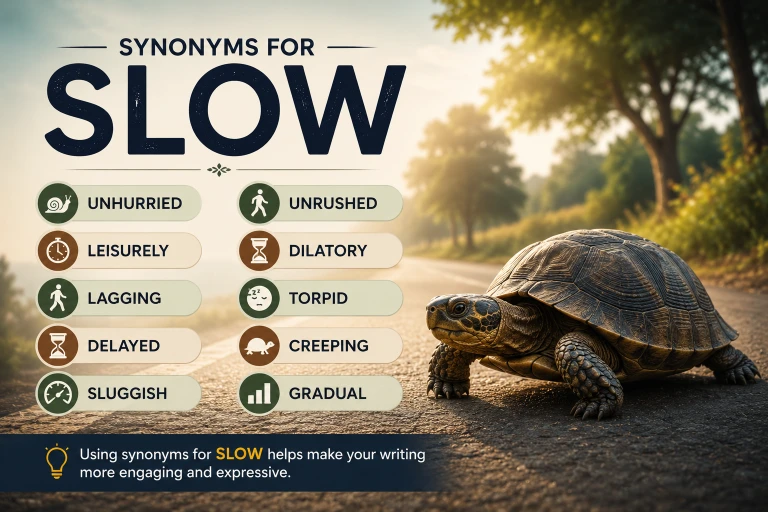
Synonyms for Slow are words that have a similar meaning to “slow” and help make your writing and speaking more varied, natural, and engaging.
Have you ever written a sentence and used the word “slow” again and again? Many students, bloggers, and writers face this problem. Repeating the same word too often can make your writing sound dull and less engaging.
For example, you might say, “The internet is slow today” or “The bus is slow.” Using different words can make your sentences clearer, more natural, and more interesting.
Learning synonyms for slow helps you improve your vocabulary and communicate more effectively. Whether you’re writing essays, blog posts, emails, or simply trying to speak better English, these alternatives will help you avoid repetition and choose the right word for every situation.
50 Synonyms for Slow
1. Sluggish (Adjective)
US: /ˈslʌɡ.ɪʃ/ | UK: /ˈslʌɡ.ɪʃ/
Meaning: Moving or working very slowly.
Examples:
- My computer feels sluggish today.
- The app became sluggish after the update.
2. Leisurely (Adjective)
US: /ˈliː.ʒɚ.li/ | UK: /ˈleʒ.ə.li/
Meaning: Done in a relaxed and unhurried way.
Examples:
- We took a leisurely walk after dinner.
- She enjoyed a leisurely morning at home.
3. Unhurried (Adjective)
US: /ʌnˈhɝː.id/ | UK: /ʌnˈhʌr.id/
Meaning: Not done quickly.
Examples:
- He spoke in an unhurried manner.
- We had an unhurried lunch together.
4. Gradual (Adjective)
US: /ˈɡrædʒ.u.əl/ | UK: /ˈɡrædʒ.u.əl/
Meaning: Happening little by little.
Examples:
- The weather showed a gradual change.
- Her skills improved in a gradual way.
5. Delayed (Adjective)
US: /dɪˈleɪd/ | UK: /dɪˈleɪd/
Meaning: Happening later than expected.
Examples:
- The train was delayed this morning.
- My package arrived a day late.
Read More: SynSynonyms for Sad in English: Express Every Emotiononyms
6. Lagging (Adjective)
US: /ˈlæɡ.ɪŋ/ | UK: /ˈlæɡ.ɪŋ/
Meaning: Falling behind others.
Examples:
- The website is lagging today.
- Our team is lagging behind schedule.
7. Crawling (Adjective)
US: /ˈkrɑː.lɪŋ/ | UK: /ˈkrɔː.lɪŋ/
Meaning: Moving very slowly.
Examples:
- Traffic was crawling on the highway.
- The line was crawling forward.
8. Lazy (Adjective)
US: /ˈleɪ.zi/ | UK: /ˈleɪ.zi/
Meaning: Not active or quick.
Examples:
- The lazy cat slept all afternoon.
- He felt lazy after lunch.
9. Idle (Adjective)
US: /ˈaɪ.dəl/ | UK: /ˈaɪ.dəl/
Meaning: Not active or working.
Examples:
- The machine remained idle all day.
- Several workers stood idle outside.
10. Lethargic (Adjective)
US: /ləˈθɑːr.dʒɪk/ | UK: /ləˈθɑː.dʒɪk/
Meaning: Feeling low in energy or moving slowly.
Examples:
- I felt lethargic after the long trip.
- The hot weather made everyone lethargic.
Did You Know?
The word slow has many different meanings depending on the context. For example, sluggish is often used for poor performance, gradual describes something that happens little by little, while leisurely refers to doing something in a relaxed and unhurried way. Choosing the right synonym makes your writing more accurate and engaging.
11. Tardy (Adjective)
US: /ˈtɑːr.di/ | UK: /ˈtɑː.di/
Meaning: Late in arriving or acting.
Examples:
- He was tardy for class.
- The response was tardy but helpful.
12. Poky (Adjective)
US: /ˈpoʊ.ki/ | UK: /ˈpəʊ.ki/
Meaning: Annoyingly slow.
Examples:
- This poky computer needs replacing.
- The service was poky today.
13. Plodding (Adjective)
US: /ˈplɑː.dɪŋ/ | UK: /ˈplɒd.ɪŋ/
Meaning: Moving slowly and steadily.
Examples:
- The horse kept a plodding pace.
- He made plodding progress on the project.
14. Measured (Adjective)
US: /ˈmeʒ.ɚd/ | UK: /ˈmeʒ.əd/
Meaning: Done in a careful and steady way.
Examples:
- She took measured steps forward.
- His measured reply sounded thoughtful.
15. Steady (Adjective)
US: /ˈsted.i/ | UK: /ˈsted.i/
Meaning: Moving at a constant pace.
Examples:
- The car moved at a steady speed.
- She made steady progress in class.
16. Moderate (Adjective)
US: /ˈmɑː.dɚ.ət/ | UK: /ˈmɒd.ər.ət/
Meaning: Not fast and not extreme.
Examples:
- We walked at a moderate pace.
- The growth was moderate this year.
17. Gentle (Adjective)
US: /ˈdʒen.t̬əl/ | UK: /ˈdʒen.təl/
Meaning: Soft, calm, and not quick.
Examples:
- A gentle breeze cooled the room.
- He took a gentle approach.
18. Relaxed (Adjective)
US: /rɪˈlækst/ | UK: /rɪˈlækst/
Meaning: Calm and not rushed.
Examples:
- We enjoyed a relaxed evening.
- Her relaxed style impressed everyone.
19. Easygoing (Adjective)
US: /ˌiː.ziˈɡoʊ.ɪŋ/ | UK: /ˌiː.ziˈɡəʊ.ɪŋ/
Meaning: Calm and not hurried.
Examples:
- He has an easygoing personality.
- The meeting had an easygoing feel.
20. Slow-paced (Adjective)
US: /ˌsloʊ ˈpeɪst/ | UK: /ˌsləʊ ˈpeɪst/
Meaning: Moving or happening at a slow rate.
Examples:
- It is a slow-paced town.
- We enjoyed the slow-paced lifestyle.
Comparison Table
| Synonym | Best Used For | Meaning |
|---|---|---|
| Sluggish | Performance | Moving or working very slowly |
| Leisurely | Activities | Relaxed and unhurried |
| Gradual | Change | Happening little by little |
| Delayed | Time & schedules | Happening later than expected |
| Slow-paced | Lifestyle & places | Moving at a slow rate |
21. Dragging (Adjective)
US: /ˈdræɡ.ɪŋ/ | UK: /ˈdræɡ.ɪŋ/
Meaning: Moving more slowly than expected.
Examples:
- The afternoon was dragging on.
- The project is dragging behind schedule.
22. Lingering (Adjective)
US: /ˈlɪŋ.ɡɚ.ɪŋ/ | UK: /ˈlɪŋ.ɡər.ɪŋ/
Meaning: Lasting longer than expected.
Examples:
- A lingering smell filled the room.
- We enjoyed a lingering conversation.
23. Dawdling (Verb/Adjective)
US: /ˈdɑː.dəl.ɪŋ/ | UK: /ˈdɔː.dəl.ɪŋ/
Meaning: Wasting time by moving slowly.
Examples:
- Stop dawdling and come inside.
- The kids were dawdling in the yard.
24. Dilatory (Adjective)
US: /ˈdɪl.ə.tɔːr.i/ | UK: /ˈdɪl.ə.tər.i/
Meaning: Causing unnecessary delay.
Examples:
- His dilatory actions slowed the work.
- The team avoided dilatory behavior.
25. Late (Adjective)
US: /leɪt/ | UK: /leɪt/
Meaning: Arriving or happening after the expected time.
Examples:
- She was late for school.
- The bus arrived late again.
26. Behind (Adjective)
US: /bɪˈhaɪnd/ | UK: /bɪˈhaɪnd/
Meaning: Not keeping up with others or being late.
Examples:
- We are behind on our work.
- The runner fell behind quickly.
27. Hesitant (Adjective)
US: /ˈhez.ə.tənt/ | UK: /ˈhez.ɪ.tənt/
Meaning: Slow because of uncertainty.
Examples:
- She was hesitant to answer.
- He gave a hesitant smile.
28. Careful (Adjective)
US: /ˈker.fəl/ | UK: /ˈkeə.fəl/
Meaning: Done slowly to avoid mistakes.
Examples:
- Be careful with the glass.
- She made a careful choice.
29. Deliberate (Adjective)
US: /dɪˈlɪb.ɚ.ət/ | UK: /dɪˈlɪb.ər.ət/
Meaning: Done slowly and thoughtfully.
Examples:
- His deliberate speech was clear.
- She made a deliberate decision.
30. Methodical (Adjective)
US: /məˈθɑː.dɪ.kəl/ | UK: /məˈθɒd.ɪ.kəl/
Meaning: Done in an organized and careful way.
Examples:
- He used a methodical approach.
- The work was methodical and neat.
31. Patient (Adjective)
US: /ˈpeɪ.ʃənt/ | UK: /ˈpeɪ.ʃənt/
Meaning: Willing to wait calmly without rushing.
Examples:
- She remained patient in line.
- Be patient with the process.
32. Slothful (Adjective)
US: /ˈsloʊθ.fəl/ | UK: /ˈsləʊθ.fəl/
Meaning: Very slow because of laziness.
Examples:
- The slothful worker missed deadlines.
- His slothful habits caused problems.
33. Inactive (Adjective)
US: /ɪnˈæk.tɪv/ | UK: /ɪnˈæk.tɪv/
Meaning: Not active or busy.
Examples:
- The account stayed inactive.
- He became inactive during winter.
34. Dormant (Adjective)
US: /ˈdɔːr.mənt/ | UK: /ˈdɔː.mənt/
Meaning: Not active for a period of time.
Examples:
- The volcano is dormant now.
- The project remained dormant.
35. Motionless (Adjective)
US: /ˈmoʊ.ʃən.ləs/ | UK: /ˈməʊ.ʃən.ləs/
Meaning: Not moving at all.
Examples:
- The statue stood motionless.
- She sat motionless for minutes.
36. Stagnant (Adjective)
US: /ˈstæɡ.nənt/ | UK: /ˈstæɡ.nənt/
Meaning: Not moving, growing, or developing.
Examples:
- Sales remained stagnant this month.
- The water looked stagnant.
37. Glacial (Adjective)
US: /ˈɡleɪ.ʃəl/ | UK: /ˈɡleɪ.si.əl/
Meaning: Extremely slow.
Examples:
- Progress was glacial this week.
- The download speed felt glacial.
38. Snail-like (Adjective)
US: /ˈsneɪl.laɪk/ | UK: /ˈsneɪl.laɪk/
Meaning: Moving very slowly.
Examples:
- Traffic was snail-like today.
- The queue moved in a snail-like way.
39. Creeping (Adjective)
US: /ˈkriː.pɪŋ/ | UK: /ˈkriː.pɪŋ/
Meaning: Moving slowly and quietly.
Examples:
- The cat was creeping forward.
- Prices are creeping up slowly.
40. Lumbering (Adjective)
US: /ˈlʌm.bɚ.ɪŋ/ | UK: /ˈlʌm.bər.ɪŋ/
Meaning: Moving slowly with heavy steps.
Examples:
- The bear came lumbering closer.
- The truck was lumbering uphill.
Quick Writing Tip
Instead of repeating slow in every sentence, choose a synonym that matches the context. For example, use sluggish for performance, gradual for change, and leisurely for relaxed activities.
41. Trudging (Verb/Adjective)
US: /ˈtrʌdʒ.ɪŋ/ | UK: /ˈtrʌdʒ.ɪŋ/
Meaning: Walking slowly with effort.
Examples:
- We were trudging through mud.
- He kept trudging home.
42. Heavy (Adjective)
US: /ˈhev.i/ | UK: /ˈhev.i/
Meaning: Moving slowly because of weight.
Examples:
- The heavy cart moved slowly.
- Her heavy suitcase was hard to pull.
43. Labored (Adjective)
US: /ˈleɪ.bɚd/ | UK: /ˈleɪ.bəd/
Meaning: Done with effort and slowness.
Examples:
- He took labored breaths.
- The speech sounded labored.
44. Drawn-out (Adjective)
US: /ˌdrɔn ˈaʊt/ | UK: /ˌdrɔːn ˈaʊt/
Meaning: Lasting longer than necessary.
Examples:
- It was a drawn-out meeting.
- The process became drawn-out.
45. Lengthy (Adjective)
US: /ˈleŋθ.i/ | UK: /ˈleŋθ.i/
Meaning: Taking a long time to complete.
Examples:
- We had a lengthy discussion.
- The report was lengthy.
Common Mistakes:
Don’t use slow, sluggish, and lethargic as if they mean exactly the same thing. Choose the synonym that best fits the situation to make your writing more natural and accurate.
46. Time-consuming (Adjective)
US: /ˈtaɪm kənˌsuː.mɪŋ/ | UK: /ˈtaɪm kənˌsjuː.mɪŋ/
Meaning: Requiring a lot of time to complete.
Examples:
- Editing videos is time-consuming.
- The task was very time-consuming.
47. Slack (Adjective)
US: /slæk/ | UK: /slæk/
Meaning: Not active, busy, or fast.
Examples:
- Business was slack today.
- Work became slack after lunch.
48. Slow-moving (Adjective)
US: /ˌsloʊ ˈmuː.vɪŋ/ | UK: /ˌsləʊ ˈmuː.vɪŋ/
Meaning: Moving at a low speed.
Examples:
- It is a slow-moving vehicle.
- The storm was slow-moving.
49. Unenergetic (Adjective)
US: /ʌnˌen.ɚˈdʒet̬.ɪk/ | UK: /ʌnˌen.əˈdʒet.ɪk/
Meaning: Lacking energy or enthusiasm.
Examples:
- I felt unenergetic this morning.
- The team looked unenergetic.
50. Torpid (Adjective)
US: /ˈtɔːr.pɪd/ | UK: /ˈtɔː.pɪd/
Meaning: Very slow because of low energy or inactivity.
Examples:
- The animal seemed torpid.
- He felt torpid after the meal.
Frequently Asked Questions
What is the best synonym for slow?
Some of the best synonyms for slow are sluggish, leisurely, gradual, deliberate, and slow-paced. The best choice depends on the context.
Why should I learn synonyms for slow?
Learning synonyms helps you avoid repetition, improve your vocabulary, and make your writing more natural and engaging.
Which synonym for slow is suitable for formal writing?
Words like gradual, deliberate, methodical, and measured are commonly used in formal and professional writing.
Can I use these synonyms in everyday English?
Yes. Many of these synonyms are useful in conversations, essays, emails, blogs, and school assignments.
Conclusion
Learning synonyms for slow helps you express ideas more clearly and avoid repeating the same word. Whether you’re writing an essay, blog post, email, or simply improving your English, these alternatives will make your communication more natural and effective. Practice using these words regularly to build a stronger vocabulary and become a more confident writer.
- Read More:Synonyms for Poor: Better Words to Use Instead
- Read More:Synonyms for Experience in English: 50Amazing alternatives
- Read More:Synonyms for Enemy: Strong Word Choices

Hi, I’m Nabeel Hassan, an English vocabulary writer helping learners improve their word skills with easy synonyms, meanings, examples, and quizzes. I create simple resources to make English learning easier and more effective.