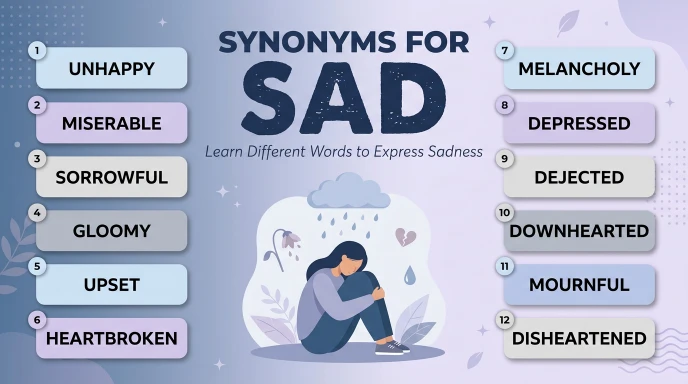
“Synonyms for sad in English” are words that have the same or similar meaning as the word “sad.
Learning synonyms for “sad” can help you express emotions more clearly and effectively in both writing and speaking. Instead of using the word “sad” repeatedly, you can choose alternatives such as “unhappy,” “miserable,” “gloomy,” or “heartbroken” to add variety and depth to your language. In this article, you will discover useful synonyms for “sad” along with their meanings and examples to improve your vocabulary and communication skills.
Knowing synonyms for sad in English can improve your writing and speaking skills. Students can write better essays, bloggers can create engaging content, content writers can avoid repetition, and everyday English users can express emotions more accurately. In this guide, you will learn 50 useful synonyms for sad in English with meanings and examples.
50 of Synonyms for Sad in English
1:Unhappy
pronuonciation: (un-HAP-ee)
Meaning:
- Feeling not pleased or not satisfied.
Examples:
- I felt unhappy after missing the bus.
- She looked unhappy during the meeting.
2: Gloomy
Pronunciation: (GLOO-mee)
Meaning:
- Feeling dark and sad inside.
Examples:
- He seemed gloomy all day.
- The rainy weather made me gloomy.
3:Miserable
Pronunciation: (MIZ-er-uh-bul)
Meaning:
- Feeling very sad and uncomfortable.
Examples:
- I felt miserable when I got sick.
- She was miserable after losing her phone.
4:Downcast
Pronunciation: (DOWN-kas)
Meaning:
- Looking sad and without hope.
Examples:
- He looked downcast after the game.
- She sat quietly with a downcast face.
5:Depressed
Pronunciation: (dih-PREST)
Meaning:
- Feeling deeply sad for a long time.
Examples:
- He felt depressed after the bad news.
- She stayed home because she felt depressed.
Read More:
6:Blue
Pronunciation: (BLOO)
Meaning:
- Feeling a little sad.
Examples:
- I felt blue on Sunday evening.
- She gets blue when she is alone.
7:Melancholy
Pronunciation: (MEL-un-kol-ee)
Meaning:
- Feeling quietly sad.
Examples:
- The song made me feel melancholy.
- He had a melancholy mood today.
8:Sorrowful
Pronunciation: (SOR-oh-ful)
Meaning:
- Feeling sadness because of a loss.
Examples:
- She felt sorrowful after the farewell.
- He gave a sorrowful smile.
9:Heartbroken
Pronunciation: (HART-broh-kuhn)
Meaning:
- Feeling extreme sadness.
Examples:
- I was heartbroken when my pet died.
- She felt heartbroken after the breakup.
10:Dejected
Pronunciation: (dih-JEK-tid)
Meaning:
- Feeling sad and disappointed.
Examples:
- He felt dejected after failing the test.
- She looked dejected after the interview.
Did you know?
English has many synonyms for “sad”, but each one is used in a different situation. Learning the correct meaning and usage of each word will help you communicate more accurately, improve your vocabulary, and avoid repeating the same word in your writing.
11:Crestfallen
Pronunciation: (KREST-faw-lun)
Meaning:
- Feeling sad because something went wrong.
Examples:
- He looked crestfallen after the loss.
- She became crestfallen when plans changed.
12:Disheartened
Pronunciation: (dis-HAR-tnd)
Meaning:
- Feeling less hopeful because of problems.
Examples:
- I felt disheartened by the result.
- She became disheartened after many mistakes.
13:Discouraged
Pronunciation: (dis-KUR-ijd)
Meaning:
- Feeling less confident to continue.
Examples:
- He felt discouraged by the criticism.
- She was discouraged after several failures.
14:Mournful
Pronunciation: (MORN-ful)
Meaning:
- Showing deep sadness.
Examples:
- The music sounded mournful.
- He had a mournful expression.
15:Woeful
Pronunciation: (woh-ful)
Meaning:
- Full of sadness or regret.
Examples:
- She gave a woeful sigh.
- He looked woeful after the argument.
16:Glum
Pronunciation: (gluhm)
Meaning:
- Quietly sad and unhappy.
Examples:
- He felt glum during lunch.
- She looked glum after school.
17:Somber
Pronunciation: (som-ber)
Meaning:
- Serious and slightly sad.
Examples:
- The room felt somber after the news.
- He spoke in a somber voice.
18:Heavyhearted
Pronunciation: (hev-ee-har-tid)
Meaning:
- Feeling sadness in the heart.
Examples:
- I left with a heavyhearted feeling.
- She felt heavyhearted that evening.
19:Morose
Pronunciation: (muh-rohz)
Meaning:
- Feeling sad and not wanting company.
Examples:
- He seemed morose at dinner.
- She stayed morose all afternoon.
20:Despairing
Pronunciation: (dih-spair-ing)
Meaning:
- Feeling no hope.
Examples:
- He felt despairing about the situation.
- She sounded despairing on the phone.
| Purpose | How these Synonyms Help |
| Academic Writing | Make eassays and assignmesnts more precise and engaging. |
| Blog Writing | Aviod repeating the same word and improve readability. |
| Creative Writing | Express emotions naturally in stories and poems |
| Daily Conversation | Speak more clealy with the right vocabulary. |
| Professtional Writing | Use suitable words in emails and reports. |
21:Regretful
Pronunciation: (rih-gret-ful)
Meaning:
- Feeling sad about a past action.
Examples:
- I felt regretful about my words.
- She looked regretful after the mistake.
22:Troubled
Pronunciation: (trub-uld)
Meaning:
- Feeling worried and sad.
Examples:
- He looked troubled this morning.
- She felt troubled by the problem.
23:Distressed
Pronunciation: (dih-strest)
Meaning:
- Feeling very upset and sad.
Examples:
- He felt distressed by the news.
- She seemed distressed during class.
24:Hurt
Pronunciation: (hurt)
Meaning:
- Feeling emotional pain.
Examples:
- I felt hurt by his comment.
- She was hurt by the joke.
25: Pained
Pronunciation: (paynd)
Meaning:
- Feeling emotional suffering.
Examples:
- He looked pained after the discussion.
- She gave a pained response.
26:Grieving
Pronunciation: (gree-ving)
Meaning:
- Feeling sadness after losing someone.
Examples:
- He was grieving for his grandfather.
- She spent time grieving quietly.
27:Brokenhearted
Pronunciation: (broh-kuhn-har-tid)
Meaning:
- Feeling extremely sad because of loss.
Examples:
- She felt brokenhearted after moving away.
- He was brokenhearted over the news.
28:Dismal
Pronunciation: (diz-muhl)
Meaning:
- Feeling very gloomy and sad.
Examples:
- The mood felt dismal today.
- He gave a dismal report.
29:Forlorn
Pronunciation: (for-lorn)
Meaning:
- Feeling lonely and sad.
Examples:
- The child looked forlorn.
- She felt forlorn in the new city.
30:Low
Pronunciation: (loh)
Meaning:
- Feeling emotionally down.
Examples:
- I felt low after work.
- She seemed low all week.
31:Tearful
Pronunciation: (teer-ful)
Meaning:
- Close to crying because of sadness.
Examples:
- He became tearful during the speech.
- She looked tearful after the movie.
32:Weepy
Pronunciation: (wee-pee)
Meaning:
- Feeling like crying easily.
Examples:
- I felt weepy that day.
- She became weepy after the call.
33:Lonesome
Pronunciation: (lohn-sum)
Meaning:
- Feeling sad because of being alone.
Examples:
- He felt lonesome during the trip.
- She looked lonesome at home.
34:Lonely
Pronunciation: (lohn-lee)
Meaning:
- Feeling alone and sad.
Examples:
- I felt lonely in a new school.
- She gets lonely on weekends.
35:Desolate
Pronunciation: (des-uh-lit)
Meaning:
- Feeling empty and very sad.
Examples:
- He felt desolate after leaving.
- She looked desolate in the photo.
36:Anguished
Pronunciation: (ang-gwisht)
Meaning:
- Feeling intense emotional pain.
Examples:
- He sounded anguished on the call.
- She felt anguished about the decision.
37:Aggrieved
Pronunciation: (uh-greevd)
Meaning:
- Feeling sad because of unfair treatment.
Examples:
- He felt aggrieved by the decision.
- She looked aggrieved after the complaint.
38:Doleful
Pronunciation: (dohl-ful)
Meaning:
- Showing sadness openly.
Examples:
- He wore a doleful expression.
- She gave a doleful look.
39:Sullen
Pronunciation: (sul-uhn)
Meaning:
- Quietly sad and unwilling to talk.
Examples:
- He stayed sullen during dinner.
- She looked sullen after practice.
40:Crestfallenhearted
Pronunciation: (krest-faw-luhn)
Meaning:
- Feeling deeply disappointed and sad.
Examples:
- He felt crestfallenhearted after the result.
- She appeared crestfallenhearted all day.
Quick Tips:
Choosing the right synonym depends on the context and the level of emotion you want to express. Instead of using the word “sad” repeatedly, select a synonym that best matches the situation. This makes your writing more engaging, improves readability, and helps you communicate more naturally in English.
41:Wistful
Pronunciation: (wist-ful)
Meaning:
- Feeling gently sad while thinking of the past.
Examples:
- He gave a wistful smile.
- She felt wistful about childhood memories.
42:Disappointed
Pronunciation: (dis-uh-poyn-tid)
Meaning:
- Feeling sad because expectations were not met.
Examples:
- I felt disappointed with my score.
- She was disappointed by the delay.
43:Inconsolable
Pronunciation: (in-kuhn-soh-luh-bul)
Meaning:
- Too sad to feel comforted.
Examples:
- He was inconsolable after the loss.
- She seemed inconsolable that night.
44:Bereaved
Pronunciation: (bih-reevd)
Meaning:
- Sad because a loved one has died.
Examples:
- The bereaved family stayed together.
- He felt bereaved after his father’s death.
45:Doleful
Pronunciation: (dohl-ful)
Meaning:
- Feeling sadness deep inside.
Examples:
- She felt dolefulhearted after moving.
- He looked dolefulhearted at the station.
46:Sunk
Pronunciation: (suhngk)
Meaning:
- Feeling emotionally low.
Examples:
- I felt sunk after the rejection.
- She seemed sunk in sadness.
47:Down
Pronunciation: (down)
Meaning:
- Feeling slightly sad.
Examples:
- He felt down this morning.
- She was down after work.
48:Joyless
Pronunciation: (joy-lis)
Meaning:
- Without happiness or excitement.
Examples:
- The day felt joyless without friends.
- He lived a joyless routine.
49:Sadhearted
Pronunciation: (sad-har-tid)
Meaning:
- Having a sad feeling in the heart.
Examples:
- She felt sadhearted after the goodbye.
- He remained sadhearted for days.
50:Suffering
Pronunciation: (suf-er-ing)
Meaning:
- Experiencing emotional pain.
Examples:
- He was suffering after the breakup.
- She kept suffering in silence.
Common Mistake:
Many learners use the word “sad” in every situation. However, different emotions require different synonyms. For example, saying heartbroken after a breakup or disappointed after failing an exam sounds much more natural than simply saying sad.
Conclusion
Learning synonyms for sad in English helps you express feelings more clearly and naturally. These words can improve your writing, blogging, speaking, and everyday communication. Instead of using the same word repeatedly, you can choose the exact word that matches your emotion.
Practice these synonyms in emails, essays, social media posts, and daily conversations. The more you use them, the more confident and fluent your English will become.
Discover more Articles:

Hi, I’m Nabeel Hassan, an English vocabulary writer helping learners improve their word skills with easy synonyms, meanings, examples, and quizzes. I create simple resources to make English learning easier and more effective.