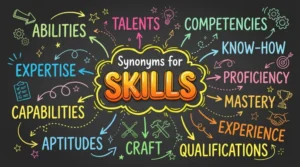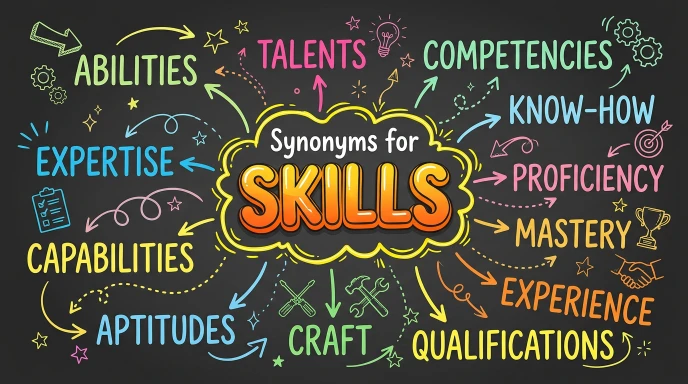
Skills are the abilities and knowledge that help someone perform tasks or do something well. Common synonyms for skills include abilities, talents, capabilities, expertise, strengths, proficiency, competence, and aptitudes.
These words can describe practical, creative, professional, physical, and communication skills. However, each alternative has a slightly different meaning. For example, expertise refers to advanced knowledge, while talent often describes a natural ability.
Learning synonyms for skills can help you write better resumes, improve academic writing, and express your abilities more clearly. This guide covers 25 useful alternatives with meanings and natural examples.
What Does Skills Mean?
Definition
Skills is the plural form of skill. It refers to the abilities, knowledge, and experience that help a person perform a task effectively.
Skills can be learned through education, practice, training, and experience. Some abilities may also come naturally.
Examples
- She has excellent communication skills.
- The company is looking for candidates with strong technical skills.
- Reading and writing are important skills for students.
Connotative Meaning
The word skills usually has a positive meaning. It suggests that someone can perform a task with knowledge, practice, or ability.
For example:
- Professional skills: Abilities used at work.
- Creative skills: Abilities used to create art, music, or designs.
- Social skills: Abilities used to communicate with others.
- Technical skills: Practical knowledge of tools, systems, or technology.
Etymology
The word skill comes from Old Norse skil, meaning distinction, understanding, or discernment. It later developed the meaning of knowledge and the ability to perform a task.
Pronunciation
- US IPA: /skɪlz/
- UK IPA: /skɪlz/
Syllables
Skills has one syllable.
Affixation Pattern
Skill is a base word. The final s in skills is a plural suffix.
Related Concepts
- Ability: The power to do something.
- Talent: A natural ability.
- Knowledge: Information and understanding gained through learning.
- Experience: Knowledge gained through practice.
- Competence: The ability to perform a task successfully.
Complete List of 25 Synonyms for Skills
The following alternatives describe different types of abilities, knowledge, and expertise. Some are more suitable for professional writing, while others work better in everyday conversations.
| Synonym | Meaning | Formality Level |
| 1. Abilities | Powers to do something | Neutral |
| 2. Talents | Natural abilities | Neutral |
| 3. Capabilities | Powers or capacity to perform tasks | Formal |
| 4. Expertise | Advanced knowledge or skill | Formal |
| 5. Strengths | Areas in which someone performs well | Neutral |
| 6. Proficiency | A high level of ability | Formal |
| 7. Competencies | Knowledge and abilities needed for a task | Formal |
| 8. Aptitudes | Natural ability to learn or do something | Formal |
| 9. Knacks | Special natural abilities | Informal |
| 10. Gifts | Special natural talents | Neutral |
| 11. Craftsmanship | Skill in making or creating things | Neutral |
| 12. Techniques | Methods used to perform tasks | Neutral |
| 13. Know how | Practical knowledge | Informal |
| 14. Mastery | Complete or advanced control of a subject | Formal |
| 15. Proficiencies | Areas of demonstrated ability | Formal |
| 16. Qualifications | Skills or credentials that make someone suitable | Formal |
| 17. Competence | The ability to do something effectively | Formal |
| 18. Dexterity | Skill in using the hands or body | Formal |
| 19. Finesse | Delicate and controlled skill | Neutral |
| 20. Aptness | Natural suitability or ability | Formal |
| 21. Accomplishments | Things successfully achieved through ability or effort | Neutral |
| 22. Specialties | Areas of particular knowledge or ability | Neutral |
| 23. Strengths | Things someone does especially well | Neutral |
| 24. Experience | Knowledge gained through practice | Neutral |
| 25. Talents | Special abilities or gifts | Neutral |
Note: Some words above overlap in meaning but are not exact replacements in every sentence. For example, qualifications may include certificates, while experience describes knowledge gained over time.
Formality Comparison of Skills Synonyms
Choose a synonym based on the type of writing and the message you want to express.
| Formality | Suitable Synonyms |
| Formal | Expertise, proficiency, competencies, mastery, qualifications |
| Neutral | Abilities, talents, strengths, techniques, experience |
| Informal | Knacks, know how, gifts |
| Professional | Capabilities, competencies, specialties, qualifications |
| Practical | Dexterity, craftsmanship, techniques, know how |
Tip: Use competencies, proficiency, or expertise in professional documents. Use abilities or talents in everyday writing.
25 Detailed Synonyms for Skills With Examples
1. Abilities
Part of Speech: Noun (plural)
US IPA: /əˈbɪl.ə.tiz/
UK IPA: /əˈbɪl.ə.tiz/
Meaning: The powers or qualities that allow someone to perform tasks.
Formality: Neutral
Formal Example: The position requires strong analytical abilities.
Informal Example: She has excellent abilities in drawing and painting.
2. Talents
Part of Speech: Noun (plural)
US IPA: /ˈtæl.ənts/
UK IPA: /ˈtæl.ənts/
Meaning: Natural abilities that help someone do something well.
Formality: Neutral
Formal Example: The program helps young people develop their creative talents.
Informal Example: He has many talents, especially in music.
3. Capabilities
Part of Speech: Noun (plural)
US IPA: /ˌkeɪ.pəˈbɪl.ə.tiz/
UK IPA: /ˌkeɪ.pəˈbɪl.ə.tiz/
Meaning: The abilities or capacity to complete tasks successfully.
Formality: Formal
Formal Example: The company values employees with strong technical capabilities.
Informal Example: This computer has impressive capabilities.
4. Expertise
Part of Speech: Noun
US IPA: /ˌek.spɚˈtiːz/
UK IPA: /ˌek.spɜːˈtiːz/
Meaning: Advanced knowledge or ability in a particular subject or activity.
Formality: Formal
Formal Example: Her financial expertise helped the organization improve its budget.
Informal Example: We need his expertise to fix this problem.
5. Strengths
Part of Speech: Noun (plural)
US IPA: /streŋkθs/
UK IPA: /streŋkθs/
Meaning: Areas in which someone has strong abilities or performs well.
Formality: Neutral
Formal Example: Communication and leadership are important strengths for this position.
Informal Example: Cooking and organizing are two of her biggest strengths.
6. Proficiency
Part of Speech: Noun
US IPA: /prəˈfɪʃ.ən.si/
UK IPA: /prəˈfɪʃ.ən.si/
Meaning: A high level of ability or competence in a particular activity.
Formality: Formal
Formal Example: The job requires proficiency in computer programming.
Informal Example: His proficiency in English has improved through daily practice.
7. Competencies
Part of Speech: Noun (plural)
US IPA: /ˈkɑːm.pə.tən.siz/
UK IPA: /ˈkɒm.pɪ.tən.siz/
Meaning: The knowledge, abilities, and behaviors needed to perform a task effectively.
Formality: Formal
Formal Example: The training program develops essential leadership competencies.
Informal Example: Teamwork and problem solving are useful competencies at work.
8. Aptitudes
Part of Speech: Noun (plural)
US IPA: /ˈæp.tə.tuːdz/
UK IPA: /ˈæp.tɪ.tjuːdz/
Meaning: Natural abilities or potential to learn and perform certain tasks.
Formality: Formal
Formal Example: The assessment identifies students’ mathematical aptitudes.
Informal Example: She has a natural aptitude for learning languages.
9. Knacks
Part of Speech: Noun (plural)
US IPA: /næks/
UK IPA: /næks/
Meaning: Special or natural abilities to do something easily and well.
Formality: Informal
Formal Example: The designer has a particular knack for creating simple layouts.
Informal Example: My brother has a knack for fixing broken gadgets.
10. Gifts
Part of Speech: Noun (plural)
US IPA: /ɡɪfts/
UK IPA: /ɡɪfts/
Meaning: Natural abilities or talents that make someone good at something.
Formality: Neutral
Formal Example: Her artistic gifts became clear during her early education.
Informal Example: He has a real gift for making people laugh.
11. Craftsmanship
Part of Speech: Noun
US IPA: /ˈkræfts.mən.ʃɪp/
UK IPA: /ˈkrɑːfts.mən.ʃɪp/
Meaning: The skill and care involved in making or creating something.
Formality: Neutral
Formal Example: The furniture is admired for its excellent craftsmanship.
Informal Example: You can see the craftsmanship in every detail of this table.
12. Techniques
Part of Speech: Noun (plural)
US IPA: /tekˈniːks/
UK IPA: /tekˈniːks/
Meaning: Particular methods or ways of performing an activity.
Formality: Neutral
Formal Example: Students learn effective research techniques during the course.
Informal Example: She showed me some useful cooking techniques.
13. Know how
Part of Speech: Noun
US IPA: /ˈnoʊ.haʊ/
UK IPA: /ˈnəʊ.haʊ/
Meaning: Practical knowledge and understanding of how to do something.
Formality: Informal
Formal Example: The project requires technical know how and practical experience.
Informal Example: He has the know how to repair almost anything.
14. Mastery
Part of Speech: Noun
US IPA: /ˈmæs.tɚ.i/
UK IPA: /ˈmɑː.stər.i/
Meaning: A high level of knowledge, control, or ability in a subject.
Formality: Formal
Formal Example: The course helps students achieve mastery of advanced writing techniques.
Informal Example: Her mastery of the piano is amazing.
15. Proficiencies
Part of Speech: Noun (plural)
US IPA: /prəˈfɪʃ.ən.siz/
UK IPA: /prəˈfɪʃ.ən.siz/
Meaning: Particular areas in which someone has a high level of ability.
Formality: Formal
Formal Example: Applicants should list their language proficiencies on the application.
Informal Example: His computer proficiencies helped him get the job.
16. Qualifications
Part of Speech: Noun (plural)
US IPA: /ˌkwɑː.lə.fəˈkeɪ.ʃənz/
UK IPA: /ˌkwɒl.ɪ.fɪˈkeɪ.ʃənz/
Meaning: The education, training, experience, or abilities that make someone suitable for a role.
Formality: Formal
Formal Example: The applicant has the necessary qualifications for the position.
Informal Example: Her teaching qualifications helped her find a good job.
17. Competence
Part of Speech: Noun
US IPA: /ˈkɑːm.pə.təns/
UK IPA: /ˈkɒm.pɪ.təns/
Meaning: The ability to perform a task successfully and effectively.
Formality: Formal
Formal Example: The manager demonstrated strong leadership competence.
Informal Example: You need basic computer competence for this job.
18. Dexterity
Part of Speech: Noun
US IPA: /dekˈster.ə.ti/
UK IPA: /dekˈster.ə.ti/
Meaning: The ability to use your hands or body with speed, accuracy, and control.
Formality: Formal
Formal Example: The surgeon needs excellent manual dexterity.
Informal Example: She showed great dexterity while making the tiny decorations.
19. Finesse
Part of Speech: Noun
US IPA: /fɪˈnes/
UK IPA: /fɪˈnes/
Meaning: The ability to perform something with precision, control, and style.
Formality: Neutral
Formal Example: The negotiator handled the difficult discussion with great finesse.
Informal Example: He played the difficult guitar solo with real finesse.
20. Aptness
Part of Speech: Noun
US IPA: /ˈæpt.nəs/
UK IPA: /ˈæpt.nəs/
Meaning: The quality of being suitable or appropriate for a particular purpose; sometimes, natural suitability for a task.
Formality: Formal
Formal Example: Her aptness for the role became clear during the assessment.
Informal Example: His aptness for solving puzzles impressed everyone.
21. Accomplishments
Part of Speech: Noun (plural)
US IPA: /əˈkɑːm.plɪʃ.mənts/
UK IPA: /əˈkʌm.plɪʃ.mənts/
Meaning: Successful achievements that may demonstrate someone’s abilities and effort.
Formality: Neutral
Formal Example: The report highlights the team’s major accomplishments.
Informal Example: Learning to play the guitar is one of her proudest accomplishments.
22. Specialties
Part of Speech: Noun (plural)
US IPA: /ˈspeʃ.əl.tiz/
UK IPA: /ˈspeʃ.əl.tiz/
Meaning: Particular subjects or activities in which someone has special knowledge or ability.
Formality: Neutral
Formal Example: Data analysis and project management are her main specialties.
Informal Example: Baking cakes is one of my mother’s specialties.
23. Experience
Part of Speech: Noun
US IPA: /ɪkˈspɪr.i.əns/
UK IPA: /ɪkˈspɪə.ri.əns/
Meaning: Knowledge or ability gained by doing something over time.
Formality: Neutral
Formal Example: The position requires practical experience in customer service.
Informal Example: You gain useful experience by trying new things.
24. Aptitudes
Part of Speech: Noun (plural)
US IPA: /ˈæp.tə.tuːdz/
UK IPA: /ˈæp.tɪ.tjuːdz/
Meaning: Natural abilities that make learning or performing certain activities easier.
Formality: Formal
Formal Example: The school evaluates students’ creative and academic aptitudes.
Informal Example: He has strong musical aptitudes.
25. Talents
Part of Speech: Noun (plural)
US IPA: /ˈtæl.ənts/
UK IPA: /ˈtæl.ənts/
Meaning: Natural abilities that allow someone to perform certain activities well.
Formality: Neutral
Formal Example: The organization supports young people’s artistic talents.
Informal Example: Her cooking talents always impress our family.
Synonyms for Skills by Category
Different situations call for different words. Use these categories to find a suitable alternative to skills.
Professional Skills Synonyms
- Expertise: Advanced knowledge in a particular field.
- Competencies: Abilities needed to perform a job.
- Proficiency: A high level of ability.
- Qualifications: Training, education, or experience for a role.
- Capabilities: The power to complete professional tasks.
Natural Skills Synonyms
- Talents: Abilities someone naturally possesses.
- Gifts: Special natural abilities.
- Aptitudes: Natural potential to learn or perform something.
- Knacks: An easy ability to do something well.
Practical Skills Synonyms
- Know how: Practical knowledge of how to do something.
- Techniques: Methods used to complete tasks.
- Dexterity: Physical control and coordination.
- Craftsmanship: Skill in making or creating things.
- Finesse: Precise and controlled performance.
Communication Skills Synonyms
- Abilities: General powers to communicate.
- Competencies: Communication abilities needed in specific situations.
- Proficiency: A high level of communication ability.
- Expertise: Advanced knowledge of communication practices.
- Strengths: Areas of communication in which someone performs well.
Creative Skills Synonyms
- Talents: Natural creative abilities.
- Gifts: Special artistic abilities.
- Craftsmanship: Skill in creating detailed work.
- Finesse: Careful and controlled creative performance.
- Specialties: Particular creative areas of knowledge or ability.
Antonyms of Skills
Antonyms are words with opposite meanings. The opposite of skills usually describes a lack of ability, knowledge, or competence.
| Antonym | Meaning |
| Inability | Lack of power to do something |
| Incompetence | Lack of the ability to perform a task properly |
| Ineptitude | Lack of skill or judgment |
| Weakness | An area where someone lacks ability |
| Inexperience | Lack of practical knowledge |
| Unskillfulness | Lack of skill |
| Inefficiency | Failure to work effectively |
| Incapacity | Lack of ability or power |
Example: The job requires strong technical skills, but his lack of experience made the task difficult.
Quiz: Test Your Knowledge of Skills Synonyms
Choose the correct answer for each question.
1. Which word describes natural abilities?
A. Talents
B. Consequences
C. Techniques
D. Outcomes
2. Which synonym means advanced knowledge in a particular field?
A. Weakness
B. Expertise
C. Inexperience
D. Inability
3. Which word describes the ability to use your hands with precision?
A. Mastery
B. Competence
C. Dexterity
D. Qualification
4. Which synonym refers to practical knowledge of how to do something?
A. Know how
B. Significance
C. Aftermath
D. Impression
5. Which word describes the ability to perform a task effectively?
A. Collision
B. Competence
C. Weakness
D. Inaction
6. Which word means a high level of ability in a particular subject?
A. Proficiency
B. Inability
C. Triviality
D. Reaction
Quiz Answers
- A. Talents
- B. Expertise
- C. Dexterity
- A. Know how
- B. Competence
- A. Proficiency
Usage Tips: How to Choose the Right Synonym for Skills
Choosing the right synonym depends on the situation and the type of ability you want to describe.
- Use abilities when talking about someone’s general power to do something.
- Choose talents when describing natural or special abilities.
- Use expertise when someone has advanced knowledge in a particular field.
- Choose proficiency when describing a high level of performance.
- Use competencies when discussing abilities needed for a job.
- Choose dexterity when talking about physical coordination or hand movements.
- Use know how for practical knowledge gained through experience.
- Choose strengths when describing the areas in which someone performs especially well.
Remember: Skills are often learned through practice, while talents and aptitudes can describe natural abilities. Select the word that best matches your intended meaning.
Frequently Asked Questions About Skills Synonyms
1. What are the most common synonyms for skills?
Common synonyms for skills include abilities, talents, capabilities, expertise, strengths, proficiency, and competencies. These words describe different types and levels of ability.
2. What is another word for skills on a resume?
Useful alternatives include competencies, expertise, proficiencies, qualifications, and capabilities. These words can make your resume sound clear and professional.
3. What is a synonym for good skills?
You can use strong abilities, excellent capabilities, proficiency, expertise, or competence. The best choice depends on the type of ability you want to describe.
4. What is the difference between skills and talents?
Skills are abilities that people often develop through learning and practice. Talents are usually natural abilities that may improve with training.
5. What are professional synonyms for skills?
Professional alternatives include competencies, expertise, proficiency, qualifications, and capabilities. They are useful in resumes, job applications, and workplace documents.
6. What is the opposite of skills?
Common opposites include inability, incompetence, ineptitude, unskillfulness, and inexperience. These words describe a lack of ability or practical knowledge.
7. How can I describe my skills in better words?
Use specific terms such as technical expertise, communication abilities, leadership competencies, or problem solving proficiency. Specific descriptions help readers understand what you can do.
Conclusion
Learning synonyms for skills helps you describe abilities in a more accurate and interesting way. Words such as abilities, talents, expertise, proficiency, competencies, and capabilities are useful in everyday conversations, academic writing, and professional documents.
Some alternatives describe natural gifts, while others focus on knowledge gained through education and practice. For example, use talents for natural abilities and expertise for advanced knowledge in a particular field.
Always consider the context before choosing a replacement. With regular practice, these 25 synonyms for skills can help you improve your vocabulary, write stronger sentences, and explain your abilities with confidence.
Discover More Articles:

Hi, I’m Emma Wilson, an English vocabulary writer helping learners improve their word skills with synonyms, meanings, examples, and quizzes. I create simple resources to make English learning easier.