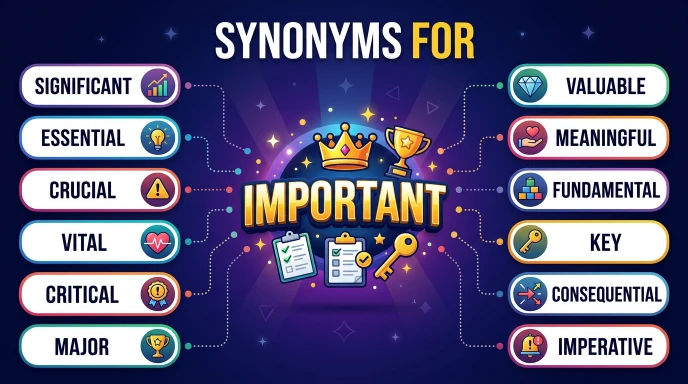
Synonyms for important include significant, essential, crucial, vital, major, and meaningful.
These words describe something that has great value, influence, or importance. The best synonym depends on the context. For example, essential describes something necessary, while significant refers to something that has a strong effect or meaning. You can use crucial when a decision or action is extremely important.
Learning different words for important can make your English more precise and interesting. This guide explains 25 useful alternatives with simple meanings, pronunciation, and natural examples.
What Does Important Mean?
Important means having great value, meaning, influence, or effect. It describes something that deserves attention or plays a major role in a situation. For example: “Education is important for personal growth.” The word can describe people, decisions, events, tasks, ideas, and responsibilities.
Meaning of Important
Important is an adjective used to describe someone or something that has considerable value, meaning, influence, or significance. It can refer to something necessary, urgent, or deserving special attention.
Definition
Important: Having great value, influence, meaning, or significance.
Examples
- Education plays an important role in building a better future.
- Please remember this important meeting.
- Good health is important for a happy life.
Connotative Meaning
Important often suggests value, respect, priority, or influence. It can describe something that deserves attention because of its benefits, consequences, or role in a situation.
Etymology
The word important comes from French important, which developed from the Latin verb importare, meaning “to bring in” or “to carry into.” Its modern meaning relates to something that carries weight or significance.
Pronunciation
- US IPA: /ɪmˈpɔːr.tənt/
- UK IPA: /ɪmˈpɔː.tənt/
Syllables
Im por tant 3 syllables.
Affixation Pattern
- Root: Port, related to carrying or bringing
- Prefix: Im
- Suffix: ant
- Word formation: Important
Related Concepts
- Significance
- Value
- Priority
- Necessity
- Influence
- Relevance
- Responsibility
- Urgency
Complete List of 25 Synonyms for Important
| No. | Synonym | Meaning | Formality Level |
| 1 | Significant | Having great meaning or influence | Formal |
| 2 | Essential | Completely necessary | Neutral |
| 3 | Crucial | Extremely important to success | Neutral |
| 4 | Vital | Necessary for life or success | Neutral |
| 5 | Major | Greater or more important than others | Neutral |
| 6 | Key | Having a central or leading role | Neutral |
| 7 | Critical | Extremely important or necessary | Formal |
| 8 | Fundamental | Forming the basic foundation of something | Formal |
| 9 | Principal | First in importance or leading | Formal |
| 10 | Primary | Main or most important | Neutral |
| 11 | Paramount | More important than anything else | Formal |
| 12 | Pivotal | Having a central effect on an outcome | Formal |
| 13 | Substantial | Considerable in amount or importance | Formal |
| 14 | Meaningful | Having value or significance | Neutral |
| 15 | Valuable | Worth a lot or useful | Neutral |
| 16 | Notable | Worth noticing or remembering | Formal |
| 17 | Prominent | Important, well known, or influential | Formal |
| 18 | Influential | Having the power to affect others | Formal |
| 19 | Relevant | Closely connected to the subject | Neutral |
| 20 | Urgent | Requiring immediate attention | Neutral |
| 21 | Imperative | Absolutely necessary | Formal |
| 22 | Indispensable | Too necessary to do without | Formal |
| 23 | Preeminent | More important or superior than others | Formal |
| 24 | Consequential | Producing important effects or results | Formal |
| 25 | Momentous | Extremely important because of its effects | Formal |
Note: These synonyms have slightly different meanings. For example, “essential” means necessary, “urgent” means requiring immediate attention, and “influential” describes the power to affect others.
Formality Comparison of Important Synonyms
| Synonym | Formality | Best Use |
| Significant | Formal | Important effects or changes |
| Essential | Neutral | Necessary things |
| Crucial | Neutral | Decisions and successful outcomes |
| Vital | Neutral | Life, health, or success |
| Major | Neutral | Main events or issues |
| Key | Neutral | Main factors or roles |
| Critical | Formal | Serious decisions or situations |
| Fundamental | Formal | Basic principles |
| Paramount | Formal | Highest priorities |
| Pivotal | Formal | Turning points |
| Meaningful | Neutral | Valuable experiences or ideas |
| Momentous | Formal | Historic or life changing events |
Detailed Synonyms for Important
1. Significant
Part of Speech: Adjective
US IPA: /sɪɡˈnɪf.ɪ.kənt/
UK IPA: /sɪɡˈnɪf.ɪ.kənt/
Meaning: Having great meaning, value, or influence.
Formality: Formal
- Formal Example: The research revealed a significant improvement in student performance.
- Informal Example: This is a significant moment in my life.
2. Essential
Part of Speech: Adjective
US IPA: /ɪˈsen.ʃəl/
UK IPA: /ɪˈsen.ʃəl/
Meaning: Completely necessary or extremely important.
Formality: Neutral
- Formal Example: Clean water is essential for public health.
- Informal Example: Good communication is essential for a strong friendship.
3. Crucial
Part of Speech: Adjective
US IPA: /ˈkruː.ʃəl/
UK IPA: /ˈkruː.ʃəl/
Meaning: Extremely important for achieving a successful result.
Formality: Neutral
- Formal Example: Accurate information is crucial for effective decision making.
- Informal Example: Your advice was crucial to my success.
4. Vital
Part of Speech: Adjective
US IPA: /ˈvaɪ.t̬əl/
UK IPA: /ˈvaɪ.təl/
Meaning: Necessary for life, success, or proper functioning.
Formality: Neutral
- Formal Example: Regular exercise is vital for maintaining good health.
- Informal Example: Your support is vital to our team.
5. Major
Part of Speech: Adjective
US IPA: /ˈmeɪ.dʒɚ/
UK IPA: /ˈmeɪ.dʒə/
Meaning: Greater, more serious, or more important than others.
Formality: Neutral
- Formal Example: The government announced a major change in its education policy.
- Informal Example: Passing the exam was a major achievement for me.
6. Key
Part of Speech: Adjective
US IPA: /kiː/
UK IPA: /kiː/
Meaning: Having a central or especially important role.
Formality: Neutral
- Formal Example: Communication is a key factor in organizational success.
- Informal Example: Practice is the key to improving your English.
7. Critical
Part of Speech: Adjective
US IPA: /ˈkrɪt̬.ɪ.kəl/
UK IPA: /ˈkrɪt.ɪ.kəl/
Meaning: Extremely important or necessary for a particular outcome.
Formality: Formal
- Formal Example: Accurate data is critical to the success of the project.
- Informal Example: Your help was critical during that difficult time.
8. Fundamental
Part of Speech: Adjective
US IPA: /ˌfʌn.dəˈmen.təl/
UK IPA: /ˌfʌn.dəˈmen.təl/
Meaning: Forming the basic foundation of something.
Formality: Formal
- Formal Example: Trust is fundamental to a healthy relationship.
- Informal Example: Reading is a fundamental skill for every student.
9. Principal
Part of Speech: Adjective
US IPA: /ˈprɪn.sə.pəl/
UK IPA: /ˈprɪn.sə.pəl/
Meaning: First in importance or the main one.
Formality: Formal
- Formal Example: The principal objective of the study is to improve learning outcomes.
- Informal Example: Our principal concern is keeping everyone safe.
10. Primary
Part of Speech: Adjective
US IPA: /ˈpraɪ.mer.i/
UK IPA: /ˈpraɪ.mər.i/
Meaning: Main or most important.
Formality: Neutral
- Formal Example: The primary goal of the organization is to reduce poverty.
- Informal Example: My primary focus is finishing my studies.
11. Paramount
Part of Speech: Adjective
US IPA: /ˈper.ə.maʊnt/
UK IPA: /ˈpær.ə.maʊnt/
Meaning: More important than anything else.
Formality: Formal
- Formal Example: Patient safety is of paramount importance in hospitals.
- Informal Example: Honesty is paramount in any close friendship.
12. Pivotal
Part of Speech: Adjective
US IPA: /ˈpɪv.ə.t̬əl/
UK IPA: /ˈpɪv.ə.təl/
Meaning: Having a central or decisive effect on an outcome.
Formality: Formal
- Formal Example: The agreement played a pivotal role in ending the conflict.
- Informal Example: That conversation was pivotal in my decision to change careers.
13. Substantial
Part of Speech: Adjective
US IPA: /səbˈstæn.ʃəl/
UK IPA: /səbˈstæn.ʃəl/
Meaning: Considerable in size, amount, or importance.
Formality: Formal
- Formal Example: The project made a substantial contribution to local development.
- Informal Example: She made a substantial difference to our team.
14. Meaningful
Part of Speech: Adjective
US IPA: /ˈmiː.nɪŋ.fəl/
UK IPA: /ˈmiː.nɪŋ.fəl/
Meaning: Having value, purpose, or significance.
Formality: Neutral
- Formal Example: The program created meaningful opportunities for young people.
- Informal Example: Spending time with family makes life meaningful.
15. Valuable
Part of Speech: Adjective
US IPA: /ˈvæl.jə.bəl/
UK IPA: /ˈvæl.jə.bəl/
Meaning: Having great worth, usefulness, or importance.
Formality: Neutral
- Formal Example: The report provides valuable information for future research.
- Informal Example: Your feedback is valuable to me.
16. Notable
Part of Speech: Adjective
US IPA: /ˈnoʊ.t̬ə.bəl/
UK IPA: /ˈnəʊ.tə.bəl/
Meaning: Worth noticing, mentioning, or remembering.
Formality: Formal
- Formal Example: The company achieved notable progress during the year.
- Informal Example: She made a notable improvement in her writing.
17. Prominent
Part of Speech: Adjective
US IPA: /ˈprɑː.mə.nənt/
UK IPA: /ˈprɒm.ɪ.nənt/
Meaning: Important, well known, or influential.
Formality: Formal
- Formal Example: Several prominent scientists attended the conference.
- Informal Example: He became a prominent figure in the local community.
18. Influential
Part of Speech: Adjective
US IPA: /ˌɪn.fluˈen.ʃəl/
UK IPA: /ˌɪn.fluˈen.ʃəl/
Meaning: Having the power to affect people, decisions, or events.
Formality: Formal
- Formal Example: The influential report changed the direction of public policy.
- Informal Example: My older sister has been an influential person in my life.
19. Relevant
Part of Speech: Adjective
US IPA: /ˈrel.ə.vənt/
UK IPA: /ˈrel.ə.vənt/
Meaning: Closely connected to a subject or situation.
Formality: Neutral
- Formal Example: Researchers must include relevant information in their reports.
- Informal Example: Please share any relevant details about the problem.
20. Urgent
Part of Speech: Adjective
US IPA: /ˈɝː.dʒənt/
UK IPA: /ˈɜː.dʒənt/
Meaning: Requiring immediate attention or action.
Formality: Neutral
- Formal Example: The organization must address the urgent need for clean water.
- Informal Example: I have an urgent message to share with you.
21. Imperative
Part of Speech: Adjective
US IPA: /ɪmˈper.ə.t̬ɪv/
UK IPA: /ɪmˈper.ə.tɪv/
Meaning: Absolutely necessary or extremely important.
Formality: Formal
- Formal Example: It is imperative to protect personal information online.
- Informal Example: It is imperative that we finish this task today.
22. Indispensable
Part of Speech: Adjective
US IPA: /ˌɪn.dɪˈspen.sə.bəl/
UK IPA: /ˌɪn.dɪˈspen.sə.bəl/
Meaning: So necessary or useful that it cannot be done without.
Formality: Formal
- Formal Example: Reliable data is indispensable to scientific research.
- Informal Example: My phone has become indispensable for daily tasks.
23. Preeminent
Part of Speech: Adjective
US IPA: /priˈem.ə.nənt/
UK IPA: /priˈem.ɪ.nənt/
Meaning: More important, powerful, or distinguished than others.
Formality: Formal
- Formal Example: She is a preeminent researcher in the field of medicine.
- Informal Example: He is considered a preeminent expert in computer security.
24. Consequential
Part of Speech: Adjective
US IPA: /ˌkɑːn.səˈkwen.ʃəl/
UK IPA: /ˌkɒn.sɪˈkwen.ʃəl/
Meaning: Producing important effects or results.
Formality: Formal
- Formal Example: The policy change had consequential effects on the national economy.
- Informal Example: It was a consequential decision that changed my future.
25. Momentous
Part of Speech: Adjective
US IPA: /moʊˈmen.t̬əs/
UK IPA: /məʊˈmen.təs/
Meaning: Extremely important because of its possible effects or consequences.
Formality: Formal
- Formal Example: The country experienced a momentous change in its political history.
- Informal Example: Graduation was a momentous day for our family.
Prototype Meaning of Important
The central idea of important is having enough value, influence, or meaning to deserve attention.
Imagine a student preparing for an important examination. The student studies regularly, completes assignments, and asks teachers for help. The examination matters because it can affect the student’s future opportunities. In this situation, the examination is important, preparation is essential, and time management is crucial.
This example shows how different synonyms describe different levels and types of importance.
Synonyms for Important by Category
Extremely Important
- Crucial
- Critical
- Vital
- Paramount
- Imperative
- Momentous
Necessary Things
- Essential
- Indispensable
- Fundamental
- Vital
Main Priorities
- Primary
- Principal
- Key
- Major
Meaning and Value
- Significant
- Meaningful
- Valuable
- Notable
- Substantial
Influence and Effects
- Influential
- Prominent
- Pivotal
- Consequential
- Relevant
Antonyms of Important
Antonyms are words with opposite meanings. They describe something that has little value, influence, or significance.
| Antonym | Meaning |
| Unimportant | Having little or no importance |
| Insignificant | Too small or minor to matter |
| Trivial | Not serious or important |
| Minor | Less important or serious |
| Irrelevant | Not connected to the subject |
| Inconsequential | Having little effect or importance |
| Negligible | So small that it can be ignored |
| Meaningless | Having no clear meaning or value |
| Unnecessary | Not needed |
| Ordinary | Not special or unusual |
Quiz: Test Your Knowledge of Important Synonyms
Choose the best answer for each question.
1. Which word is a common synonym for important?
A. Trivial
B. Significant
C. Ordinary
D. Minor
2. Which word means completely necessary?
A. Essential
B. Irrelevant
C. Negligible
D. Unimportant
3. Which synonym describes something extremely important for success?
A. Casual
B. Crucial
C. Minor
D. Meaningless
4. Which word means more important than anything else?
A. Paramount
B. Ordinary
C. Trivial
D. Unnecessary
5. Which word describes something that can strongly affect an outcome?
A. Pivotal
B. Negligible
C. Minor
D. Irrelevant
6. Which synonym means requiring immediate attention?
A. Valuable
B. Urgent
C. Meaningful
D. Prominent
7. Which word is an antonym of important?
A. Vital
B. Significant
C. Insignificant
D. Essential
Answer Key
- B. Significant
- A. Essential
- B. Crucial
- A. Paramount
- A. Pivotal
- B. Urgent
- C. Insignificant
Usage Tips for Important Synonyms
- Use “significant” when describing something with great meaning or influence.
- Use “essential” when something is necessary and cannot be ignored.
- Use “crucial” when a decision or action strongly affects success.
- Use “vital” when something is necessary for life or proper functioning.
- Use “paramount” when describing the highest priority.
- Use “pivotal” when something plays a central role in changing an outcome.
- Use “urgent” when something needs immediate attention.
- Use “meaningful” when describing something with personal or emotional value.
- Use “relevant” when information is directly connected to a topic.
- Check the context before replacing important with another word because not all synonyms express the same type of importance.
Frequently Asked Questions (FAQs)
1. What are the best synonyms for important?
Some of the best synonyms for important are significant, essential, crucial, vital, major, and key. These words describe different kinds of value, necessity, and influence.
2. What is another word for important in formal writing?
Significant, paramount, fundamental, pivotal, and consequential are useful alternatives in formal writing. Choose one that fits the meaning of your sentence.
3. What is a simple synonym for important?
Key and major are simple alternatives to important. You can also use significant when describing something with great meaning or influence.
4. What is the opposite of important?
The opposite of important is unimportant. Other antonyms include insignificant, trivial, minor, and inconsequential.
5. Is significant the same as important?
The words are closely related. Significant often emphasizes meaning, influence, or noticeable effects, while important has a broader meaning.
6. What are some strong words for very important?
Strong alternatives include crucial, vital, critical, paramount, imperative, and indispensable. These words express a high level of importance or necessity.
7. How can I use important in a sentence?
Use important to describe something that deserves attention or has great value. For example: “Good communication is important for building strong relationships.”
Conclusion
Learning synonyms for important helps you express value, necessity, influence, and significance in different ways. Words such as significant, essential, crucial, vital, and paramount can make your English writing clearer and more effective.
However, each word has a slightly different meaning. Use essential when something is necessary, crucial when success depends on it, and significant when it has a strong meaning or effect.
Practice these alternatives in conversations, essays, and everyday writing. With regular practice, you can improve your vocabulary and communicate your ideas with greater confidence.
Discover More Articles:

Hi, I’m Emma Wilson, an English vocabulary writer helping learners improve their word skills with synonyms, meanings, examples, and quizzes. I create simple resources to make English learning easier.