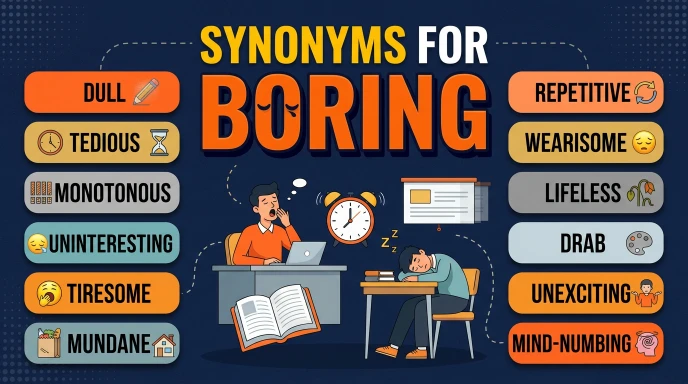
Synonyms for boring include dull, tedious, monotonous, tiresome, uninteresting, and repetitive.
These words help describe something that does not hold your attention or make you feel interested. However, each word has a slightly different meaning. For example, tedious describes something tiring because it takes too long, while monotonous describes something that stays the same.
Learning synonyms for boring can help students, English learners, bloggers, and content writers express their ideas more clearly. In this guide, you will find 25 useful alternatives with simple meanings, pronunciation, and natural examples. You will also learn how to choose the right word for different situations.
Meaning of Boring
Definition
Boring is an adjective that describes something not interesting, exciting, or enjoyable. It can describe a person, activity, book, lesson, movie, or situation that fails to hold your attention.
Examples
- The movie was boring, so we left early.
- I find long meetings boring.
Connotative Meaning
The word boring usually has a negative meaning. It suggests that something lacks excitement, variety, or interest. It can also sound critical when used to describe a person.
Etymology
The word boring comes from the verb bore, meaning to make someone feel tired or uninterested. Its modern use developed in the eighteenth century.
Pronunciation
- US IPA: /ˈbɔːr.ɪŋ/
- UK IPA: /ˈbɔː.rɪŋ/
Syllables
Bor ing — 2 syllables.
Affixation Pattern
Bore + ing
The suffix ing forms the adjective boring, describing something that causes boredom.
Related Concepts
- Bored: Feeling uninterested.
- Boredom: The state of feeling bored.
- Interesting: Something that holds attention.
- Exciting: Something that creates enthusiasm.
Complete Synonyms List
Here are 25 synonyms for boring with their meanings and formality levels.
| Synonym | Meaning | Formality Level |
| 1. Dull | Not interesting or exciting | Neutral |
| 2. Tedious | Long and tiring | Formal |
| 3. Monotonous | Repeating in the same way | Formal |
| 4. Tiresome | Making you feel tired | Neutral |
| 5. Uninteresting | Not holding attention | Neutral |
| 6. Mundane | Ordinary and lacking excitement | Formal |
| 7. Dreary | Dull and depressing | Neutral |
| 8. Wearisome | Causing tiredness or boredom | Formal |
| 9. Repetitive | Happening again and again | Neutral |
| 10. Humdrum | Ordinary and lacking variety | Informal |
| 11. Stale | No longer fresh or interesting | Neutral |
| 12. Lifeless | Lacking energy or excitement | Neutral |
| 13. Uninspiring | Failing to create interest | Neutral |
| 14. Dry | Lacking excitement or humor | Informal |
| 15. Flat | Lacking energy or emotion | Neutral |
| 16. Tedious | — | — |
| 17. Unexciting | Not creating excitement | Neutral |
| 18. Lackluster | Lacking energy or interest | Neutral |
| 19. Sleep inducing | Making someone feel sleepy | Informal |
| 20. Monotonous sounding | Having an unchanging sound | Context specific |
| 21. Routine | Following the same usual pattern | Neutral |
| 22. Predictable | Easy to guess; lacking surprise | Neutral |
| 23. Drab | Dull and uninteresting | Neutral |
| 24. Insipid | Lacking interest or excitement | Formal |
| 25. Prosaic | Ordinary and unimaginative | Formal |
Note: Some alternatives describe specific kinds of boredom. For example, predictable means lacking surprise, while drab often describes something dull in appearance or character.
Formality Comparison
Different synonyms for boring work better in different situations.
| Formality | Useful Words |
| Formal | Tedious, monotonous, mundane, wearisome, insipid, prosaic |
| Neutral | Dull, tiresome, uninteresting, dreary, repetitive, lifeless |
| Informal | Humdrum, dry, sleep inducing |
Tip: Use tedious in academic writing and dull in everyday conversations.
Detailed Synonyms for Boring
1. Dull
Part of Speech: Adjective
US IPA: /dʌl/
UK IPA: /dʌl/
Meaning: Something that lacks interest, excitement, or energy.
Formality: Neutral
- Formal: The presentation was dull and lacked useful information.
- Informal: That movie was so dull that I almost fell asleep.
2. Tedious
Part of Speech: Adjective
US IPA: /ˈtiː.di.əs/
UK IPA: /ˈtiː.di.əs/
Meaning: Something that takes a long time and makes you feel tired or bored.
Formality: Formal
- Formal: The research process was tedious but necessary.
- Informal: Filling out all these forms is tedious.
3. Monotonous
Part of Speech: Adjective
US IPA: /məˈnɑː.t̬ən.əs/
UK IPA: /məˈnɒt.ən.əs/
Meaning: Something that stays the same and becomes boring through repetition.
Formality: Formal
- Formal: Employees complained about the monotonous nature of the work.
- Informal: His voice sounds monotonous during every class.
4. Tiresome
Part of Speech: Adjective
US IPA: /ˈtaɪr.səm/
UK IPA: /ˈtaɪə.səm/
Meaning: Something that makes you feel tired or annoyed.
Formality: Neutral
- Formal: The repeated delays became tiresome for everyone.
- Informal: His constant complaints are tiresome.
5. Uninteresting
Part of Speech: Adjective
US IPA: /ʌnˈɪn.trə.stɪŋ/
UK IPA: /ʌnˈɪn.trə.stɪŋ/
Meaning: Something that does not attract attention or curiosity.
Formality: Neutral
- Formal: The report contained several uninteresting details.
- Informal: I found the show uninteresting.
6. Mundane
Part of Speech: Adjective
US IPA: /mʌnˈdeɪn/
UK IPA: /mʌnˈdeɪn/
Meaning: Ordinary and lacking excitement or variety.
Formality: Formal
- Formal: Technology can make mundane tasks easier.
- Informal: My daily routine feels mundane.
7. Dreary
Part of Speech: Adjective
US IPA: /ˈdrɪr.i/
UK IPA: /ˈdrɪə.ri/
Meaning: Dull, gloomy, and lacking enjoyment.
Formality: Neutral
- Formal: The team faced a dreary and difficult working environment.
- Informal: It was a dreary afternoon at home.
8. Wearisome
Part of Speech: Adjective
US IPA: /ˈwɪr.i.səm/
UK IPA: /ˈwɪə.rɪ.səm/
Meaning: Causing someone to feel tired or bored.
Formality: Formal
- Formal: The lengthy discussion became wearisome.
- Informal: This long journey is getting wearisome.
9. Repetitive
Part of Speech: Adjective
US IPA: /rɪˈpet̬.ə.t̬ɪv/
UK IPA: /rɪˈpet.ə.tɪv/
Meaning: Involving the same actions or information again and again.
Formality: Neutral
- Formal: The job involved repetitive administrative tasks.
- Informal: This game gets repetitive after a while.
10. Humdrum
Part of Speech: Adjective
US IPA: /ˈhʌm.drʌm/
UK IPA: /ˈhʌm.drʌm/
Meaning: Ordinary, routine, and lacking excitement.
Formality: Informal
- Formal: The novel describes the humdrum nature of everyday life.
- Informal: I want a break from my humdrum routine.
11. Stale
Part of Speech: Adjective
US IPA: /steɪl/
UK IPA: /steɪl/
Meaning: No longer fresh, new, or interesting.
Formality: Neutral
- Formal: The campaign relied on stale ideas.
- Informal: This joke is getting stale.
12. Lifeless
Part of Speech: Adjective
US IPA: /ˈlaɪf.ləs/
UK IPA: /ˈlaɪf.ləs/
Meaning: Lacking energy, activity, or excitement.
Formality: Neutral
- Formal: The performance felt lifeless and lacked emotion.
- Informal: The party was lifeless without music.
13. Uninspiring
Part of Speech: Adjective
US IPA: /ˌʌn.ɪnˈspaɪr.ɪŋ/
UK IPA: /ˌʌn.ɪnˈspaɪə.rɪŋ/
Meaning: Failing to create interest, enthusiasm, or motivation.
Formality: Neutral
- Formal: The proposal offered an uninspiring vision for the future.
- Informal: That speech was really uninspiring.
14. Dry
Part of Speech: Adjective
US IPA: /draɪ/
UK IPA: /draɪ/
Meaning: Lacking excitement, emotion, or humor.
Formality: Informal
- Formal: The lecture used a dry and technical writing style.
- Informal: His jokes are sometimes dry.
15. Flat
Part of Speech: Adjective
US IPA: /flæt/
UK IPA: /flæt/
Meaning: Lacking energy, excitement, or emotion.
Formality: Neutral
- Formal: The speaker delivered a flat presentation.
- Informal: The party felt flat without our friends.
16. Unexciting
Part of Speech: Adjective
US IPA: /ˌʌn.ɪkˈsaɪ.t̬ɪŋ/
UK IPA: /ˌʌn.ɪkˈsaɪ.tɪŋ/
Meaning: Not interesting, thrilling, or enjoyable.
Formality: Neutral
- Formal: The event was considered unexciting by many visitors.
- Informal: The match was pretty unexciting.
17. Lackluster
Part of Speech: Adjective
US IPA: /ˈlækˌlʌs.tɚ/
UK IPA: /ˈlækˌlʌs.tə/
Meaning: Lacking energy, quality, or excitement.
Formality: Neutral
- Formal: The company reported a lackluster performance.
- Informal: The show was lackluster this year.
18. Sleep inducing
Part of Speech: Adjective
US IPA: /ˈsliːp.ɪnˌduː.sɪŋ/
UK IPA: /ˈsliːp.ɪnˌdjuː.sɪŋ/
Meaning: So boring or relaxing that it makes someone feel sleepy.
Formality: Informal
- Formal: The lengthy speech had a sleep inducing effect.
- Informal: That documentary was sleep inducing.
19. Routine
Part of Speech: Adjective
US IPA: /ruːˈtiːn/
UK IPA: /ruːˈtiːn/
Meaning: Ordinary and following a regular pattern, sometimes without excitement.
Formality: Neutral
- Formal: The staff completed their routine duties.
- Informal: My weekends have become routine.
20. Predictable
Part of Speech: Adjective
US IPA: /prɪˈdɪk.tə.bəl/
UK IPA: /prɪˈdɪk.tə.bəl/
Meaning: Easy to guess because there are no surprises.
Formality: Neutral
- Formal: The story followed a predictable pattern.
- Informal: The ending was so predictable.
21. Drab
Part of Speech: Adjective
US IPA: /dræb/
UK IPA: /dræb/
Meaning: Dull, plain, and lacking color or excitement.
Formality: Neutral
- Formal: The office had a drab appearance.
- Informal: This room looks drab without decorations.
22. Insipid
Part of Speech: Adjective
US IPA: /ɪnˈsɪp.ɪd/
UK IPA: /ɪnˈsɪp.ɪd/
Meaning: Lacking interest, flavor, or character.
Formality: Formal
- Formal: Critics described the novel as insipid.
- Informal: The conversation was insipid and dull.
23. Prosaic
Part of Speech: Adjective
US IPA: /proʊˈzeɪ.ɪk/
UK IPA: /prəʊˈzeɪ.ɪk/
Meaning: Ordinary, practical, and lacking imagination.
Formality: Formal
- Formal: The writer turned a prosaic subject into an interesting story.
- Informal: His explanation sounded prosaic.
24. Unvaried
Part of Speech: Adjective
US IPA: /ʌnˈver.id/
UK IPA: /ʌnˈveə.rid/
Meaning: Not changing or offering much variety.
Formality: Formal
- Formal: The course followed an unvaried teaching method.
- Informal: The meals became unvaried after a few days.
25. Tedious looking
Part of Speech: Adjective
US IPA: /ˈtiː.di.əs ˌlʊk.ɪŋ/
UK IPA: /ˈtiː.di.əs ˌlʊk.ɪŋ/
Meaning: Appearing likely to be boring or tiring.
Formality: Informal
- Formal: The document appeared tedious looking at first glance.
- Informal: That long manual looks tedious looking.
Prototype Meaning of Boring
A prototype meaning is the central idea people usually connect with a word.
The prototype meaning of boring is something that fails to hold attention or create interest.
For example:
- A long lecture with no interaction.
- A movie with a predictable story.
- A task that repeats the same steps.
- A conversation with no interesting topics.
These situations show the basic meaning of boring.
Synonyms for Boring by Category
Different situations need different alternatives. Use these categories to choose the best word.
For a Boring Person
- Dull
- Uninteresting
- Tedious
- Humdrum
- Uninspiring
A Boring Task
- Tedious
- Repetitive
- Monotonous
- Wearisome
- Mundane
For a Boring Movie or Book
- Dull
- Unexciting
- Predictable
- Insipid
- Lackluster
Boring Day or Routine
- Humdrum
- Dreary
- Routine
- Drab
- Mundane
Boring Speech or Presentation
- Dry
- Flat
- Monotonous
- Lifeless
- Uninspiring
Antonyms of Boring
Antonyms are words with opposite meanings. Here are some useful opposites of boring.
| Antonym | Meaning |
| Interesting | Holding attention |
| Exciting | Creating enthusiasm |
| Fascinating | Extremely interesting |
| Entertaining | Providing enjoyment |
| Engaging | Keeping someone involved |
| Thrilling | Creating strong excitement |
| Captivating | Holding attention completely |
| Enjoyable | Giving pleasure |
| Stimulating | Encouraging interest or thought |
| Amusing | Making someone laugh or smile |
Quiz: Test Your Knowledge of Boring Synonyms
Choose the correct answer for each question.
1. Which word means something that repeats in the same way?
A. Exciting
B. Monotonous
C. Fascinating
D. Amusing
2. Which synonym describes something long and tiring?
A. Tedious
B. Thrilling
C. Captivating
D. Enjoyable
3. What does the word mundane mean?
A. Very exciting
B. Full of surprises
C. Ordinary and lacking excitement
D. Extremely funny
4. Which word means lacking energy or excitement?
A. Fascinating
B. Lackluster
C. Interesting
D. Stimulating
5. Which synonym describes something easy to guess?
A. Predictable
B. Thrilling
C. Entertaining
D. Inspiring
6. Which word means lacking interest or character?
A. Amusing
B. Insipid
C. Exciting
D. Engaging
Answer Key
- B. Monotonous
- A. Tedious
- C. Ordinary and lacking excitement
- B. Lackluster
- A. Predictable
- B. Insipid
Usage Tips: How to Use Synonyms for Boring
Choosing the right synonym makes your writing clearer and more natural.
- Use dull for something that does not hold attention.
- Use tedious for long and tiring activities.
- Use monotonous when the same thing happens repeatedly.
- Use mundane for ordinary daily tasks.
- Use dreary for dull or gloomy situations.
- Use predictable when something has no surprises.
- Use insipid for something that lacks interest or character.
Remember: Not every synonym for boring works in every sentence. Think about the situation before choosing a replacement.
FAQs About Synonyms for Boring
1. What are the best synonyms for boring?
Some of the best synonyms for boring are dull, tedious, monotonous, tiresome, uninteresting, and mundane. These words describe different types of boredom.
2. What is a formal word for boring?
Tedious, monotonous, wearisome, and insipid are formal alternatives. They are useful in academic and professional writing.
3. What is a simple word for boring?
Dull is one of the simplest alternatives to boring. You can use it for movies, books, lessons, and activities.
4. What is the difference between boring and tedious?
Boring means something does not hold your interest. Tedious describes something that feels long, tiring, or difficult to complete because it takes too much time.
5. What is another word for a boring person?
You can use dull, uninteresting, or tedious to describe a person. However, these words can sound rude, so use them carefully.
6. What is the opposite of boring?
The opposite of boring includes interesting, exciting, fascinating, entertaining, and engaging. These words describe things that attract attention and create enjoyment.
7. How can I avoid using boring repeatedly?
Use alternatives such as dull, tedious, mundane, monotonous, and unexciting. Choose each word based on the exact meaning you want to express.
Conclusion
Learning synonyms for boring helps you improve your English vocabulary and make your writing more interesting. Words such as dull, tedious, monotonous, mundane, and tiresome can describe different types of boring experiences.
Some words work best for daily activities, while others are more suitable for formal writing. Remember that synonyms can have slightly different meanings, so choose them carefully. Practice these words in your conversations, school assignments, emails, and articles.
The more you use them, the easier it becomes to express your ideas clearly and naturally.
Discover More Articles:

Hi, I’m Emma Collins, and I enjoy creating simple English vocabulary resources that make learning easier for everyone. I write about synonyms, antonyms, word meanings, vocabulary lists, and writing tips using clear, everyday language. My goal is to help students, writers, teachers, and English learners build their vocabulary, improve their writing, and feel more confident using English. I take time to research every article carefully so the information is accurate, practical, and easy to understand.