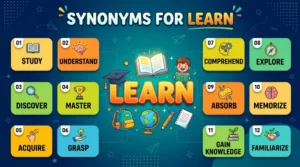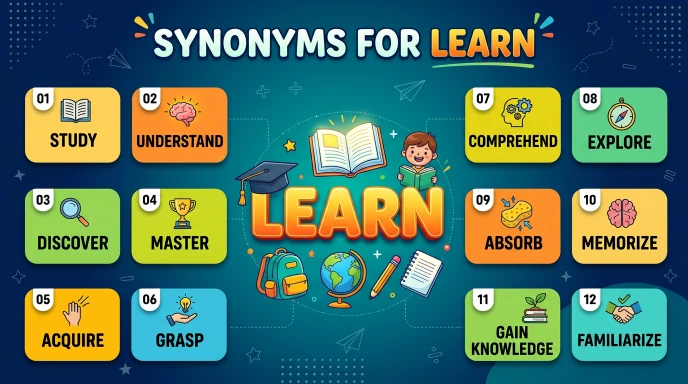
Learn means to gain knowledge, develop a skill, or understand something through study, practice, or experience. Common synonyms for learn include study, discover, understand, master, grasp, acquire, absorb, and comprehend.
Each word has a slightly different meaning. For example, study means to spend time gaining knowledge, while master means to develop a high level of ability. You can use these alternatives in school assignments, everyday conversations, professional writing, and educational content. Learning synonyms for learn will help you express ideas more clearly, avoid repetition, and build a stronger English vocabulary.
What Does Learn Mean?
Definition
Learn is a verb that means to gain knowledge, information, or a new ability through study, teaching, practice, or experience.
It can also mean becoming aware of a fact or discovering information about something.
Examples
- Students learn new words in English class.
- I want to learn how to play the guitar.
- She learned about the history of her country.
Connotative Meaning
The word learn usually has a positive meaning. It suggests personal growth, education, improvement, and the development of knowledge or abilities.
For example:
- Academic learning: Gaining knowledge through books, lessons, and education.
- Practical learning: Developing abilities through hands on activities.
- Experiential learning: Gaining knowledge from real life situations.
- Self directed learning: Studying independently without regular instruction.
Etymology
The word learn comes from Old English leornian, meaning to get knowledge, study, or be taught. It is related to the idea of gaining understanding through education and experience.
Pronunciation
- US IPA: /lɝːn/
- UK IPA: /lɜːn/
Syllables
Learn has one syllable.
Affixation Pattern
Learn is a base word. Its common forms include:
- Learner: A person who learns. The suffix er indicates a person who performs an action.
- Learning: The process of gaining knowledge. The suffix ing forms a noun or participle.
- Learned: The past tense and past participle of learn. It can also describe someone with extensive knowledge.
Related Concepts
- Education: The process of teaching and gaining knowledge.
- Knowledge: Information and understanding gained through learning.
- Practice: Repeated activity that improves an ability.
- Training: Instruction that develops specific abilities.
- Understanding: Knowledge of the meaning or nature of something.
Complete List of 25 Synonyms for Learn
Here are 25 useful alternatives for learn. Some describe gaining information, while others focus on understanding, practice, or developing a skill.
| Synonym | Meaning | Formality Level |
| 1. Study | Gain knowledge by reading or practicing | Neutral |
| 2. Discover | Find information that was previously unknown | Neutral |
| 3. Understand | Know the meaning of something | Neutral |
| 4. Master | Develop a high level of ability | Neutral |
| 5. Grasp | Understand something clearly | Neutral |
| 6. Acquire | Gain knowledge or a skill | Formal |
| 7. Absorb | Take in information and understand it | Neutral |
| 8. Comprehend | Understand something fully | Formal |
| 9. Memorize | Learn information so you can remember it | Neutral |
| 10. Familiarize | Become knowledgeable about something | Formal |
| 11. Explore | Investigate a subject to gain knowledge | Neutral |
| 12. Examine | Study something carefully | Formal |
| 13. Investigate | Find facts through careful research | Formal |
| 14. Research | Study a subject to discover information | Formal |
| 15. Practice | Improve a skill through repetition | Neutral |
| 16. Train | Develop a skill through instruction and practice | Neutral |
| 17. Understand | Develop knowledge of an idea | Neutral |
| 18. Pick up | Learn something informally or naturally | Informal |
| 19. Take in | Receive and understand information | Informal |
| 20. Retain | Keep information in your memory | Formal |
| 21. Get the hang of | Learn how to do something | Informal |
| 22. Figure out | Find the answer or understand something | Informal |
| 23. Catch on | Begin to understand something | Informal |
| 24. Become acquainted with | Gain knowledge or familiarity | Formal |
| 25. Develop | Build a skill or ability over time | Neutral |
Note: These alternatives are not interchangeable in every sentence. For example, memorize focuses on remembering information, while discover means finding something previously unknown.
Formality Comparison of Learn Synonyms
Different situations call for different alternatives to learn.
| Formality | Suitable Synonyms |
| Formal | Acquire, comprehend, investigate, familiarize, retain |
| Neutral | Study, discover, understand, master, practice |
| Informal | Pick up, take in, figure out, catch on |
| Academic | Research, examine, comprehend, study |
| Skill Development | Master, train, practice, develop |
Tip: Use acquire or comprehend in formal writing. Choose pick up or get the hang of in casual conversations.
25 Detailed Synonyms for Learn With Examples
1. Study
Part of Speech: Verb
US IPA: /ˈstʌd.i/
UK IPA: /ˈstʌd.i/
Meaning: To spend time reading, practicing, or examining something to gain knowledge.
Formality: Neutral
Formal Example: Students must study the subject carefully before taking the examination.
Informal Example: I need to study for my English test tonight.
2. Discover
Part of Speech: Verb
US IPA: /dɪˈskʌv.ɚ/
UK IPA: /dɪˈskʌv.ər/
Meaning: To find or become aware of something that was previously unknown.
Formality: Neutral
Formal Example: Researchers discovered new information about the ancient civilization.
Informal Example: I discovered a great way to remember new words.
3. Understand
Part of Speech: Verb
US IPA: /ˌʌn.dɚˈstænd/
UK IPA: /ˌʌn.dəˈstænd/
Meaning: To know the meaning, importance, or nature of something.
Formality: Neutral
Formal Example: Students should understand the main principles before applying them.
Informal Example: I finally understand how this game works.
4. Master
Part of Speech: Verb
US IPA: /ˈmæs.tɚ/
UK IPA: /ˈmɑː.stə/
Meaning: To develop a high level of knowledge or ability in a particular subject or activity.
Formality: Neutral
Formal Example: She worked hard to master the principles of computer programming.
Informal Example: It took me months to master this guitar song.
5. Grasp
Part of Speech: Verb
US IPA: /ɡræsp/
UK IPA: /ɡrɑːsp/
Meaning: To understand an idea, concept, or situation clearly.
Formality: Neutral
Formal Example: The students quickly grasped the main concepts of the lesson.
Informal Example: I couldn’t grasp the instructions at first.
6. Acquire
Part of Speech: Verb
US IPA: /əˈkwaɪr/
UK IPA: /əˈkwaɪə/
Meaning: To gain knowledge, information, or a new ability through learning or experience.
Formality: Formal
Formal Example: Children acquire language skills through interaction and practice.
Informal Example: I want to acquire some basic computer skills.
7. Absorb
Part of Speech: Verb
US IPA: /əbˈzɔːrb/
UK IPA: /əbˈzɔːb/
Meaning: To take in and understand information, knowledge, or ideas.
Formality: Neutral
Formal Example: Students need time to absorb the information presented during the lecture.
Informal Example: I like to absorb new information by watching educational videos.
8. Comprehend
Part of Speech: Verb
US IPA: /ˌkɑːm.prɪˈhend/
UK IPA: /ˌkɒm.prɪˈhend/
Meaning: To understand something fully or clearly.
Formality: Formal
Formal Example: Readers must comprehend the central argument of the article.
Informal Example: I couldn’t comprehend why he was so upset.
9. Memorize
Part of Speech: Verb
US IPA: /ˈmem.ə.raɪz/
UK IPA: /ˈmem.ə.raɪz/
Meaning: To learn information so that you can remember it accurately.
Formality: Neutral
Formal Example: Students are encouraged to memorize important formulas before the examination.
Informal Example: I need to memorize these new English words.
10. Familiarize
Part of Speech: Verb
US IPA: /fəˈmɪl.jə.raɪz/
UK IPA: /fəˈmɪl.i.ə.raɪz/
Meaning: To make yourself or someone else familiar with a subject, process, or situation.
Formality: Formal
Formal Example: Employees should familiarize themselves with the company’s safety rules.
Informal Example: I want to familiarize myself with this new application.
11. Explore
Part of Speech: Verb
US IPA: /ɪkˈsplɔːr/
UK IPA: /ɪkˈsplɔː/
Meaning: To investigate or examine a subject to discover more about it.
Formality: Neutral
Formal Example: Students explore different approaches to solving environmental problems.
Informal Example: I love to explore new topics online.
12. Examine
Part of Speech: Verb
US IPA: /ɪɡˈzæm.ɪn/
UK IPA: /ɪɡˈzæm.ɪn/
Meaning: To study or inspect something carefully to understand it.
Formality: Formal
Formal Example: Researchers examined the results to identify important patterns.
Informal Example: Let’s examine this example before moving on.
13. Investigate
Part of Speech: Verb
US IPA: /ɪnˈves.tə.ɡeɪt/
UK IPA: /ɪnˈves.tɪ.ɡeɪt/
Meaning: To find facts or information by studying a subject carefully.
Formality: Formal
Formal Example: Scientists investigate the causes of environmental changes.
Informal Example: I want to investigate why my computer keeps freezing.
14. Research
Part of Speech: Verb
US IPA: /rɪˈsɝːtʃ/
UK IPA: /rɪˈsɜːtʃ/
Meaning: To study a subject carefully to collect information and develop knowledge.
Formality: Formal
Formal Example: Students must research their chosen topics before writing their reports.
Informal Example: I need to research a few ideas before buying a laptop.
15. Practice
Part of Speech: Verb
US IPA: /ˈpræk.tɪs/
UK IPA: /ˈpræk.tɪs/
Meaning: To repeat an activity regularly to improve a skill or ability.
Formality: Neutral
Formal Example: Learners should practice speaking English to improve their fluency.
Informal Example: I practice the piano every evening.
16. Train
Part of Speech: Verb
US IPA: /treɪn/
UK IPA: /treɪn/
Meaning: To develop knowledge or abilities through instruction and repeated practice.
Formality: Neutral
Formal Example: The organization helps employees train for leadership positions.
Informal Example: I want to train myself to type faster.
17. Pick Up
Part of Speech: Phrasal Verb
US IPA: /pɪk ʌp/
UK IPA: /pɪk ʌp/
Meaning: To learn something informally, often through observation or experience.
Formality: Informal
Formal Example: New employees can pick up essential workplace practices through mentoring.
Informal Example: I picked up a few Spanish words while traveling.
18. Take In
Part of Speech: Phrasal Verb
US IPA: /teɪk ɪn/
UK IPA: /teɪk ɪn/
Meaning: To receive and understand information or ideas.
Formality: Informal
Formal Example: Students need time to take in complex information.
Informal Example: There was so much information that I couldn’t take it all in.
19. Retain
Part of Speech: Verb
US IPA: /rɪˈteɪn/
UK IPA: /rɪˈteɪn/
Meaning: To keep information in your memory after learning it.
Formality: Formal
Formal Example: Regular revision helps students retain important information.
Informal Example: I remember things better when I write them down and retain the main points.
20. Get the Hang Of
Part of Speech: Idiom
US IPA: /ɡet ðə hæŋ əv/
UK IPA: /ɡet ðə hæŋ əv/
Meaning: To gradually learn how to do something through practice.
Formality: Informal
Formal Example: With regular training, employees can get the hang of the new software.
Informal Example: I finally got the hang of riding a bicycle.
21. Figure Out
Part of Speech: Phrasal Verb
US IPA: /ˈfɪɡ.jɚ aʊt/
UK IPA: /ˈfɪɡ.ər aʊt/
Meaning: To find an answer or understand something by thinking about it.
Formality: Informal
Formal Example: The students figured out how to solve the difficult problem.
Informal Example: I can’t figure out how this machine works.
22. Catch On
Part of Speech: Phrasal Verb
US IPA: /kætʃ ɑːn/
UK IPA: /kætʃ ɒn/
Meaning: To begin to understand something after some explanation or practice.
Formality: Informal
Formal Example: Most participants caught on to the new procedure after the demonstration.
Informal Example: Don’t worry; you’ll catch on after a few lessons.
23. Become Acquainted With
Part of Speech: Phrase
US IPA: /bɪˈkʌm əˈkweɪn.tɪd wɪð/
UK IPA: /bɪˈkʌm əˈkweɪn.tɪd wɪð/
Meaning: To become familiar with a person, subject, or situation.
Formality: Formal
Formal Example: New staff members must become acquainted with the company’s policies.
Informal Example: I want to become acquainted with the local area before moving there.
24. Develop
Part of Speech: Verb
US IPA: /dɪˈvel.əp/
UK IPA: /dɪˈvel.əp/
Meaning: To gradually build or improve a skill, ability, or area of knowledge.
Formality: Neutral
Formal Example: The course helps students develop critical thinking abilities.
Informal Example: I want to develop my writing skills this year.
25. Gain
Part of Speech: Verb
US IPA: /ɡeɪn/
UK IPA: /ɡeɪn/
Meaning: To obtain knowledge, understanding, or experience through learning or practice.
Formality: Neutral
Formal Example: Students gain valuable knowledge through practical training.
Informal Example: I hope to gain more confidence when speaking English.
Synonyms for Learn by Category
Different situations require different alternatives. These categories can help you choose the most suitable word.
Synonyms for Learn Something New
- Discover: Find information that was previously unknown.
- Explore: Investigate a subject to gain knowledge.
- Acquire: Gain new information or abilities.
- Pick up: Learn something informally.
- Become acquainted with: Develop familiarity with a subject.
Synonyms for Learn a Skill
- Master: Develop a high level of ability.
- Practice: Improve through repetition.
- Train: Develop an ability through instruction.
- Develop: Build or improve a skill over time.
- Get the hang of: Learn how to perform an activity.
For Learn Quickly
- Grasp: Understand an idea clearly.
- Catch on: Begin to understand something.
- Pick up: Learn something naturally or quickly.
- Absorb: Take in information.
- Figure out: Understand something through thinking.
For Learn in Academic Writing
- Study: Gain knowledge through reading and lessons.
- Comprehend: Understand information fully.
- Research: Investigate a subject carefully.
- Examine: Study something in detail.
- Acquire: Gain knowledge or abilities.
Synonyms for Learn Through Experience
- Discover: Find something through experience.
- Understand: Develop knowledge of a situation.
- Gain: Obtain knowledge or experience.
- Pick up: Learn informally through observation.
- Master: Develop strong ability through practice.
Antonyms of Learn
Antonyms are words with opposite meanings. The opposite of learn depends on the intended context.
| Antonym | Meaning |
| Forget | Fail to remember information |
| Ignore | Pay no attention to something |
| Overlook | Fail to notice or consider something |
| Misunderstand | Understand something incorrectly |
| Unlearn | Remove or change previously learned knowledge or habits |
| Neglect | Fail to give attention to something |
| Disregard | Ignore or pay little attention to something |
| Remain ignorant | Continue without knowledge of something |
Example: Students should learn from their mistakes instead of ignoring the lessons they provide.
Quiz: Test Your Knowledge of Learn Synonyms
Choose the best answer for each question.
1. Which word means to gain knowledge through reading and studying?
A. Study
B. Forget
C. Ignore
D. Overlook
2. Which synonym means to develop a high level of ability?
A. Discover
B. Master
C. Neglect
D. Examine
3. Which word means to understand something clearly?
A. Grasp
B. Forget
C. Disregard
D. Ignore
4. Which phrasal verb means to learn something informally?
A. Give up
B. Pick up
C. Turn down
D. Look after
5. Which word means to keep information in your memory?
A. Explore
B. Retain
C. Investigate
D. Develop
6. Which word describes learning through repeated activity?
A. Practice
B. Ignore
C. Overlook
D. Misunderstand
Quiz Answers
- A. Study
- B. Master
- A. Grasp
- B. Pick up
- B. Retain
- A. Practice
Usage Tips: How to Choose the Right Synonym for Learn
Not every synonym for learn works in the same situation. Follow these tips to choose the correct alternative.
- Use study when someone gains knowledge through books, lessons, or research.
- Choose discover when someone finds information that was previously unknown.
- Use master when someone develops a high level of ability.
- Choose grasp when someone understands an idea or concept clearly.
- Use acquire in formal writing when discussing gained knowledge or abilities.
- Choose memorize when someone learns information to remember it.
- Use pick up when someone learns something naturally or informally.
- Choose practice when someone improves an ability through repetition.
- Use retain when discussing the ability to remember learned information.
- Choose develop when someone gradually improves a skill over time.
Remember: Learning can involve gaining information, understanding an idea, or developing an ability. Choose a synonym that matches the exact meaning of your sentence.
Frequently Asked Questions About Learn Synonyms
1. What are the most common synonyms for learn?
Common synonyms for learn include study, discover, understand, master, grasp, acquire, absorb, and comprehend. Each word describes a different part of the learning process.
2. What is another word for learn in academic writing?
Useful academic alternatives include study, acquire, comprehend, investigate, research, and examine. Choose the word that best describes the learning activity.
3. What is a synonym for learn quickly?
Words and phrases such as grasp, catch on, pick up, and absorb can describe learning quickly. Their suitability depends on the sentence.
4. What is the difference between learn and study?
Learn means to gain knowledge or develop an ability. Study means to spend time reading, practicing, or examining something to gain that knowledge.
5. What is a formal synonym for learn?
Acquire and comprehend are useful formal alternatives. Investigate and research also work when learning involves carefully examining a subject.
6. What is the opposite of learn?
Common opposites include forget, ignore, disregard, and misunderstand. The best choice depends on the intended meaning.
7. How can I use learn synonyms in a sentence?
Choose an alternative that matches your meaning. For example, you can say, “I want to master English grammar” or “Students acquire knowledge through practice.”
Conclusion
Learning synonyms for learn can make your English vocabulary stronger and your writing more natural. Words such as study, discover, understand, master, acquire, and comprehend help describe different ways of gaining knowledge. Some alternatives focus on education, while others describe understanding, memorizing, or developing practical abilities.
For example, use study when talking about schoolwork and master when describing a high level of skill. Always consider the context before replacing one word with another. With regular practice, these 25 synonyms for learn can help you write clearer sentences, communicate confidently, and express your ideas in more interesting ways.
Discover More Articles:

Hi, I’m Emma Wilson, an English vocabulary writer helping learners improve their word skills with synonyms, meanings, examples, and quizzes. I create simple resources to make English learning easier.