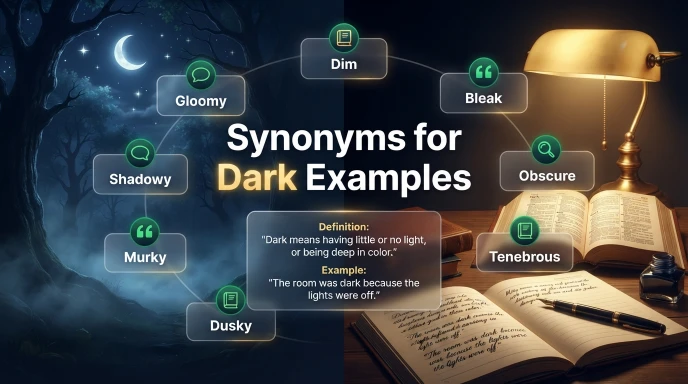
Synonyms for dark are words with similar meanings. “Dark” means having little or no light. It can also refer to a deep color or a gloomy feeling.
Have you ever written the word dark many times in the same paragraph? It can make your writing sound dull. Imagine you are describing a quiet forest at night. Instead of saying, “The forest was dark,” you can say, “The forest was dim” or “The forest was gloomy.” These small changes make your writing more interesting.
Learning synonyms for dark helps many people. Students, bloggers, content writers, and everyday English users can find the right word. They can choose the best word for any situation. It also improves speaking, storytelling, and creative writing. In this guide, you’ll find easy synonyms for dark. Each synonym has a simple meaning. You’ll also see real-life examples for everyday use.
A List of 50 Synonym Words
1. Dim (Adjective)
Pronunciation: UK: /dɪm/ | US: /dɪm/
Meaning: Having only a small amount of light.
Examples:
- The room looked dim after sunset.
- We read under a dim lamp.
2. Gloomy (Adjective)
Pronunciation: UK: /ˈɡluː.mi/ | US: /ˈɡluː.mi/
Meaning: Dark and making people feel sad.
Examples:
- The sky looked gloomy today.
- The old house felt gloomy.
3. Shadowy (Adjective)
Pronunciation: UK: /ˈʃæd.əʊ.i/ | US: /ˈʃæd.oʊ.i/
Meaning: Full of shadows with very little light.
Examples:
- We walked along a shadowy path.
- The garden became shadowy at sunset.
4. Murky (Adjective)
Pronunciation: UK: /ˈmɜː.ki/ | US: /ˈmɝː.ki/
Meaning: Dark and hard to see through.
Examples:
- The river looked murky after the rain.
- We could not see the fish in the murky water.
5. Dusky (Adjective)
Pronunciation: UK: /ˈdʌs.ki/ | US: /ˈdʌs.ki/
The light faded as evening approached.
Examples:
- The sky turned dusky before night.
- We started our walk in the dusky light.
6. Shady (Adjective)
Pronunciation: UK: /ˈʃeɪ.di/ | US: /ˈʃeɪ.di/
Meaning: Protected from direct sunlight.
Examples:
- We sat under a shady tree.
- This park has many shady spots.
7. Black (Adjective)
Pronunciation: UK: /blæk/ | US: /blæk/
Meaning: Having the darkest color.
Examples:
- She wore a black sweater.
- The puppy has black fur.
8. Obscure (Adjective)
Pronunciation: UK: /əbˈskjʊə/ | US: /əbˈskjʊr/
Meaning: Not easy to see or understand.
Examples:
- The sign was obscure in the fog.
- His face stayed obscure in the photo.
9. Opaque (Adjective)
Pronunciation: UK: /əʊˈpeɪk/ | US: /oʊˈpeɪk/
Meaning: Not allowing light to pass through.
Examples:
- Someone makes the bottle of opaque glass.
- We could not see through the opaque door.
10. Cloudy (Adjective)
Pronunciation: UK: /ˈklaʊ.di/ | US: /ˈklaʊ.di/
Meaning: Covered with many clouds.
Examples:
- It was cloudy all afternoon.
- We stayed inside on the cloudy day.
11. Overcast (Adjective)
Pronunciation: UK: /ˌəʊ.vəˈkɑːst/ | US: /ˌoʊ.vɚˈkæst/
Meaning: Completely covered with clouds.
Examples:
- The sky was overcast this morning.
- We expected rain because it was overcast.
12. Dull (Adjective)
Pronunciation: UK: /dʌl/ | US: /dʌl/
Meaning: Not bright or shiny.
Examples:
- The light looked dull today.
- The old paint became dull.
13. Somber (Adjective)
Pronunciation: UK: /ˈsɒm.bə/ | US: /ˈsɑːm.bɚ/
Meaning: Dark, serious, or sad.
Examples:
- He wore somber clothes.
- The room had a somber mood.
14. Bleak (Adjective)
Pronunciation: UK: /bliːk/ | US: /bliːk/
Meaning: Cold, empty, and dark.
Examples:
- The road looked bleak in winter.
- The empty field seemed bleak.
15. Mysterious (Adjective)
Pronunciation: UK: /mɪˈstɪə.ri.əs/ | US: /mɪˈstɪr.i.əs/
Meaning: Hard to understand because it seems secret.
Examples:
- We heard a mysterious noise.
- The cave looked mysterious.
16. Dreary (Adjective)
Pronunciation: UK: /ˈdrɪə.ri/ | US: /ˈdrɪr.i/
Meaning: Dark, dull, and sad.
Examples:
- It was a dreary afternoon.
- The street looked dreary after the storm.
17. Tenebrous (Adjective)
Pronunciation: UK: /ˈten.ə.brəs/ | US: /ˈten.ə.brəs/
Meaning: Very dark or full of darkness.
Examples:
- The tunnel looked tenebrous.
- We walked through a tenebrous forest.
18. Darkened (Adjective)
Pronunciation: UK: /ˈdɑː.kənd/ | US: /ˈdɑːr.kənd/
Meaning: Made darker than before.
Examples:
- The room darkened after sunset.
- Clouds darkened the sky.
19. Lightless (Adjective)
Pronunciation: UK: /ˈlaɪt.ləs/ | US: /ˈlaɪt.ləs/
Meaning: Having no light.
Examples:
- We entered a lightless cave.
- The hallway was lightless.
20. Unlit (Adjective)
Pronunciation: UK: /ʌnˈlɪt/ | US: /ʌnˈlɪt/
Meaning: Without lights turned on.
Examples:
- The street was unlit.
- We walked along an unlit road.
21. Pitch-black (Adjective)
Pronunciation: UK: /ˌpɪtʃ ˈblæk/ | US: /ˌpɪtʃ ˈblæk/
Meaning: Completely dark.
Examples:
- The room became pitch-black.
- It was pitch-black outside.
22. Inky (Adjective)
Pronunciation: UK: /ˈɪŋ.ki/ | US: /ˈɪŋ.ki/
Meaning: Very dark like black ink.
Examples:
- The night sky looked inky.
- He painted the wall in an inky color.
23. Sable (Adjective)
Pronunciation: UK: /ˈseɪ.bəl/ | US: /ˈseɪ.bəl/
Meaning: Deep black in color.
Examples:
- The horse had sable fur.
- She wore a sable coat.
24. Ebony (Adjective)
Pronunciation: UK: /ˈeb.ən.i/ | US: /ˈeb.ən.i/
Meaning: Very dark black.
Examples:
- The table had an ebony finish.
- His hair was ebony black.
25. Coal-black (Adjective)
Pronunciation: UK: /ˌkəʊl ˈblæk/ | US: /ˌkoʊl ˈblæk/
Meaning: As black as coal.
Examples:
- The smoke turned coal-black.
- The kitten had coal-black fur.
26. Jet-black (Adjective)
Pronunciation: UK: /ˌdʒet ˈblæk/ | US: /ˌdʒet ˈblæk/
Meaning: Very shiny black.
Examples:
- She has jet-black hair.
- The car was jet-black.
27. Midnight (Adjective)
Pronunciation: UK: /ˈmɪd.naɪt/ | US: /ˈmɪd.naɪt/
Meaning: Very dark like the middle of the night.
Examples:
- The sea looked midnight blue.
- He wore a midnight jacket.
28. Gray (Adjective)
Pronunciation: UK: /ɡreɪ/ | US: /ɡreɪ/
Meaning: Dark and cloudy in appearance.
Examples:
- Gray clouds covered the sky.
- The morning looked gray.
29. Smoky (Adjective)
Pronunciation: UK: /ˈsməʊ.ki/ | US: /ˈsmoʊ.ki/
Meaning: Dark because of smoke.
Examples:
- The kitchen looked smoky.
- A smoky smell filled the room.
30. Foggy (Adjective)
Pronunciation: UK: /ˈfɒɡ.i/ | US: /ˈfɑː.ɡi/
Meaning: Covered with thick fog.
Examples:
- It was a foggy morning.
- We drove carefully in the foggy weather.
31. Hazy (Adjective)
Pronunciation: UK: /ˈheɪ.zi/ | US: /ˈheɪ.zi/
Meaning: Not clear because of light mist.
Examples:
- The hills looked hazy.
- The view became hazy.
32. Twilight (Adjective)
Pronunciation: UK: /ˈtwaɪ.laɪt/ | US: /ˈtwaɪ.laɪt/
Meaning: Having the soft light before night.
Examples:
- We walked in the twilight sky.
- Birds flew home during twilight.
33. Faded (Adjective)
Pronunciation: UK: /ˈfeɪ.dɪd/ | US: /ˈfeɪ.dɪd/
Meaning: Less bright than before.
Examples:
- The old photo looked faded.
- The shirt became faded after many washes.
34. Shadowed (Adjective)
Pronunciation: UK: /ˈʃæd.əʊd/ | US: /ˈʃæd.oʊd/
Meaning: Covered by shadows.
Examples:
- The doorway stayed shadowed.
- Tall trees kept the path shadowed.
35. Cimmerian (Adjective)
Pronunciation: UK: /sɪˈmɪə.ri.ən/ | US: /sɪˈmɪr.i.ən/
Meaning: Extremely dark or gloomy.
Examples:
- The cave was Cimmerian inside.
- We could not see in the Cimmerian forest.
36. Caliginous (Adjective)
Pronunciation: UK: /kəˈlɪdʒ.ɪ.nəs/ | US: /kəˈlɪdʒ.ə.nəs/
Meaning: Very dark or full of mist.
Examples:
- The valley looked caliginous.
- A caliginous sky covered the town.
37. Funereal (Adjective)
Pronunciation: UK: /fjuːˈnɪə.ri.əl/ | US: /fjuːˈner.i.əl/
Meaning: Very dark, sad, or gloomy.
Examples:
- The room had a funereal mood.
- He wore funereal clothes.
38. Murk (Noun)
Pronunciation: UK: /mɜːk/ | US: /mɝːk/
Meaning: Deep darkness or heavy mist.
Examples:
- The ship disappeared into the murk.
- We walked through the murk.
39. Shade-filled (Adjective)
Pronunciation: UK: /ʃeɪd fɪld/ | US: /ʃeɪd fɪld/
Meaning: Full of shade with little sunlight.
Examples:
- We rested in a shade-filled garden.
- The trail stayed shade-filled all day.
40. Sunless (Adjective)
Pronunciation: UK: /ˈsʌn.ləs/ | US: /ˈsʌn.ləs/
Meaning: Without sunlight.
Examples:
- It was a sunless winter day.
- The valley remained sunless.
41. Night-black (Adjective)
Pronunciation: UK: /naɪt blæk/ | US: /naɪt blæk/
Meaning: As dark as the night.
Examples:
- The horse had night-black hair.
- The clouds turned night-black.
42. Gloaming (Noun)
Pronunciation: UK: /ˈɡləʊ.mɪŋ/ | US: /ˈɡloʊ.mɪŋ/
Meaning: The time when daylight is fading.
Examples:
- Birds sang during the gloaming.
- We reached home in the gloaming.
43. Blackish (Adjective)
Pronunciation: UK: /ˈblæk.ɪʃ/ | US: /ˈblæk.ɪʃ/
Meaning: Somewhat black in color.
Examples:
- The water looked blackish.
- The clouds became blackish.
44. Pitch-dark (Adjective)
Pronunciation: UK: /ˌpɪtʃ ˈdɑːk/ | US: /ˌpɪtʃ ˈdɑːrk/
Meaning: Completely without light.
Examples:
- The basement was pitch-dark.
- We waited in the pitch-dark room.
45. Grim (Adjective)
Pronunciation: UK: /ɡrɪm/ | US: /ɡrɪm/
Meaning: Dark and depressing.
Examples:
- The castle looked grim.
- The weather stayed grim.
46. Cheerless (Adjective)
Pronunciation: UK: /ˈtʃɪə.ləs/ | US: /ˈtʃɪr.ləs/
Meaning: Without brightness or happiness.
Examples:
- The hall felt cheerless.
- Rain made the day cheerless.
47. Lightproof (Adjective)
Pronunciation: UK: /ˈlaɪt.pruːf/ | US: /ˈlaɪt.pruːf/
Meaning: Not allowing light to enter.
Examples:
- The curtains were lightproof.
- We bought a lightproof bag.
48. Sooty (Adjective)
Pronunciation: UK: /ˈsʊt.i/ | US: /ˈsʊt.i/
Meaning: Covered with black soot.
Examples:
- The chimney looked sooty.
- His hands became sooty.
49. Low-lit (Adjective)
Pronunciation: UK: /ˌləʊ ˈlɪt/ | US: /ˌloʊ ˈlɪt/
Meaning: Having only a little light.
Examples:
- The restaurant was low-lit.
- We enjoyed the low-lit room.
50. Unilluminated (Adjective)
Pronunciation: UK: /ˌʌn.ɪˈluː.mɪ.neɪ.tɪd/ | US: /ˌʌn.ɪˈluː.mə.neɪ.t̬ɪd/
Meaning: Without any light.
Examples:
- The hallway remained unilluminated.
- We crossed an unilluminated bridge.
Conclusion
Learning synonyms for dark helps you use better words. This can improve your writing and speech. These words make essays, blog posts, emails, and daily conversations more interesting. They also help you describe places, colors, feelings, and stories more clearly.
Practice using one or two new words each day. The more you use them, the stronger and more natural your English vocabulary will become.
Read More:

Hi, I’m Emma Wilson, an English vocabulary writer helping learners improve their word skills with synonyms, meanings, examples, and quizzes. I create simple resources to make English learning easier.