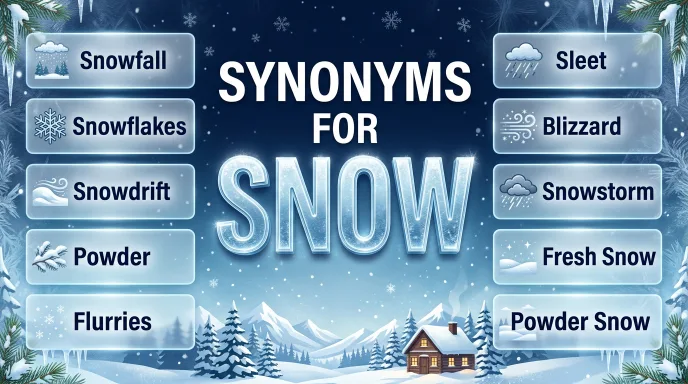
Synonyms for snow include snowfall, snowflakes, powder, flurries, and snow cover, depending on the context. Snow is frozen water that falls from clouds as tiny ice crystals. It can cover roads, trees, mountains, and gardens with a white blanket.
For example, you might describe a snowy morning as beautiful, peaceful, or magical. Learning synonyms for snow helps you describe winter weather, snowy landscapes, and cold conditions in more interesting ways. Students can use these words in essays and school assignments. Bloggers and content writers can make their descriptions more vivid.
English learners can also use these terms in everyday conversations. In this guide, you will find 50 synonyms and related words for snow, with simple meanings and examples.
List of Synonyms for Snow
1. Snowfall
Meaning: The falling of snow from the sky.
Examples:
- The snowfall covered the streets overnight.
- Heavy snowfall delayed our trip.
2. Snowflakes
Meaning: Tiny ice crystals that fall from clouds as snow.
Examples:
- Snowflakes landed on her coat.
- The children watched the snowflakes fall.
3. Flurries
Meaning: Short periods of light snowfall.
Examples:
- Light flurries began in the afternoon.
- Snow flurries covered the garden.
4. Powder Snow
Meaning: Light, dry, loose snow that is easy to move through.
Examples:
- Skiers enjoyed the fresh powder snow.
- The mountain was covered in powder snow.
5. Snow Cover
Meaning: A layer of snow covering the ground.
Examples:
- Snow cover remained on the hills.
- The thick snow cover protected the ground.
6. Snowpack
Meaning: A layer of snow that builds up on the ground over time.
Examples:
- The snowpack grew thicker during winter.
- Warm weather caused the snowpack to melt.
7. Fresh Snow
Meaning: Snow that has recently fallen and has not been disturbed.
Examples:
- Fresh snow covered the path.
- We walked through the fresh snow.
8. White Blanket
Meaning: A layer of snow covering the ground like a blanket.
Examples:
- A white blanket covered the village.
- The fields looked peaceful under a white blanket.
9. Snowdrift
Meaning: A pile of snow formed by the wind.
Examples:
- A snowdrift blocked the driveway.
- The car stopped beside a large snowdrift.
10. Snowbank
Meaning: A large pile of snow, often beside a road or path.
Examples:
- The children played beside the snowbank.
- A tall snowbank lined the road.
11. Sleet
Meaning: Frozen or partly frozen precipitation that falls as small ice pellets or a rain and snow mixture, depending on the region.
Examples:
- Sleet made the road slippery.
- The forecast warned of snow and sleet.
12. Hail
Meaning: Balls or lumps of ice that fall from storm clouds.
Examples:
- Hail damaged the garden plants.
- The storm brought hail and strong winds.
13. Ice Crystals
Meaning: Tiny pieces of ice that form in cold conditions.
Examples:
- Ice crystals sparkled in the sunlight.
- The snow contained delicate ice crystals.
14. Frost
Meaning: A thin layer of ice crystals that forms on cold surfaces.
Examples:
- Frost covered the grass in the morning.
- The windows were covered with frost.
15. Rime
Meaning: A white coating of ice that forms when supercooled water droplets freeze on a cold surface.
Examples:
- Rime covered the branches near the mountain.
- The fence was coated with white rime.
16. Hoarfrost
Meaning: A white, feathery deposit of ice crystals that forms on cold surfaces.
Examples:
- Hoarfrost decorated the trees.
- The field glistened with hoarfrost.
17. Snowstorm
Meaning: A storm that brings falling snow and often strong winds.
Examples:
- The snowstorm closed the airport.
- We stayed indoors during the snowstorm.
18. Blizzard
Meaning: A severe snowstorm with strong winds and very poor visibility.
Examples:
- The blizzard trapped travelers indoors.
- Schools closed because of the blizzard.
19. Whiteout
Meaning: A condition in which falling or blowing snow makes it difficult to see.
Examples:
- The driver slowed down during the whiteout.
- A sudden whiteout made the road hard to see.
20. Snow Squall
Meaning: A brief but intense period of snowfall, often accompanied by strong winds.
Examples:
- A snow squall crossed the highway.
- The snow squall reduced visibility quickly.
21. Powder
Meaning: Fine, loose snow with a soft texture.
Examples:
- The skier moved easily through the powder.
- Fresh powder covered the mountain slope.
22. Slush
Meaning: Partly melted snow mixed with water.
Examples:
- Slush covered the sidewalk.
- Her boots became wet from the slush.
23. Snow Pellet
Meaning: A small, soft ice particle that forms when snow crystals collect supercooled water droplets.
Examples:
- A snow pellet landed on his glove.
- Snow pellets covered the cold ground.
24. Graupel
Meaning: Small, soft pellets of ice formed when supercooled water freezes onto snow crystals.
Examples:
- Graupel fell during the winter shower.
- The weather report mentioned possible graupel.
25. Snow Crust
Meaning: A hard or firm layer that forms on the surface of snow.
Examples:
- The snow crust cracked beneath his boots.
- Warm days created a hard snow crust.
26. Snowfield
Meaning: A large area of land covered with snow.
Examples:
- The hikers crossed a wide snowfield.
- The snowfield stretched across the mountain.
27. Snow Layer
Meaning: A layer of snow resting on a surface or another layer.
Examples:
- A thick snow layer covered the roof.
- The snow layer melted in the afternoon.
28. Snow Blanket
Meaning: A covering of snow spread across the ground.
Examples:
- A snow blanket covered the garden.
- The village looked lovely beneath its snow blanket.
29. Snow Covering
Meaning: Snow spread over the surface of an object or area.
Examples:
- The snow covering hid the garden path.
- A thin snow covering rested on the roof.
30. Snow Deposit
Meaning: Snow that has collected on a surface or in a particular place.
Examples:
- A snow deposit formed near the doorway.
- The wind moved the snow deposit across the field.
31. Winter Precipitation
Meaning: Water that falls from the atmosphere during cold weather, including snow.
Examples:
- Winter precipitation increased in the mountains.
- The region receives heavy winter precipitation.
32. Frozen Precipitation
Meaning: Water that falls from clouds in frozen form.
Examples:
- Frozen precipitation covered the road.
- The forecast predicted frozen precipitation overnight.
33. Icefall
Meaning: A fall or descent of ice from a high place; in some contexts, it can describe falling ice rather than snow.
Examples:
- The climbers avoided the dangerous icefall.
- The glacier’s icefall looked impressive.
34. Snow Shower
Meaning: A short period of snowfall that may begin and end quickly.
Examples:
- A snow shower passed through the town.
- We saw a brief snow shower after lunch.
35. Snow Burst
Meaning: A sudden, brief period of heavy snowfall.
Examples:
- A snow burst covered the road in minutes.
- The snow burst ended as quickly as it began.
36. Snowfall Event
Meaning: A period during which snow falls in a particular area.
Examples:
- The snowfall event lasted several hours.
- Officials prepared for the next snowfall event.
37. Winter Flakes
Meaning: Snowflakes falling during the winter season.
Examples:
- Winter flakes drifted past the window.
- The children caught winter flakes on their gloves.
38. Ice Pellets
Meaning: Small pieces of ice that fall from the sky.
Examples:
- Ice pellets bounced off the pavement.
- The storm brought ice pellets in the evening.
39. Frozen Flakes
Meaning: Frozen particles or flakes of precipitation.
Examples:
- Frozen flakes settled on the fence.
- The wind carried frozen flakes across the field.
40. Snow Dust
Meaning: A very light layer of snow or fine snow particles.
Examples:
- A dusting of snow dust covered the steps.
- The wind blew snow dust across the path.
41. Dusting of Snow
Meaning: A very thin covering of snow on a surface.
Examples:
- A dusting of snow covered the lawn.
- The hills received a light dusting of snow.
42. Snowfall Accumulation
Meaning: The amount of snow that collects on the ground over a period.
Examples:
- Snowfall accumulation reached several inches.
- The weather service measured snowfall accumulation.
43. Snow Clumps
Meaning: Groups of snow stuck together in small or large lumps.
Examples:
- Snow clumps fell from the tree branches.
- The children threw soft snow clumps.
44. Snow Mound
Meaning: A raised pile or heap of snow.
Examples:
- A snow mound stood beside the garage.
- The children built a fort around the snow mound.
45. Snow Heap
Meaning: A pile of snow gathered in one place.
Examples:
- A snow heap blocked the garden gate.
- The workers cleared the snow heap from the entrance.
46. Snowdrifting
Meaning: The movement or accumulation of snow caused by the wind.
Examples:
- Snowdrifting made the road difficult to use.
- The forecast warned of snowdrifting overnight.
47. Snowfall Flakes
Meaning: Snowflakes that fall from the sky during snowfall.
Examples:
- Snowfall flakes landed on the car window.
- The snowfall flakes sparkled under the streetlights.
48. Snowy Cover
Meaning: A surface layer of snow covering land or an object.
Examples:
- A snowy cover hid the garden beds.
- The mountain had a thick snowy cover.
49. Snow Blanket Layer
Meaning: A layer of snow spread across the ground.
Examples:
- The snow blanket layer protected the plants from the cold.
- A fresh snow blanket layer covered the field.
50. White Precipitation
Meaning: A descriptive expression for snow falling from the sky.
Examples:
- White precipitation began before sunrise.
- The forecast predicted white precipitation in the hills.
Conclusion
Learning synonyms and related words for snow can make your writing more vivid and descriptive. Words such as snowfall, flurries, powder snow, snowdrift, blizzard, frost, and slush help describe different winter conditions. Students can use them in essays, while bloggers and content writers can use them to create engaging descriptions of winter scenes.
Remember that some terms describe snow itself, while others refer to ice, storms, or snow covered surfaces. Choose the word that best matches your meaning, and practice using it in your own sentences.
Exercise
Fill in the Blanks
- A severe snowstorm with strong winds is called a ________.
- A thin layer of ice crystals on grass is called ________.
- Partly melted snow mixed with water is called ________.
- A pile of snow formed by wind is called a ________.
- A short period of light snowfall is called a ________.
Answers:
- blizzard
- frost
- slush
- snowdrift
- flurry
Multiple Choice Questions
1. Which word describes a severe snowstorm with strong winds?
A. Frost
B. Blizzard
C. Slush
D. Rime
Answer: B. Blizzard
2. What is a snowdrift?
A. A pile of snow formed by wind
B. A type of summer rain
C. A frozen lake
D. A thin layer of frost
Answer: A. A pile of snow formed by wind
3. Which term describes partly melted snow mixed with water?
A. Powder snow
B. Hoarfrost
C. Slush
D. Snowpack
Answer: C. Slush
4. What is a brief period of light snowfall called?
A. Flurry
B. Icefall
C. Snow crust
D. Snowfield
Answer: A. Flurry
5. Which term describes a condition in which snow makes it difficult to see?
A. Snowbank
B. Whiteout
C. Snow layer
D. Snow mound
Answer: B. Whiteout
FAQs
1. What are the most common synonyms for snow?
Common alternatives and related terms include snowfall, snowflakes, flurries, powder snow, and snow cover. The best choice depends on the sentence.
2. What is another word for fresh snow?
You can use powder snow when the snow is light and loose, or a dusting of snow when only a thin layer has fallen.
3. What is a synonym for heavy snow?
Depending on the context, you can use heavy snowfall or snowstorm. A blizzard refers to a severe snowstorm with strong winds and very poor visibility.
4. What is the difference between snow and sleet?
Snow forms as ice crystals that join into snowflakes. Sleet commonly refers to small ice pellets that form when falling snow melts and then refreezes before reaching the ground.
5. How can I describe snow in creative writing?
Use descriptive terms such as powder snow, snowflakes, white blanket, snowdrift, and snowfield. Add sensory details about the snow’s color, texture, movement, and effect on the landscape.
Discover More Articles:

Hi, I’m Emma Collins, and I enjoy creating simple English vocabulary resources that make learning easier for everyone. I write about synonyms, antonyms, word meanings, vocabulary lists, and writing tips using clear, everyday language. My goal is to help students, writers, teachers, and English learners build their vocabulary, improve their writing, and feel more confident using English. I take time to research every article carefully so the information is accurate, practical, and easy to understand.