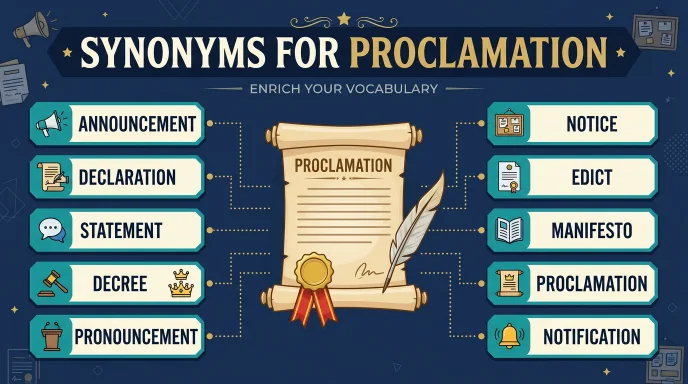
Synonyms for proclamation include announcement, declaration, pronouncement, statement, notice, edict, decree, and official announcement, depending on the context.
A proclamation is a public or official statement that makes information, a decision, or an important message known. Governments, leaders, organizations, and public figures often issue proclamations to share important news or recognize special events.
However, not every announcement is a proclamation. Some words suggest legal authority, while others simply describe information shared with the public.
Learning synonyms for proclamation helps students, writers, bloggers, and English learners choose words that fit the situation. In this guide, you will explore 25 useful alternatives, their meanings, pronunciation, examples, formality levels, related terms, antonyms, and practical usage tips.
Common synonyms for proclamation include announcement, declaration, pronouncement, statement, notice, edict, decree, and formal announcement. The best synonym depends on the context. For example, decree often suggests an authoritative order, while announcement usually means information shared with a group or the public.
What Does Proclamation Mean?
A proclamation is a public or official statement that announces something important. It may communicate a decision, recognize an event, or formally declare a particular position.
Definition
A proclamation is a formal or public announcement made by a person or authority.
Examples
- The mayor issued a proclamation for the town’s anniversary.
- The government made a proclamation about the national holiday.
Connotative Meaning
The word proclamation often sounds formal, official, and important. It may suggest authority, public recognition, or a message intended for a wide audience.
Etymology
Proclamation comes through Old French from Latin proclamatio, related to proclamare, meaning to cry out or announce publicly.
Pronunciation
- US: /ˌprɑːkləˈmeɪʃən/
- UK: /ˌprɒkləˈmeɪʃən/
Syllables
Proclamation has four syllables:
proc-la-ma-tion
Affixation Pattern
Common forms and related words include:
- Proclaim: to announce publicly or formally.
- Proclaimed: announced in the past.
- Proclaiming: announcing something.
- Proclamation: a formal or public announcement.
Related Concepts
- Announcement
- Declaration
- Official statement
- Public notice
- Decree
- Edict
- Public address
- Formal announcement
Complete Synonyms for Proclamation
The best synonym depends on the purpose and authority behind the message. Some words describe general announcements, while others suggest a formal decision or an authoritative order.
| Synonym | Simple Meaning | Formality Level |
| Announcement | Information made known to people | Neutral |
| Declaration | A clear and formal statement | Formal |
| Pronouncement | An official or authoritative statement | Formal |
| Statement | Something said or written clearly | Neutral |
| Notice | Information given to inform people | Neutral |
| Decree | An official order issued by an authority | Formal |
| Edict | An official order or command | Formal |
| Manifesto | A public statement of beliefs or aims | Formal |
| Proclamation of intent | A formal statement of plans or purpose | Formal |
| Official announcement | Information formally shared by an authority | Formal |
| Public declaration | A statement made openly for people to hear | Formal |
| Address | A formal speech to an audience | Formal |
| Message | Information communicated to others | Neutral |
| Bulletin | A short official announcement or report | Formal |
| Communiqué | An official statement issued to the public or media | Formal |
| Notification | Information sent to make someone aware of something | Formal |
| Declaration of policy | A formal statement explaining a policy | Formal |
| Resolution | A formal decision or statement of intent | Formal |
| Edict of authority | An order issued by someone with authority | Formal |
| Decree of law | An authoritative order with legal effect in some systems | Formal |
| Statement of intent | A statement explaining a planned action | Formal |
| Public notice | Information displayed or shared for public awareness | Neutral |
| Formal statement | A carefully prepared official statement | Formal |
| Pronouncement of policy | An authoritative statement about a policy | Formal |
| Announcement of decision | Information explaining a decision | Neutral |
Note: These alternatives are related in meaning, but they are not interchangeable in every sentence. A decree or edict carries a stronger sense of authority than a general announcement.
Formality Comparison of Proclamation Synonyms
Formal
Use these terms in legal, government, historical, or official contexts:
- Declaration
- Pronouncement
- Decree
- Edict
- Manifesto
- Communiqué
- Resolution
- Official announcement
- Formal statement
Neutral
These words work in everyday writing and communication:
- Announcement
- Statement
- Notice
- Message
- Bulletin
- Notification
- Public notice
- Address
Informal
Proclamation itself is more formal than everyday speech. In casual conversation, simpler words are often more natural:
- Announcement
- Message
- Statement
- News
Detailed Synonyms for Proclamation
1. Announcement
Part of Speech: Noun
US/UK IPA: /əˈnaʊnsmənt/
Meaning: Information made known to a person or group.
Formality: Neutral
Formal example:
The mayor made an announcement about the new public library.
Informal example:
I have an announcement to share with everyone.
2. Declaration
Part of Speech: Noun
US/UK IPA: /ˌdekləˈreɪʃən/
Meaning: A clear or formal statement about something.
Formality: Formal
Formal example:
The government issued a declaration of emergency.
Informal example:
She made a declaration about her future plans.
3. Pronouncement
Part of Speech: Noun
US/UK IPA: /prəˈnaʊnsmənt/
Meaning: An official or authoritative statement.
Formality: Formal
Formal example:
The judge delivered a pronouncement on the case.
Informal example:
His pronouncement surprised everyone in the room.
4. Statement
Part of Speech: Noun
US/UK IPA: /ˈsteɪtmənt/
Meaning: Something expressed clearly in speech or writing.
Formality: Neutral
Formal example:
The organization released a statement about the policy.
Informal example:
Her statement made the situation clear.
5. Notice
Part of Speech: Noun
US/UK IPA: /ˈnoʊtɪs/ /ˈnəʊtɪs/
Meaning: Information given to make people aware of something.
Formality: Neutral
Formal example:
The council posted a notice about the road closure.
Informal example:
I saw a notice on the classroom door.
6. Decree
Part of Speech: Noun/Verb
US/UK IPA: /dɪˈkriː/
Meaning: An official order made by someone with authority.
Formality: Formal
Formal example:
The ruler issued a decree to protect the historic site.
Informal example:
The old story describes a decree from the king.
7. Edict
Part of Speech: Noun
US/UK IPA: /ˈiːdɪkt/
Meaning: An official order or command.
Formality: Formal
Formal example:
The emperor announced an edict concerning public safety.
Informal example:
The new rule felt like an edict to the workers.
8. Manifesto
Part of Speech: Noun
US/UK IPA: /ˌmænɪˈfestoʊ/ /ˌmænɪˈfestəʊ/
Meaning: A public statement of beliefs, goals, or plans.
Formality: Formal
Formal example:
The party published a manifesto before the election.
Informal example:
She wrote a manifesto explaining her ideas.
9. Proclamation of Intent
Part of Speech: Noun Phrase
US/UK IPA: Varies by word
Meaning: A formal statement explaining what someone plans to do.
Formality: Formal
Formal example:
The organization issued a proclamation of intent before the campaign.
Informal example:
His proclamation of intent explained his next steps.
10. Official Announcement
Part of Speech: Noun Phrase
US/UK IPA: Varies by word
Meaning: Information formally shared by an authorized person or organization.
Formality: Formal
Formal example:
The department made an official announcement about the new program.
Informal example:
We are waiting for the official announcement.
11. Public Declaration
Part of Speech: Noun Phrase
US/UK IPA: Varies by word
Meaning: A statement made openly for the public to hear or read.
Formality: Formal
Formal example:
The leader made a public declaration of support.
Informal example:
Her public declaration surprised her friends.
12. Address
Part of Speech: Noun
US/UK IPA: /əˈdres/
Meaning: A formal speech delivered to an audience.
Formality: Formal
Formal example:
The president delivered an address to the nation.
Informal example:
We listened to her address at the event.
13. Message
Part of Speech: Noun
US/UK IPA: /ˈmesɪdʒ/
Meaning: Information communicated from one person or group to another.
Formality: Neutral
Formal example:
The leader shared a message of unity.
Informal example:
His message gave everyone hope.
14. Bulletin
Part of Speech: Noun
US/UK IPA: /ˈbʊlətɪn/
Meaning: A short official announcement or report.
Formality: Formal
Formal example:
The agency released a bulletin about the weather conditions.
Informal example:
I read the latest bulletin this morning.
15. Communiqué
Part of Speech: Noun
US/UK IPA: /kəˌmjuːnɪˈkeɪ/
Meaning: An official statement issued by an organization or authority.
Formality: Formal
Formal example:
The ministers issued a communiqué after the meeting.
Informal example:
The group shared a communiqué about its plans.
16. Notification
Part of Speech: Noun
US/UK IPA: /ˌnoʊtɪfɪˈkeɪʃən/ /ˌnəʊtɪfɪˈkeɪʃən/
Meaning: Information sent to tell someone about an event or change.
Formality: Formal
Formal example:
The office sent a notification about the policy change.
Informal example:
I received a notification about the meeting.
17. Declaration of Policy
Part of Speech: Noun Phrase
US/UK IPA: Varies by word
Meaning: A formal statement explaining an organization’s policy or position.
Formality: Formal
Formal example:
The agency released a declaration of policy for the coming year.
Informal example:
The announcement explained the group’s policy.
18. Resolution
Part of Speech: Noun
US/UK IPA: /ˌrezəˈluːʃən/
Meaning: A formal decision or statement adopted by a group.
Formality: Formal
Formal example:
The council passed a resolution recognizing the community volunteers.
Informal example:
The group shared a resolution about its future plans.
19. Edict of Authority
Part of Speech: Noun Phrase
US/UK IPA: Varies by word
Meaning: An order issued by a person or institution with authority.
Formality: Formal
Formal example:
The historical record describes an edict of authority issued by the ruler.
Informal example:
The order sounded like an edict of authority.
20. Decree of Law
Part of Speech: Noun Phrase
US/UK IPA: Varies by word
Meaning: An authoritative order that has legal effect in certain systems.
Formality: Formal
Formal example:
The decree established new requirements for public services.
Informal example:
The book describes a decree issued by the government.
21. Statement of Intent
Part of Speech: Noun Phrase
US/UK IPA: Varies by word
Meaning: A statement explaining a person’s or group’s plans.
Formality: Formal
Formal example:
The organization published a statement of intent before negotiations.
Informal example:
She shared a statement of intent about her goals.
22. Public Notice
Part of Speech: Noun Phrase
US/UK IPA: Varies by word
Meaning: Information made available for the public to read.
Formality: Neutral
Formal example:
The city posted a public notice about the construction work.
Informal example:
I saw a public notice near the entrance.
23. Formal Statement
Part of Speech: Noun Phrase
US/UK IPA: Varies by word
Meaning: A carefully prepared statement made in an official situation.
Formality: Formal
Formal example:
The company issued a formal statement after the meeting.
Informal example:
He prepared a formal statement to explain his decision.
24. Pronouncement of Policy
Part of Speech: Noun Phrase
US/UK IPA: Varies by word
Meaning: An authoritative statement explaining a policy or official position.
Formality: Formal
Formal example:
The minister made a pronouncement of policy during the briefing.
Informal example:
Everyone discussed the leader’s new policy statement.
25. Announcement of Decision
Part of Speech: Noun Phrase
US/UK IPA: Varies by word
Meaning: Information shared to explain a decision.
Formality: Neutral
Formal example:
The committee made an announcement of its decision.
Informal example:
We waited all day for the announcement of the decision.
Prototype Meaning of Proclamation
The prototype meaning of proclamation is a formal public announcement that makes a decision, message, or important fact known.
For example:
The mayor issued a proclamation declaring a day of celebration.
This sentence shows how proclamations are often used in public or official settings. A proclamation can recognize an event, express an official position, or announce a matter of public importance.
The best alternative depends on the message. Announcement works for general information, declaration emphasizes a clear statement, and decree suggests an authoritative order.
Synonyms for Proclamation by Category
General Announcements
Use these terms for information shared with people:
- Announcement
- Statement
- Notice
- Message
- Bulletin
- Notification
- Public notice
Official or Government Proclamations
These terms fit formal announcements by authorities:
- Declaration
- Pronouncement
- Decree
- Edict
- Official announcement
- Communiqué
- Public declaration
Statements of Beliefs or Intentions
Use these terms when someone explains a position, belief, or plan:
- Manifesto
- Statement of intent
- Declaration
- Declaration of policy
- Public declaration
Formal Speeches and Public Messages
These terms can describe messages delivered to an audience:
- Address
- Public declaration
- Announcement
- Pronouncement
- Message
Antonyms of Proclamation
Proclamation does not have one exact antonym in every context. However, these words can express contrasting ideas.
- Secrecy keeping information hidden from others.
- Concealment preventing something from being seen or known.
- Silence the absence of speech or public communication.
- Suppression preventing information from being shared or expressed.
- Retraction a withdrawal of a statement previously made.
- Denial a statement that something is not true or did not happen.
Examples:
- Proclamation: The organization made a public proclamation.
- Secrecy: The organization kept its plans secret.
These words are contextual opposites rather than exact dictionary antonyms.
Quiz: Synonyms for Proclamation
1. Which word is closest in meaning to proclamation?
A. Announcement
B. Whisper
C. Silence
D. Secret
2. Which word often refers to an official order?
A. Decree
B. Message
C. Note
D. Conversation
3. Which word describes a public statement of beliefs or goals?
A. Manifesto
B. Receipt
C. Invitation
D. Reminder
4. Which word means an official statement issued after a meeting?
A. Communiqué
B. Whisper
C. Question
D. Joke
5. Which word refers to a formal speech delivered to an audience?
A. Address
B. Notice
C. Memo
D. Label
6. Which word describes information shared to make people aware of something?
A. Notification
B. Concealment
C. Silence
D. Secrecy
7. Which word can describe a formal decision adopted by a group?
A. Resolution
B. Rumor
C. Whisper
D. Guess
Answer Key
- A Announcement
- A Decree
- A Manifesto
- A Communiqué
- A Address
- A Notification
- A Resolution
Usage Tips for Synonyms for Proclamation
- Use announcement for general information shared with an audience.
- Use declaration for a clear or formal statement.
- Use pronouncement when the statement sounds authoritative.
- Use decree for an official order issued by an authority.
- Use edict for a formal command, especially in historical or governmental contexts.
- Use manifesto for a public statement of beliefs, aims, or plans.
- Use communiqué for an official statement issued by an organization or group.
- Use address when referring to a formal speech.
- Use notice when information is posted or shared to inform people.
- Use statement of intent when someone explains what they plan to do.
- Do not use every synonym in the same way. The speaker’s authority and the purpose of the message matter.
Frequently Asked Questions About Synonyms for Proclamation
What is the most common synonym for proclamation?
Announcement is one of the most common alternatives. Declaration is another useful choice when the statement is formal or authoritative.
What is a formal synonym for proclamation?
Declaration, pronouncement, decree, edict, and communiqué are formal alternatives. The best choice depends on the type of statement.
What is the difference between a proclamation and an announcement?
An announcement shares information with an audience. A proclamation is often more formal and may be issued by a public authority or leader.
What is a synonym for an official proclamation?
Useful alternatives include official announcement, public declaration, pronouncement, decree, and communiqué. Some have stronger legal or authoritative meanings than others.
What is the difference between a proclamation and a decree?
A proclamation usually announces or declares something publicly. A decree is generally an authoritative order, sometimes with legal effect.
What is the opposite of proclamation?
There is no single exact opposite. Secrecy, concealment, silence, and suppression can express contrasting ideas.
Can declaration replace proclamation?
Yes, in some contexts. Declaration works when a formal statement is being made, but proclamation often emphasizes a public or official announcement.
What is a synonym for proclamation in simple English?
Announcement is a simple and widely understood alternative. Statement can also work when the focus is on communicating information.
Conclusion
Learning synonyms for proclamation can help you choose accurate words for public statements, official messages, and formal decisions. Announcement is a good choice for general information, while declaration and pronouncement suggest a more formal statement.
Decree and edict are better when an authoritative order is involved, and manifesto is useful for a public statement of beliefs or goals. Although these words are related, they do not all mean exactly the same thing.
Consider the purpose, audience, and authority behind the message before choosing a synonym. With practice, you can use these alternatives to make your English writing clearer and more precise.
Discover More Articles:

Hi, I’m Emma Collins, and I enjoy creating simple English vocabulary resources that make learning easier for everyone. I write about synonyms, antonyms, word meanings, vocabulary lists, and writing tips using clear, everyday language. My goal is to help students, writers, teachers, and English learners build their vocabulary, improve their writing, and feel more confident using English. I take time to research every article carefully so the information is accurate, practical, and easy to understand.