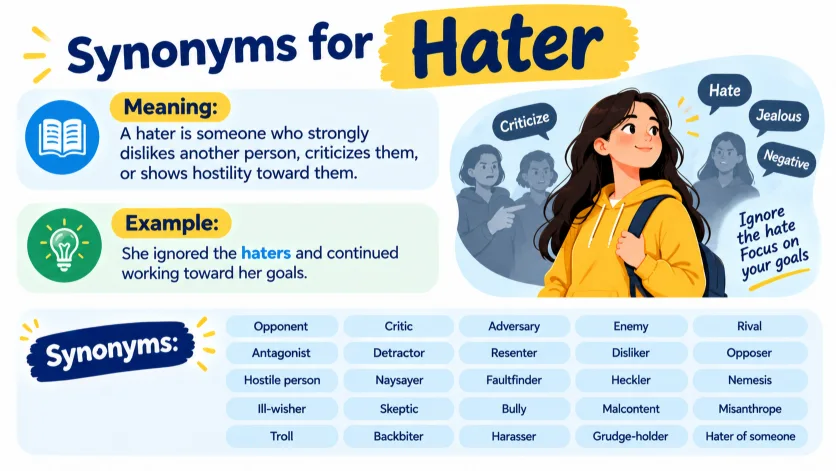
Synonyms for hater include critic, opponent, detractor, adversary, rival, enemy, and antagonist. We all meet people who dislike someone, disagree with others, or speak against a person or idea.
The word hater often describes someone who shows strong dislike or negativity toward another person. Learning synonyms for hater helps you express these feelings in a more accurate way. Some words describe a person who dislikes someone, while others describe a critic, competitor, or enemy. Students can use these words in essays and assignments.
Bloggers and content writers can use them to avoid repeating the same word. In daily English, these synonyms help you describe relationships, disagreements, and negative behavior more clearly.
List of Synonyms for Hater
1. Critic
Meaning: A person who expresses negative opinions about someone or something.
Examples:
- Every artist has a critic.
- The critic disliked his latest movie.
2. Detractor
Meaning: A person who speaks against someone or tries to reduce their reputation.
Examples:
- The singer ignored every detractor.
- Her success silenced many detractors.
3. Opponent
Meaning: A person who disagrees with or competes against someone.
Examples:
- His opponent challenged his ideas.
- She respected her political opponent.
4. Adversary
Meaning: A person who strongly opposes another person.
Examples:
- The lawyer faced a tough adversary.
- He treated his adversary with respect.
5. Enemy
Meaning: A person who feels strong dislike or hostility toward another person.
Examples:
- He considered the rival team his enemy.
- She did not want to make an enemy.
6. Antagonist
Meaning: A person who opposes or creates problems for another person.
Examples:
- The antagonist tried to stop the hero.
- The story’s antagonist caused many problems.
7. Rival
Meaning: A person who competes with another person for the same goal.
Examples:
- His rival won the competition.
- She trained hard to beat her rival.
8. Foe
Meaning: An enemy or person who opposes someone.
Examples:
- The hero defeated his foe.
- They became foes after the argument.
9. Opposer
Meaning: A person who disagrees with or resists something.
Examples:
- The opposer spoke against the proposal.
- Every opposer was allowed to share an opinion.
10. Disliker
Meaning: A person who does not like someone or something.
Examples:
- He was a disliker of loud music.
- Even a disliker praised her performance.
11. Hater
Meaning: A person who expresses strong dislike or negativity toward someone.
Examples:
- The athlete ignored the haters online.
- A hater posted an unkind comment.
12. Malcontent
Meaning: A person who is unhappy and often complains about things.
Examples:
- The malcontent criticized every new idea.
- One malcontent complained throughout the meeting.
13. Naysayer
Meaning: A person who often says that ideas or plans will fail.
Examples:
- The naysayer doubted the new project.
- She proved the naysayers wrong.
14. Pessimist
Meaning: A person who usually expects bad results.
Examples:
- The pessimist thought the plan would fail.
- Even the pessimist enjoyed the good news.
15. Cynic
Meaning: A person who often doubts people’s motives or sincerity.
Examples:
- The cynic questioned the politician’s promises.
- He sounded like a cynic during the discussion.
16. Skeptic
Meaning: A person who doubts whether something is true or useful.
Examples:
- The skeptic asked for more evidence.
- She remained a skeptic about the plan.
17. Faultfinder
Meaning: A person who often looks for mistakes or faults in others.
Examples:
- The faultfinder criticized every detail.
- Nobody enjoys working with a faultfinder.
18. Nitpicker
Meaning: A person who focuses too much on small mistakes.
Examples:
- The nitpicker complained about tiny errors.
- Don’t be a nitpicker over simple details.
19. Belittler
Meaning: A person who makes others feel unimportant or inferior.
Examples:
- The belittler mocked his coworker’s ideas.
- She refused to listen to a belittler.
20. Mockery Maker
Meaning: A person who makes fun of others in an unkind way.
Examples:
- The mockery maker laughed at the new student.
- Nobody liked the mockery maker’s cruel jokes.
21. Bully
Meaning: A person who repeatedly hurts, threatens, or intimidates others.
Examples:
- The bully teased younger students.
- The school took action against the bully.
22. Taunter
Meaning: A person who tries to upset someone by making insulting remarks.
Examples:
- The taunter shouted rude comments.
- The player ignored the taunter.
23. Troll
Meaning: A person who posts insulting or upsetting messages online to provoke others.
Examples:
- The troll left rude comments on her page.
- He blocked the troll from his account.
24. Abuser
Meaning: A person who treats another person in a harmful or cruel way.
Examples:
- The abuser was reported to the authorities.
- She sought help to stay safe from her abuser.
25. Hater of Success
Meaning: A person who resents another person’s achievements.
Examples:
- A hater of success may criticize every achievement.
- She refused to let haters of success discourage her.
26. Jealous Person
Meaning: A person who feels unhappy about another person’s success or advantages.
Examples:
- A jealous person may spread unfair rumors.
- He ignored the jealous person at work.
27. Envious Person
Meaning: A person who wants something another person has.
Examples:
- The envious person envied her promotion.
- He tried not to act like an envious person.
28. Resenter
Meaning: A person who feels bitterness about another person’s actions or success.
Examples:
- The resenter struggled to accept her promotion.
- He did not want to become a resenter.
29. Hostile Person
Meaning: A person who shows anger, opposition, or unfriendliness.
Examples:
- The hostile person refused to cooperate.
- She stayed calm around the hostile person.
30. Opponent of Progress
Meaning: A person who resists change or improvements.
Examples:
- The opponent of progress rejected the new plan.
- Every opponent of progress raised concerns.
31. Condemner
Meaning: A person who strongly expresses disapproval of someone or something.
Examples:
- The condemner spoke against the decision.
- The condemner called the behavior unacceptable.
32. Denouncer
Meaning: A person who publicly criticizes or exposes something as wrong.
Examples:
- The denouncer spoke against corruption.
- The denouncer shared evidence of wrongdoing.
33. Disparager
Meaning: A person who speaks about someone or something in a disrespectful way.
Examples:
- The disparager mocked the team’s efforts.
- She ignored the disparager’s remarks.
34. Slanderer
Meaning: A person who spreads false spoken statements that damage someone’s reputation.
Examples:
- The slanderer spread a false story.
- He took action against the slanderer.
35. Defamer
Meaning: A person who damages another person’s reputation through false statements.
Examples:
- The defamer shared false claims online.
- The public figure challenged the defamer’s claims.
36. Insulter
Meaning: A person who speaks rudely or offensively to others.
Examples:
- The insulter apologized for his words.
- She refused to argue with the insulter.
37. Provocateur
Meaning: A person who deliberately tries to cause anger or a strong reaction.
Examples:
- The provocateur tried to start an argument.
- The crowd refused to respond to the provocateur.
38. Agitator
Meaning: A person who encourages others to protest or become upset about an issue.
Examples:
- The agitator called for a public protest.
- The speaker was accused of being an agitator.
39. Trouble Maker
Meaning: A person who often causes problems or conflict.
Examples:
- The trouble maker started an argument.
- The teacher spoke with the trouble maker.
40. Oppressive Person
Meaning: A person who uses power to control or treat others unfairly.
Examples:
- The oppressive person ignored everyone’s concerns.
- The team stood up to the oppressive person.
41. Tormentor
Meaning: A person who repeatedly causes someone emotional or physical suffering.
Examples:
- The child finally told an adult about the tormentor.
- The tormentor was warned to stop.
42. Persecutor
Meaning: A person who repeatedly treats someone cruelly or unfairly.
Examples:
- The persecutor targeted people who disagreed.
- The victim sought protection from the persecutor.
43. Nemesis
Meaning: A person who is a persistent rival or source of difficulty.
Examples:
- The detective finally caught his nemesis.
- His old rival became his nemesis.
44. Antagonizer
Meaning: A person who deliberately annoys or provokes others.
Examples:
- The antagonizer kept making rude comments.
- She told the antagonizer to stop.
45. Hounding Critic
Meaning: A critic who repeatedly attacks or pressures someone.
Examples:
- The actor ignored the hounding critic.
- The hounding critic kept questioning his choices.
46. Detracting Voice
Meaning: A person or opinion that tries to reduce the value of someone’s work.
Examples:
- Every detracting voice questioned her success.
- He continued working despite each detracting voice.
47. Adversary
Meaning: A person who actively opposes someone in a conflict or competition.
Examples:
- She prepared carefully for her adversary.
- Her adversary respected her determination.
48. Opponent of Someone
Meaning: A person who disagrees with or competes against another person.
Examples:
- He faced an opponent in the final round.
- Her opponent challenged the proposal.
49. Criticizer
Meaning: A person who frequently points out faults or expresses disapproval.
Examples:
- The criticizer found fault with every suggestion.
- He learned not to take every criticizer seriously.
50. Antagonistic Person
Meaning: A person who behaves in an unfriendly or opposing way.
Examples:
- The antagonistic person rejected every suggestion.
- She stayed polite with the antagonistic person.
Conclusion
Learning synonyms for hater helps you describe dislike, criticism, rivalry, and hostile behavior more clearly. Words such as critic, detractor, rival, opponent, troll, bully, and antagonist have different meanings, so choose the word that best fits the situation.
Students can use these words in essays, while bloggers and content writers can use them to avoid repetition. In daily conversations, precise vocabulary helps you explain relationships and disagreements. Practice these synonyms in sentences and real life examples to improve your English vocabulary.
Exercise
Fill in the Blanks
- A person who often says that plans will fail is a ________.
- Someone who posts upsetting comments online to provoke people is a ________.
- A person who repeatedly hurts or intimidates others is a ________.
- A person who speaks against someone’s success is a ________.
- A person who competes against you is your ________.
Answers:
- naysayer
- troll
- bully
- detractor
- rival
Multiple Choice Questions
1. Which word describes a person who often finds faults in others?
A. Faultfinder
B. Supporter
C. Ally
D. Admirer
Answer: A. Faultfinder
2. Which word describes a person who deliberately provokes others online?
A. Mentor
B. Troll
C. Partner
D. Friend
Answer: B. Troll
3. Which word means a person who strongly opposes someone?
A. Adversary
B. Admirer
C. Supporter
D. Helper
Answer: A. Adversary
4. Which word describes someone who spreads false spoken claims that damage a person’s reputation?
A. Slanderer
B. Learner
C. Listener
D. Performer
Answer: A. Slanderer
5. Which word describes a person who repeatedly intimidates others?
A. Bully
B. Ally
C. Guide
D. Guest
Answer: A. Bully
Discover More Articles:

Hi, I’m Nabeel Hassan, an English vocabulary writer helping learners improve their word skills with easy synonyms, meanings, examples, and quizzes. I create simple resources to make English learning easier and more effective.