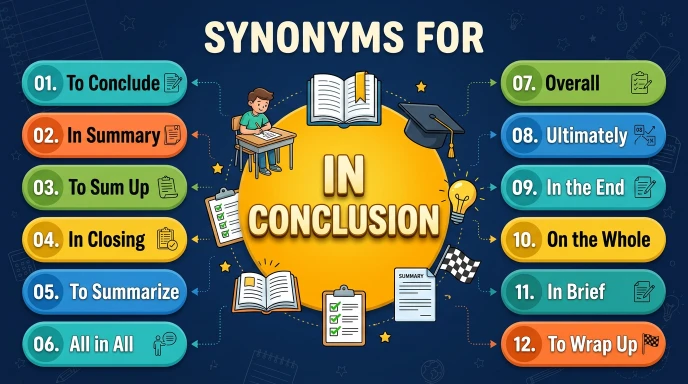
Synonyms for in conclusion include to summarize, in summary, finally, overall, to sum up, in closing, and ultimately.
These phrases are used to finish an essay, summarize important points, or bring a discussion to an end. The phrase in conclusion is commonly used in academic writing, essays, articles, reports, and presentations. Students, bloggers, writers, and English learners can use these alternatives to make their writing more natural and engaging.
However, each phrase has a slightly different purpose. Some introduce a final summary, while others highlight the main idea or give a final thought. Learning these alternatives will help you improve your vocabulary and write stronger conclusions.
50 Synonyms for In Conclusion
1. In Summary
Meaning: In summary introduces a short statement of the main points.
Examples:
- In summary, education plays an important role in society.
- In summary, the project was successful.
2. To Sum Up
Meaning: To sum up means to present the most important points briefly.
Examples:
- To sum up, hard work leads to success.
- To sum up, we need better solutions to this problem.
3. Finally
Meaning: Finally introduces the last point or final statement.
Examples:
- Finally, everyone should take responsibility for their actions.
- Finally, the results show that our plan worked.
4. Overall
Meaning: Overall gives a general view or final judgment about something.
Examples:
- Overall, the experience was positive.
- Overall, students performed well in the examination.
5. In Closing
Meaning: In closing introduces the final part of a speech, essay, or discussion.
Examples:
- In closing, I would like to thank everyone for their support.
- In closing, teamwork is the key to success.
6. To Conclude
Meaning: To conclude introduces the final thoughts or summary of a discussion.
Examples:
- To conclude, regular exercise improves health.
- To conclude, technology has changed our lives.
7. All in All
Meaning: All in all gives a final opinion after considering everything.
Examples:
- All in all, it was a wonderful experience.
- All in all, the team achieved its goals.
8. In Short
Meaning: In short presents the main idea using fewer words.
Examples:
- In short, honesty builds strong relationships.
- In short, the new system saves time.
9. In Brief
Meaning: In brief introduces a short explanation of the main points.
Examples:
- In brief, the research supports our idea.
- In brief, students need more learning opportunities.
10. Ultimately
Meaning: Ultimately expresses the final result or most important point.
Examples:
- Ultimately, success depends on hard work.
- Ultimately, everyone wants a better future.
11. On the Whole
Meaning: On the whole gives a general judgment after considering all aspects.
Examples:
- On the whole, the event was successful.
- On the whole, the results were encouraging.
12. In the End
Meaning: In the end describes the final result after everything has happened.
Examples:
- In the end, we found the right solution.
- In the end, patience helped her succeed.
13. To Summarize
Meaning: To summarize introduces a brief statement of the main ideas.
Examples:
- To summarize, the study highlights the importance of education.
- To summarize, healthy habits improve daily life.
14. As a Final Point
Meaning: As a final point introduces the last important idea.
Examples:
- As a final point, we should protect the environment.
- As a final point, communication is essential for teamwork.
15. In a Nutshell
Meaning: In a nutshell expresses the main idea in a very short way.
Examples:
- In a nutshell, practice makes you better.
- In a nutshell, the business needs a new strategy.
16. In Essence
Meaning: In essence expresses the most important or basic meaning of something.
Examples:
- In essence, success requires dedication.
- In essence, the plan focuses on helping students.
17. All Things Considered
Meaning: All things considered gives a final opinion after thinking about every important factor.
Examples:
- All things considered, moving abroad was a good decision.
- All things considered, the project was worth the effort.
18. Taking Everything into Account
Meaning: This phrase introduces a final judgment after considering all relevant details.
Examples:
- Taking everything into account, the decision was correct.
- Taking everything into account, the team performed well.
19. In the Final Analysis
Meaning: In the final analysis introduces the most important conclusion after careful thought.
Examples:
- In the final analysis, education creates better opportunities.
- In the final analysis, honesty matters most.
20. To Wrap Up
Meaning: To wrap up means to finish a discussion or summarize its main points.
Examples:
- To wrap up, let’s review the main lessons.
- To wrap up, teamwork helped us complete the project.
21. As a Result
Meaning: As a result introduces an outcome caused by something.
Examples:
- As a result, the company improved its performance.
- As a result, more students joined the program.
22. Therefore
Meaning: Therefore introduces a logical result or conclusion.
Examples:
- Therefore, we should take action immediately.
- Therefore, education must remain a priority.
23. Thus
Meaning: Thus introduces a result or final statement based on previous information.
Examples:
- Thus, the experiment proved our theory.
- Thus, teamwork became the foundation of success.
24. Hence
Meaning: Hence introduces a result or logical conclusion.
Examples:
- Hence, regular practice is important.
- Hence, the company decided to change its strategy.
25. Consequently
Meaning: Consequently introduces something that happens because of an earlier event or action.
Examples:
- Consequently, the school improved its teaching methods.
- Consequently, the business gained more customers.
26. For These Reasons
Meaning: For these reasons introduces a conclusion based on previously explained points.
Examples:
- For these reasons, we should protect natural resources.
- For these reasons, the proposal deserves support.
27. Given These Points
Meaning: Given these points introduces a final statement based on the information discussed.
Examples:
- Given these points, the plan seems reasonable.
- Given these points, students need better resources.
28. Based on the Above
Meaning: Based on the above refers to information already discussed before presenting a conclusion.
Examples:
- Based on the above, we can support the new policy.
- Based on the above, the results are clear.
29. To Put It Simply
Meaning: To put it simply introduces a clear and easy explanation of the main idea.
Examples:
- To put it simply, teamwork makes difficult tasks easier.
- To put it simply, everyone needs a fair chance.
30. In Other Words
Meaning: In other words restates an idea using different or simpler language.
Examples:
- In other words, success requires patience.
- In other words, we need to work together.
31. As Discussed
Meaning: As discussed refers to the main points explained earlier.
Examples:
- As discussed, education is important for personal growth.
- As discussed, the new plan has several benefits.
32. In Light of This
Meaning: In light of this introduces a conclusion based on the information provided.
Examples:
- In light of this, we should reconsider our decision.
- In light of this, the company needs a new approach.
33. With This in Mind
Meaning: With this in mind introduces a final thought while considering previous information.
Examples:
- With this in mind, we should focus on quality education.
- With this in mind, the team created a better strategy.
34. On Balance
Meaning: On balance expresses a final judgment after considering advantages and disadvantages.
Examples:
- On balance, the benefits outweigh the risks.
- On balance, the decision was a good one.
35. In Retrospect
Meaning: In retrospect means thinking about something after it has happened.
Examples:
- In retrospect, the experience taught us valuable lessons.
- In retrospect, accepting the offer was the right decision.
36. To Bring It All Together
Meaning: To bring it all together means to connect the main ideas into one final statement.
Examples:
- To bring it all together, education and effort create success.
- To bring it all together, teamwork makes the project stronger.
37. As a Whole
Meaning: As a whole refers to something considered in its entirety.
Examples:
- As a whole, the program was beneficial.
- As a whole, the research provides useful information.
38. In Final Thoughts
Meaning: In final thoughts introduces the last ideas or reflections on a topic.
Examples:
- In final thoughts, we must remember the value of kindness.
- In final thoughts, the experience changed my perspective.
39. To Finish
Meaning: To finish introduces the last point or statement.
Examples:
- To finish, I want to thank everyone for their help.
- To finish, we should remember our main goal.
40. As We Have Seen
Meaning: As we have seen refers to the important points already explained.
Examples:
- As we have seen, technology has many benefits.
- As we have seen, healthy habits improve our lives.
41. The Bottom Line
Meaning: The bottom line expresses the most important fact or final point.
Examples:
- The bottom line is that hard work pays off.
- The bottom line is that customers deserve quality service.
42. At the End of the Day
Meaning: At the end of the day expresses the most important final point.
Examples:
- At the end of the day, happiness matters most.
- At the end of the day, our choices shape our future.
43. To End With
Meaning: To end with introduces the final statement or idea.
Examples:
- To end with, I would like to thank my teachers.
- To end with, everyone should believe in themselves.
44. In a Final Word
Meaning: In a final word introduces a last comment or statement.
Examples:
- In a final word, kindness makes the world better.
- In a final word, we must continue working toward our goals.
45. Summing Up
Meaning: Summing up means reviewing the main ideas briefly.
Examples:
- Summing up, the project achieved its main goals.
- Summing up, good communication builds strong teams.
46. In Conclusion of the Matter
Meaning: This phrase introduces the final judgment about a particular subject.
Examples:
- In conclusion of the matter, both sides agreed to cooperate.
- In conclusion of the matter, the evidence supported our decision.
47. To State the Main Point
Meaning: To state the main point introduces the most important idea clearly.
Examples:
- To state the main point, education creates opportunities.
- To state the main point, we need a better solution.
48. In Final Consideration
Meaning: In final consideration introduces a judgment after reviewing the important details.
Examples:
- In final consideration, the proposal offers several benefits.
- In final consideration, the team made the right choice.
49. To Close
Meaning: To close introduces the final words of a speech, article, or discussion.
Examples:
- To close, I appreciate everyone’s hard work.
- To close, we must continue learning and growing.
50. As a Final Thought
Meaning: As a final thought introduces one last idea or reflection.
Examples:
- As a final thought, never stop believing in yourself.
- As a final thought, small actions can create big changes.
How to Choose the Right Synonym for In Conclusion
Not every alternative to in conclusion fits every situation. Choose a phrase based on your writing style and purpose.
- Use in summary when reviewing the main points of an essay.
- Use to sum up for a short and simple summary.
- Use finally when introducing your last point.
- Use overall when giving a general opinion.
- Use in closing when ending a speech or formal discussion.
- Use ultimately when expressing the final result or main idea.
- Use all things considered when giving a final judgment.
- Use in a nutshell when explaining something briefly.
Synonyms for In Conclusion in Different Contexts
| Context | Best Alternative | Example |
| Academic writing | In summary | In summary, education creates opportunities. |
| Essay writing | To conclude | To conclude, practice improves performance. |
| Formal speech | In closing | In closing, thank you for your support. |
| General opinion | Overall | Overall, the results were positive. |
| Short summary | In short | In short, teamwork matters. |
| Final result | Ultimately | Ultimately, hard work leads to success. |
| Final judgment | On balance | On balance, the plan was successful. |
| Casual writing | All in all | All in all, it was a great day. |
| Brief explanation | In a nutshell | In a nutshell, communication is essential. |
| Logical result | Therefore | Therefore, we should take action. |
Exercise: Fill in the Blanks
Choose the correct phrase from the word bank.
Word Bank: In Summary, Overall, Finally, To Sum Up, In Closing, Ultimately, All in All, Therefore, In Short, To Conclude
- ______, education plays an important role in building a better future.
- ______, the students performed very well in the examination.
- ______, I would like to thank everyone for attending.
- ______, we should protect the environment.
- ______, the project was a great success.
- ______, hard work and patience lead to success.
- ______, the company achieved its main goals.
- ______, we need to make a better decision.
- ______, teamwork makes difficult tasks easier.
- ______, the research supports our main argument.
Answers:
- To Conclude
- Overall
- In Closing
- Therefore
- All in All
- Ultimately
- Finally
- To Sum Up
- In Short
- In Summary
Context Based MCQs
1. Which phrase is commonly used to introduce a short summary?
A. For example
B. In summary
C. On the other hand
D. In contrast
Answer: B. In summary
2. Which phrase is suitable for ending a formal speech?
A. In closing
B. For instance
C. Meanwhile
D. However
Answer: A. In closing
3. Which phrase gives a general judgment about something?
A. Because of
B. Overall
C. Although
D. Instead
Answer: B. Overall
4. Which phrase means presenting the main points briefly?
A. To sum up
B. In addition
C. For example
D. On the contrary
Answer: A. To sum up
5. Which phrase is suitable for expressing the final result?
A. Meanwhile
B. Ultimately
C. Similarly
D. Furthermore
Answer: B. Ultimately
6. Which phrase is commonly used in casual writing to give a final opinion?
A. All in all
B. In contrast
C. For example
D. In addition
Answer: A. All in all
7. Which phrase introduces a logical result?
A. However
B. Therefore
C. Although
D. Meanwhile
Answer: B. Therefore
8. Which phrase means explaining the main idea in a very short way?
A. In a nutshell
B. On the other hand
C. For instance
D. In addition
Answer: A. In a nutshell
FAQs About Synonyms for In Conclusion
1. What are the best synonyms for in conclusion?
Some of the best alternatives to in conclusion are in summary, to sum up, finally, overall, in closing, and ultimately.
2. What is another way to say in conclusion in an essay?
You can use to conclude, in summary, to sum up, or overall in an essay. These phrases help introduce your final thoughts.
3. What is a simple alternative to in conclusion?
To sum up, in short, and finally are simple alternatives that are easy to understand and use.
4. What is a formal way to say in conclusion?
In summary, to conclude, in closing, and in the final analysis are useful alternatives in formal and academic writing.
5. What can I use instead of in conclusion in a speech?
You can use in closing, finally, to wrap up, or as a final thought when ending a speech.
6. Is overall another word for in conclusion?
Yes, overall can introduce a general final judgment or summary. However, it does not fit every sentence where in conclusion is used.
7. Should I use in conclusion in every essay?
No. You can use different phrases such as to conclude, in summary, or ultimately to make your writing sound more natural. You can also begin your final paragraph without using a transition phrase.
Conclusion
There are many useful alternatives to in conclusion, including in summary, to sum up, finally, overall, in closing, and ultimately.
Each phrase has a slightly different purpose and works in a different situation. Some are suitable for academic essays, while others work better in speeches, articles, and everyday writing.
Learning these alternatives can improve your English vocabulary and make your writing more natural. Choose the phrase that best matches your message and use it to create clear and effective conclusions.
Discover More Articles:

Hi, I’m Emma Collins, and I enjoy creating simple English vocabulary resources that make learning easier for everyone. I write about synonyms, antonyms, word meanings, vocabulary lists, and writing tips using clear, everyday language. My goal is to help students, writers, teachers, and English learners build their vocabulary, improve their writing, and feel more confident using English. I take time to research every article carefully so the information is accurate, practical, and easy to understand.