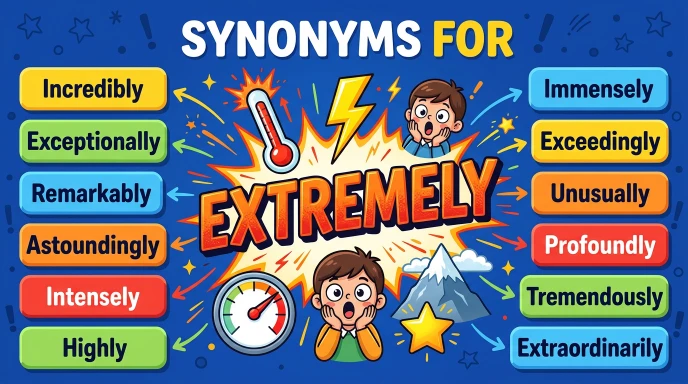
Synonyms for extremely include very, exceptionally, incredibly, extraordinarily, highly, intensely, remarkably, and exceedingly.
These words describe something that exists or happens to a very high degree. You can use them to make your writing more expressive and avoid repeating the same word. Some alternatives are suitable for everyday conversations, while others sound more formal or create stronger emphasis.
In this guide, you will learn 25 useful alternatives to extremely, along with their meanings, pronunciation, formality levels, and example sentences. You will also discover common usage mistakes and take a short quiz to practice your vocabulary.
What Are Synonyms for Extremely?
Extremely means to a very great degree or in a very high amount. Common synonyms include very, exceptionally, incredibly, extraordinarily, highly, intensely, remarkably, exceedingly, and tremendously. These words add emphasis to adjectives and adverbs. The best alternative depends on the sentence and the strength of the meaning you want to express.
Meaning of Extremely
Definition
Extremely is an adverb that means to a very great degree or to an unusually high level. It makes the meaning of an adjective or another adverb stronger.
Example: The weather is extremely hot today.
Here, extremely makes the adjective hot stronger.
Examples
- The exam was extremely difficult.
- She is extremely talented at drawing.
- The hotel was extremely comfortable.
- He drives extremely carefully.
Connotative Meaning
Extremely adds strong emphasis to a description. It can express a high level of quality, intensity, importance, difficulty, or emotion. The word itself is neutral, but the feeling depends on the adjective it modifies.
Etymology
Extremely comes from the adjective extreme, which developed from Latin extremus, meaning “outermost” or “furthest.” The suffix ly changes the adjective into an adverb.
Pronunciation
- US IPA: /ɪkˈstriːmli/
- UK IPA: /ɪkˈstriːmli/
- Syllables: 3 — ex treme ly
- Part of Speech: Adverb
Affixation Pattern
Extreme + ly = Extremely
- Extreme: Base adjective.
- ly: Suffix that forms an adverb.
Related Concepts
- Intensity: The strength or degree of something.
- Emphasis: Giving extra importance to a word or idea.
- Exaggeration: Describing something as greater than it really is.
- Degree: The level or amount of a quality.
- Superlative: Expressing the highest level of a quality.
Complete Synonyms List for Extremely
The following table contains 25 useful alternatives. Some words are stronger, more formal, or more context specific than others.
| Synonym | Meaning | Formality Level |
| 1. Very | To a high degree | Neutral |
| 2. Exceptionally | To an unusually high degree | Formal |
| 3. Incredibly | To a surprising degree | Informal |
| 4. Exceedingly | To a very great degree | Formal |
| 5. Intensely | With great strength or feeling | Neutral |
| 6. Highly | To a great degree | Neutral |
| 7. Remarkably | To a degree that attracts attention | Neutral |
| 8. Extraordinarily | Beyond what is usual | Formal |
| 9. Tremendously | To a very great extent | Neutral |
| 10. Immensely | To a very large degree | Neutral |
| 11. Profoundly | At a deep or significant level | Formal |
| 12. Terribly | To a very great degree; often negative | Informal |
| 13. Awfully | To a very great degree; informal emphasis | Informal |
| 14. Especially | More than usual or others | Neutral |
| 15. Particularly | To a notable degree | Neutral |
| 16. Unusually | In a way that is not common | Neutral |
| 17. Overwhelmingly | To an overpowering degree | Formal |
| 18. Strikingly | In a way that strongly attracts attention | Formal |
| 19. Seriously | To a considerable or important degree | Informal |
| 20. Drastically | To a great or severe extent | Neutral |
| 21. Radically | In a very great or fundamental way | Formal |
| 22. Intensely | With strong force or emotion | Neutral |
| 23. Massively | To a very large extent | Informal |
| 24. Monumentally | To an exceptionally great degree | Formal |
| 25. Inordinately | To an unusually or excessively high degree | Formal |
Formality Comparison of Extremely Synonyms
The best alternative depends on your audience and writing style.
| Formality | Alternatives |
| Informal | Incredibly, terribly, awfully, seriously, massively |
| Neutral | Very, highly, immensely, tremendously, particularly |
| Formal | Exceptionally, exceedingly, extraordinarily, profoundly, inordinately |
| Strong Emphasis | Overwhelmingly, monumentally, tremendously, immensely |
Writing Tip: Use very and incredibly in everyday conversations. Choose exceptionally, exceedingly, or extraordinarily for formal writing when they fit the meaning.
Detailed Synonyms for Extremely
1. Very
Part of Speech: Adverb
US IPA: /ˈveri/
UK IPA: /ˈveri/
Meaning: Very means to a high degree. It is one of the most common and simple alternatives to extremely.
Formality: Neutral
Formal Example: The results were very encouraging for the research team.
Informal Example: This pizza is very tasty.
2. Exceptionally
Part of Speech: Adverb
US IPA: /ɪkˈsepʃənəli/
UK IPA: /ɪkˈsepʃənəli/
Meaning: Exceptionally describes something that is unusually good, high, or noticeable.
Formality: Formal
Formal Example: The candidate demonstrated exceptionally strong leadership skills.
Informal Example: The cake tastes exceptionally good.
3. Incredibly
Part of Speech: Adverb
US IPA: /ɪnˈkredəbli/
UK IPA: /ɪnˈkredəbli/
Meaning: Incredibly means to a surprising or amazing degree.
Formality: Informal
Formal Example: The new system is incredibly effective at reducing errors.
Informal Example: That movie was incredibly funny.
4. Exceedingly
Part of Speech: Adverb
US IPA: /ɪkˈsiːdɪŋli/
UK IPA: /ɪkˈsiːdɪŋli/
Meaning: Exceedingly means to an unusually great degree. It often appears in formal writing.
Formality: Formal
Formal Example: The organization found the new procedure exceedingly useful.
Informal Example: The weather is exceedingly hot today.
5. Intensely
Part of Speech: Adverb
US IPA: /ɪnˈtensli/
UK IPA: /ɪnˈtensli/
Meaning: Intensely means with great strength, force, or emotion. It works best with feelings, activities, and experiences.
Formality: Neutral
Formal Example: The students were intensely focused on their research.
Informal Example: I was intensely excited about the trip.
6. Highly
Part of Speech: Adverb
US IPA: /ˈhaɪli/
UK IPA: /ˈhaɪli/
Meaning: Highly means to a great degree. It is commonly used with words such as recommended, skilled, effective, and successful.
Formality: Neutral
Formal Example: The report was highly informative and well organized.
Informal Example: She is highly talented at singing.
7. Remarkably
Part of Speech: Adverb
US IPA: /rɪˈmɑːrkəbli/
UK IPA: /rɪˈmɑːkəbli/
Meaning: Remarkably means to a degree that is surprising or worth noticing.
Formality: Neutral
Formal Example: The company achieved remarkably strong results this year.
Informal Example: Your little brother is remarkably good at chess.
8. Extraordinarily
Part of Speech: Adverb
US IPA: /ɪkˈstrɔːrdənerəli/
UK IPA: /ɪkˈstrɔːdənrəli/
Meaning: Extraordinarily means in a way that is far beyond what is normal or expected.
Formality: Formal
Formal Example: The scientist made an extraordinarily important discovery.
Informal Example: That was an extraordinarily beautiful view.
9. Tremendously
Part of Speech: Adverb
US IPA: /trəˈmendəsli/
UK IPA: /trɪˈmendəsli/
Meaning: Tremendously means to a very great degree or extent.
Formality: Neutral
Formal Example: The training program tremendously improved employee performance.
Informal Example: I enjoyed the concert tremendously.
10. Immensely
Part of Speech: Adverb
US IPA: /ɪˈmensli/
UK IPA: /ɪˈmensli/
Meaning: Immensely means to a very large or great degree.
Formality: Neutral
Formal Example: The research was immensely valuable to the scientific community.
Informal Example: I am immensely proud of you.
11. Profoundly
Part of Speech: Adverb
US IPA: /prəˈfaʊndli/
UK IPA: /prəˈfaʊndli/
Meaning: Profoundly means deeply or to a significant degree. It is often used for feelings, effects, and changes.
Formality: Formal
Formal Example: The experience profoundly influenced her professional decisions.
Informal Example: His words deeply and profoundly touched me.
12. Terribly
Part of Speech: Adverb
US IPA: /ˈterəbli/
UK IPA: /ˈterəbli/
Meaning: Terribly can mean extremely, especially in informal speech. It is often used with negative descriptions or feelings.
Formality: Informal
Formal Example: The region was terribly affected by the severe storm.
Informal Example: I am terribly sorry for being late.
13. Awfully
Part of Speech: Adverb
US IPA: /ˈɔːfəli/
UK IPA: /ˈɔːfəli/
Meaning: Awfully can mean very or extremely in informal English. It can also describe something unpleasant.
Formality: Informal
Formal Example: The delay was awfully inconvenient for the passengers.
Informal Example: You look awfully tired today.
14. Especially
Part of Speech: Adverb
US IPA: /ɪˈspeʃəli/
UK IPA: /ɪˈspeʃəli/
Meaning: Especially means particularly or more than usual. It emphasizes one person, thing, or situation.
Formality: Neutral
Formal Example: The new policy is especially important for small businesses.
Informal Example: I especially love chocolate ice cream.
15. Particularly
Part of Speech: Adverb
US IPA: /pərˈtɪkjələrli/
UK IPA: /pəˈtɪkjələli/
Meaning: Particularly means to a noticeable or special degree. It highlights one specific quality or point.
Formality: Neutral
Formal Example: The findings are particularly relevant to environmental studies.
Informal Example: I am particularly interested in learning Spanish.
16. Unusually
Part of Speech: Adverb
US IPA: /ʌnˈjuːʒuəli/
UK IPA: /ʌnˈjuːʒuəli/
Meaning: Unusually means in a way that is different from what is normal or expected.
Formality: Neutral
Formal Example: The region experienced unusually high temperatures this summer.
Informal Example: It is unusually quiet in the house today.
17. Overwhelmingly
Part of Speech: Adverb
US IPA: /ˌoʊvərˈwelmɪŋli/
UK IPA: /ˌəʊvəˈwelmɪŋli/
Meaning: Overwhelmingly means to such a great degree that something is difficult to resist, manage, or ignore.
Formality: Formal
Formal Example: The proposal received overwhelmingly positive support from the committee.
Informal Example: The crowd was overwhelmingly excited about the final match.
18. Strikingly
Part of Speech: Adverb
US IPA: /ˈstraɪkɪŋli/
UK IPA: /ˈstraɪkɪŋli/
Meaning: Strikingly means in a way that is very noticeable or impressive.
Formality: Formal
Formal Example: The two reports were strikingly similar in their conclusions.
Informal Example: She looks strikingly different with her new hairstyle.
19. Seriously
Part of Speech: Adverb
US IPA: /ˈsɪriəsli/
UK IPA: /ˈsɪəriəsli/
Meaning: Seriously can mean to a considerable degree, especially in informal speech. It can also mean in a serious or sincere manner.
Formality: Informal
Formal Example: The organization was seriously concerned about the financial risks.
Informal Example: I am seriously hungry right now.
20. Drastically
Part of Speech: Adverb
US IPA: /ˈdræstɪkli/
UK IPA: /ˈdrɑːstɪkli/
Meaning: Drastically means to a great or severe degree, often describing a major change or effect.
Formality: Neutral
Formal Example: The new measures drastically reduced operating costs.
Informal Example: My daily routine changed drastically after moving.
21. Radically
Part of Speech: Adverb
US IPA: /ˈrædɪkli/
UK IPA: /ˈrædɪkli/
Meaning: Radically means in a fundamental or very significant way. It often describes major changes.
Formality: Formal
Formal Example: The reforms radically transformed the education system.
Informal Example: Her new idea radically changed our plans.
22. Massively
Part of Speech: Adverb
US IPA: /ˈmæsɪvli/
UK IPA: /ˈmæsɪvli/
Meaning: Massively means to a very large degree or on a very large scale.
Formality: Informal
Formal Example: The investment massively increased the company’s production capacity.
Informal Example: That game massively improved after the update.
23. Monumentally
Part of Speech: Adverb
US IPA: /ˌmɑːnjəˈmentəli/
UK IPA: /ˌmɒnjʊˈmentəli/
Meaning: Monumentally means to an exceptionally great or important degree. It is often used for major achievements or serious mistakes.
Formality: Formal
Formal Example: The decision was monumentally important to the future of the organization.
Informal Example: I made a monumentally silly mistake yesterday.
24. Inordinately
Part of Speech: Adverb
US IPA: /ɪnˈɔːrdɪnətli/
UK IPA: /ɪˈnɔːdɪnətli/
Meaning: Inordinately means to an unusually or excessively high degree, often suggesting that something is too much.
Formality: Formal
Formal Example: The project required an inordinately large amount of funding.
Informal Example: He is inordinately proud of his new car.
25. Greatly
Part of Speech: Adverb
US IPA: /ˈɡreɪtli/
UK IPA: /ˈɡreɪtli/
Meaning: Greatly means to a large or significant degree. It often describes changes, effects, and feelings.
Formality: Neutral
Formal Example: The new technology greatly improved the accuracy of the results.
Informal Example: I greatly appreciate your help.
Prototype Meaning of Extremely
The prototype meaning of extremely is “to a very great degree.” It increases the strength of an adjective or adverb and shows that something is far above an ordinary level.
Example: The mountain was extremely high.
In this sentence:
- Extremely adds strong emphasis.
- High describes the mountain.
- Together, they show that the mountain has a very great height.
Synonyms for Extremely by Category
Different alternatives work better in different situations. Here are useful groups to help you choose the right word.
Common Everyday Alternatives
- Very
- Incredibly
- Terribly
- Awfully
- Seriously
- Really
Formal Writing Alternatives
- Exceptionally
- Exceedingly
- Extraordinarily
- Profoundly
- Inordinately
- Overwhelmingly
Alternatives for Strong Emphasis
- Tremendously
- Immensely
- Monumentally
- Incredibly
- Exceptionally
Alternatives for Significant Changes
- Drastically
- Radically
- Greatly
- Massively
For Noticeable Qualities
- Remarkably
- Strikingly
- Unusually
- Particularly
- Especially
Important: Some alternatives have special meanings. For example, drastically usually describes major changes, while profoundly often describes deep effects or feelings.
Antonyms of Extremely
Extremely describes a very high degree. Its opposite expressions suggest a low degree or limited intensity.
| Antonym | Meaning |
| Slightly | To a small degree |
| Barely | Only just |
| Hardly | Almost not |
| Scarcely | Almost not at all |
| Minimally | To a very small degree |
| Moderately | To an average degree |
| Somewhat | To a certain degree |
| Mildly | In a gentle or limited way |
| A little | To a small extent |
| Marginally | By a small amount |
Examples:
- Extremely cold → Slightly cold
- Extremely difficult → Moderately difficult
- Extremely important → Somewhat important
Quiz: Test Your Knowledge of Extremely Synonyms
Choose the best answer for each question.
1. Which word is a common synonym for extremely?
A. Slightly
B. Very
C. Rarely
D. Almost
2. Which alternative is especially suitable for formal writing?
A. Awfully
B. Exceptionally
C. Kinda
D. Sort of
3. What does immensely mean?
A. To a very large degree
B. To a small degree
C. Not at all
D. Occasionally
4. Which word often describes a major or severe change?
A. Mildly
B. Drastically
C. Barely
D. Slightly
5. Which word means in a way that attracts attention because it is unusual?
A. Remarkably
B. Hardly
C. Minimally
D. Scarcely
6. Which word can mean extremely in informal English?
A. Awfully
B. Consequently
C. Therefore
D. Similarly
7. Choose the best synonym: “The new system is _____ effective.”
A. Barely
B. Exceptionally
C. Rarely
D. Scarcely
Quiz Answer Key
- B. Very
- B. Exceptionally
- A. To a very large degree
- B. Drastically
- A. Remarkably
- A. Awfully
- B. Exceptionally
Usage Tips for Extremely and Its Synonyms
Follow these tips to use alternatives to extremely correctly.
- Use very for simple everyday sentences. It is easy to understand and works with many adjectives.
- Choose exceptionally for outstanding qualities. It often describes unusually high ability, quality, or performance.
- Use incredibly for strong informal emphasis. It makes descriptions sound more expressive.
- Choose highly with suitable adjectives. Common combinations include highly effective, highly skilled, and highly recommended.
- Use profoundly for deep effects. It works well with words such as affected, influenced, and changed.
- Choose drastically for major changes. It is suitable for describing sharp increases, decreases, or transformations.
- Avoid using every synonym in the same way. Some words describe intensity, while others describe unusual qualities or major changes.
- Do not overuse intensifiers. Too many strong words can make writing sound exaggerated.
Common Grammar Mistakes
| Incorrect Sentence | Correct Sentence |
| She is extreme talented. | She is extremely talented. |
| The movie was very extremely good. | The movie was extremely good. |
| He is highly tired. | He is extremely tired. |
| The situation changed extreme. | The situation changed drastically. |
Remember: Extremely is an adverb. Use it to modify adjectives and other adverbs, not directly as an adjective.
Frequently Asked Questions About Extremely
1. What are the 5 best synonyms for extremely?
The five useful alternatives are very, exceptionally, incredibly, extraordinarily, and exceedingly. Each expresses a high degree of something.
2. What is a simple word for extremely?
Very is the simplest and most common alternative to extremely. It works naturally in everyday conversations and basic writing.
3. Is incredibly the same as extremely?
Both words express a very high degree, but incredibly often adds a feeling of surprise or amazement. Extremely is more neutral.
4. What is a formal synonym for extremely?
Exceedingly, exceptionally, extraordinarily, and profoundly are useful formal alternatives. Choose the word that best matches the sentence.
5. What is the opposite of extremely?
Common opposites include slightly, barely, hardly, mildly, and minimally. These words describe a low degree or limited intensity.
6. Can I use highly instead of extremely?
Yes, in suitable expressions. For example, extremely effective and highly effective are both natural, but highly does not work with every adjective.
7. How can I avoid repeating extremely?
Use alternatives such as very, incredibly, remarkably, exceptionally, or tremendously when they fit the context. You can also rewrite the sentence to make the description stronger without adding an intensifier.
Conclusion
Learning synonyms for extremely can help you make your English more expressive and improve your writing style. Words such as very, exceptionally, incredibly, extraordinarily, and exceedingly are useful when you want to describe something to a high degree.
Other alternatives, including drastically, profoundly, remarkably, and immensely, work better in specific situations. Remember that these words are not always interchangeable. Choose an alternative based on the meaning, tone, and sentence structure.
Practice using different intensifiers in your conversations, essays, and daily writing. With regular practice, you can build a stronger vocabulary and communicate your ideas with greater confidence.
Discover More Articles:

Hi, I’m Emma Wilson, an English vocabulary writer helping learners improve their word skills with synonyms, meanings, examples, and quizzes. I create simple resources to make English learning easier.