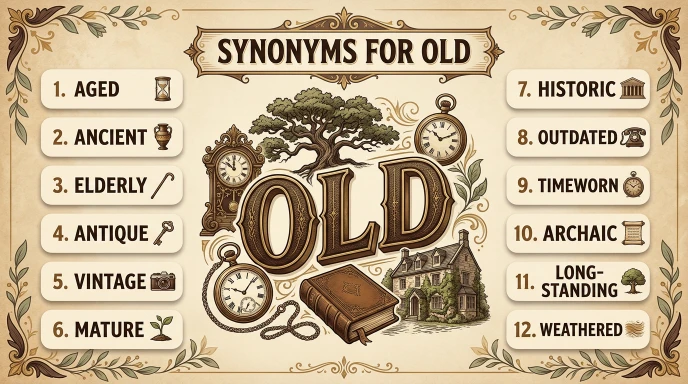
Synonyms for old include ancient, older people, aged, former, previous, outdated, antique, vintage, mature, and long standing.
These words describe people, objects, places, ideas, and things that have existed for a long time. However, each word has a slightly different meaning. Some describe a person’s age, while others refer to something from the past or something no longer modern.
Learning different ways to say old can make your English more natural and expressive. Students,
English learners, bloggers, and content writers can use these alternatives in essays, stories, conversations, and professional writing. This guide explains 25 useful synonyms with meanings, pronunciation, and practical examples.
Meaning of Old
Definition
Old is an adjective that describes someone or something that has existed for a long time. It can refer to a person of advanced age, an object that has been used for many years, or something that belongs to the past.
Examples
- My grandfather lives in an old house near the river.
- She found an old photograph in a wooden box.
Connotative Meaning
The word old can have positive, neutral, or negative meanings depending on the context.
- Positive: Old traditions can represent history and wisdom.
- Neutral: An old building may simply have existed for many years.
- Negative: An old computer may be slow or outdated.
When describing people, words such as older people and senior can sound more respectful than calling someone old.
Etymology
The word old comes from Old English eald, meaning aged or having lived for a long time. It is related to similar words in other Germanic languages.
Pronunciation
- US IPA: /oʊld/
- UK IPA: /əʊld/
Syllables
Old: 1 syllable.
Affixation Pattern
Old is a base adjective. It can form related words and expressions:
- Older: Old + er
- Oldest: Old + est
- Old fashioned: Old + fashioned
- Oldness: Old + ness
Related Concepts
- Age: The length of time someone or something has existed.
- History: Events and experiences from the past.
- Tradition: A custom passed from one generation to another.
- Experience: Knowledge gained over time.
- Antique: An old object valued for its age or historical interest.
Complete Synonyms List for Old
Here are 25 useful alternatives for old. Some describe age, while others refer to something from the past, worn through use, or no longer modern.
| Synonym | Meaning | Formality Level |
| 1. Aged | Having lived or existed for a long time | Neutral |
| 2. older people | Being advanced in age | Respectful |
| 3. Ancient | Extremely old or from a distant past | Neutral |
| 4. Antique | Old and often valuable because of age | Neutral |
| 5. Vintage | From an earlier period, often valued for its style | Neutral |
| 6. Mature | Fully developed or grown | Neutral |
| 7. Senior | Older in age or rank | Formal |
| 8. Former | Having held a position or status in the past | Neutral |
| 9. Previous | Existing or happening before the present one | Neutral |
| 10. Earlier | Belonging to a time before now | Neutral |
| 11. Past | Belonging to a time that has ended | Neutral |
| 12. Outdated | No longer modern or useful | Neutral |
| 13. Obsolete | No longer used or needed | Formal |
| 14. Old fashioned | Following an earlier style or custom | Neutral |
| 15. Archaic | Extremely old fashioned or no longer commonly used | Formal |
| 16. Timeworn | Showing signs of age or long use | Literary |
| 17. Weathered | Worn or changed by exposure to weather or time | Neutral |
| 18. Worn | Damaged or weakened through use | Neutral |
| 19. Decrepit | Very old and in poor condition | Formal |
| 20. Long standing | Existing for a long time | Formal |
| 21. Long established | Existing and recognized for many years | Formal |
| 22. Antique looking | Having the appearance of an old object | Neutral |
| 23. Aged looking | Appearing older than something or someone else | Neutral |
| 24. Time honored | Respected because of a long history | Formal |
| 25. Elder | Older in age or seniority | Formal |
Note: These words are not interchangeable in every sentence. For example, older people usually describes people & former describes a past position or role.
Formality Comparison of Old Synonyms
The best alternative depends on what you are describing and the tone of your writing.
| Formality | Synonyms | Common Use |
| Formal | older people, senior, obsolete, archaic, long standing | Reports and professional writing |
| Neutral | Aged, ancient, mature, former, previous, outdated | Everyday writing and conversation |
| Literary | Timeworn, time honored, weathered | Stories and descriptive writing |
| Informal | Old fashioned, worn | Casual conversations |
Writing tip: Use older people when respectfully describing an older person. Choose ancient for something extremely old and outdated for something that is no longer modern.
Detailed Synonyms for Old
1. Aged
Part of Speech: Adjective
US IPA: /eɪdʒd/
UK IPA: /eɪdʒd/
Meaning: Having lived or existed for a long time.
Formality: Neutral
Formal Example: The museum displayed several aged documents from the nineteenth century.
Informal Example: We visited an aged farmhouse in the countryside.
2. older people
Part of Speech: Adjective
US IPA: /ˈeldərli/
UK IPA: /ˈeldəli/
Meaning: Describes someone who is advanced in age.
Formality: Respectful
Formal Example: The hospital provides special services for older patients.
Informal Example: An older man helped us find the bus station.
3. Ancient
Part of Speech: Adjective
US IPA: /ˈeɪnʃənt/
UK IPA: /ˈeɪnʃənt/
Meaning: Extremely old or belonging to a distant historical period.
Formality: Neutral
Formal Example: Researchers discovered an ancient settlement near the river.
Informal Example: We visited an ancient castle during our holiday.
4. Antique
Part of Speech: Adjective
US IPA: /ænˈtiːk/
UK IPA: /ænˈtiːk/
Meaning: Describes an old object that may have historical, artistic, or financial value.
Formality: Neutral
Formal Example: The gallery displayed an antique collection of wooden furniture.
Informal Example: My grandmother owns an antique clock.
5. Vintage
Part of Speech: Adjective
US IPA: /ˈvɪntɪdʒ/
UK IPA: /ˈvɪntɪdʒ/
Meaning: From an earlier period and often valued for its quality, style, or character.
Formality: Neutral
Formal Example: The exhibition featured vintage clothing from the 1960s.
Informal Example: She bought a vintage jacket at the market.
6. Mature
Part of Speech: Adjective
US IPA: /məˈtʃʊr/
UK IPA: /məˈtʃʊə/
Meaning: Fully grown or developed in age, behavior, or condition.
Formality: Neutral
Formal Example: The program supports the educational needs of mature students.
Informal Example: He has become more mature over the years.
7. Senior
Part of Speech: Adjective
US IPA: /ˈsiːniər/
UK IPA: /ˈsiːniə/
Meaning: Older in age, position, or rank.
Formality: Formal
Formal Example: The organization offers special benefits to older citizens.
Informal Example: My senior colleague has worked here for twenty years.
8. Former
Part of Speech: Adjective
US IPA: /ˈfɔːrmər/
UK IPA: /ˈfɔːmə/
Meaning: Having had a particular position, role, or status in the past.
Formality: Neutral
Formal Example: The former director shared his experience with the new team.
Informal Example: My former school was close to our house.
9. Previous
Part of Speech: Adjective
US IPA: /ˈpriːviəs/
UK IPA: /ˈpriːviəs/
Meaning: Existing or happening before the present one.
Formality: Neutral
Formal Example: The previous report contained several important findings.
Informal Example: I enjoyed the previous movie more than this one.
10. Earlier
Part of Speech: Adjective or Adverb
US IPA: /ˈɜːrliər/
UK IPA: /ˈɜːliə/
Meaning: Belonging to or happening at a time before the present or another event.
Formality: Neutral
Formal Example: The earlier version of the policy included additional requirements.
Informal Example: I liked the earlier design better.
11. Past
Part of Speech: Adjective
US IPA: /pæst/
UK IPA: /pɑːst/
Meaning: Belonging to a time that has already ended.
Formality: Neutral
Formal Example: The past achievements of the organization are documented in its annual report.
Informal Example: We talked about our past adventures last night.
12. Outdated
Part of Speech: Adjective
US IPA: /ˌaʊtˈdeɪtɪd/
UK IPA: /ˌaʊtˈdeɪtɪd/
Meaning: No longer modern, current, or suitable for present needs.
Formality: Neutral
Formal Example: The company replaced its outdated computer systems.
Informal Example: My phone looks outdated compared with the new models.
13. Obsolete
Part of Speech: Adjective
US IPA: /ˌɑːbsəˈliːt/
UK IPA: /ˌɒbsəˈliːt/
Meaning: No longer used or needed because something newer has replaced it.
Formality: Formal
Formal Example: Modern technology has made many older machines obsolete.
Informal Example: This old charger is almost obsolete now.
14. Old Fashioned
Part of Speech: Adjective
US IPA: /ˌoʊldˈfæʃənd/
UK IPA: /ˌəʊldˈfæʃənd/
Meaning: Following a style, custom, or way of thinking from an earlier time.
Formality: Neutral
Formal Example: The report criticized the company’s old fashioned management practices.
Informal Example: My father prefers old fashioned music.
15. Archaic
Part of Speech: Adjective
US IPA: /ɑːrˈkeɪɪk/
UK IPA: /ɑːˈkeɪɪk/
Meaning: Extremely old fashioned or no longer commonly used.
Formality: Formal
Formal Example: The researcher explained several archaic expressions found in the manuscript.
Informal Example: Some people think that rule sounds archaic.
16. Timeworn
Part of Speech: Adjective
US IPA: /ˈtaɪmwɔːrn/
UK IPA: /ˈtaɪmwɔːn/
Meaning: Showing signs of age or long use.
Formality: Literary
Formal Example: The library preserved a timeworn manuscript from the medieval period.
Informal Example: We sat on a timeworn wooden bench.
17. Weathered
Part of Speech: Adjective
US IPA: /ˈweðərd/
UK IPA: /ˈweðəd/
Meaning: Worn or changed by exposure to weather, age, or difficult conditions.
Formality: Neutral
Formal Example: The building’s weathered walls reflected decades of exposure to the elements.
Informal Example: The old wooden door looked weathered after years in the rain.
18. Worn
Part of Speech: Adjective
US IPA: /wɔːrn/
UK IPA: /wɔːn/
Meaning: Damaged, faded, or weakened through repeated use.
Formality: Neutral
Formal Example: The archive contained several worn books with damaged covers.
Informal Example: My favorite shoes are getting worn.
19. Decrepit
Part of Speech: Adjective
US IPA: /dɪˈkrepɪt/
UK IPA: /dɪˈkrepɪt/
Meaning: Extremely old and in poor physical condition.
Formality: Formal
Formal Example: The authorities ordered the demolition of the decrepit building.
Informal Example: They moved out of the decrepit house last year.
20. Long Standing
Part of Speech: Adjective
US IPA: /ˌlɔːŋˈstændɪŋ/
UK IPA: /ˌlɒŋˈstændɪŋ/
Meaning: Existing or continuing for a long time.
Formality: Formal
Formal Example: The two organizations have a long standing partnership.
Informal Example: They have a long standing friendship.
21. Long Established
Part of Speech: Adjective
US IPA: /ˌlɔːŋ ɪˈstæblɪʃt/
UK IPA: /ˌlɒŋ ɪˈstæblɪʃt/
Meaning: Existing and recognized for many years.
Formality: Formal
Formal Example: The university is a long established center for scientific research.
Informal Example: We bought our supplies from a long established local shop.
22. Antique Looking
Part of Speech: Adjective
US IPA: /ænˈtiːk ˌlʊkɪŋ/
UK IPA: /ænˈtiːk ˌlʊkɪŋ/
Meaning: Having the appearance or style of an antique object.
Formality: Neutral
Formal Example: The designer created an antique looking cabinet for the exhibition.
Informal Example: I love that antique looking mirror.
23. Aged Looking
Part of Speech: Adjective
US IPA: /ˈeɪdʒd ˌlʊkɪŋ/
UK IPA: /ˈeɪdʒd ˌlʊkɪŋ/
Meaning: Appearing old or showing visible signs of age.
Formality: Neutral
Formal Example: The artist gave the painting an aged looking finish.
Informal Example: The old photograph has an aged looking surface.
24. Time Honored
Part of Speech: Adjective
US IPA: /ˌtaɪm ˈɑːnərd/
UK IPA: /ˌtaɪm ˈɒnəd/
Meaning: Respected because it has existed for a long time.
Formality: Formal
Formal Example: The ceremony follows a time honored cultural tradition.
Informal Example: Our family has a time honored habit of gathering every Sunday.
25. Elder
Part of Speech: Noun or Adjective
US IPA: /ˈeldər/
UK IPA: /ˈeldə/
Meaning: A person who is older than another or someone respected because of age or experience.
Formality: Formal
Formal Example: Community elders shared their knowledge with younger generations.
Informal Example: My elder brother helped me with my homework.
Prototype Meaning of Old
The prototype meaning of old is having existed or lived for a long period.
For example:
- Person: An older person has lived for many years.
- Object: An old chair may have been used for decades.
- Building: An ancient building may have a long history.
- Technology: An outdated computer may no longer meet modern needs.
This shows that old can describe age, history, condition, or a lack of modern features. The correct synonym depends on the subject and the intended meaning.
Synonyms for Old by Category
Old People
- older
- Aged
- Senior
- Elder
- Mature
For Old Things
- Antique
- Vintage
- Aged
- Timeworn
- Weathered
Synonyms for Very Old
- Ancient
- Archaic
- Decrepit
- Timeworn
Synonyms for Old Ideas or Methods
- Outdated
- Obsolete
- Old fashioned
- Archaic
- Previous
For Something From the Past
- Former
- Previous
- Earlier
- Past
- Long standing
Antonyms of Old
Antonyms are words with opposite meanings. The best opposite of old depends on its context.
| Antonym | Meaning |
| Young | Having lived for a short time |
| New | Recently made or introduced |
| Modern | Related to the present time |
| Recent | Happening or appearing not long ago |
| Fresh | New, unused, or recently produced |
| Current | Belonging to the present time |
| Latest | Most recent or newly available |
| Brand new | Completely new and unused |
Examples:
- Old house → New house
- Old person → Young person
- Old technology → Modern technology
- Old information → Current information
Quiz: Test Your Knowledge of Old Synonyms
Choose the correct answer for each question.
1. Which word describes something extremely old?
A. Recent
B. Ancient
C. Modern
D. Fresh
2. Which word is commonly used to describe an older person respectfully?
A. Obsolete
B. Vintage
C. older
D. Weathered
3. What does outdated mean?
A. Very expensive
B. No longer modern or suitable
C. Recently created
D. Completely new
4. Which word describes an old object that may have historical value?
A. Antique
B. Current
C. Fresh
D. Modern
5. Which word means existing for a long time?
A. Recent
B. Long standing
C. Brand new
D. Latest
6. What is the opposite of old when describing a person?
A. Ancient
B. Aged
C. Young
D. Former
Answer Key
- B. Ancient
- C. older
- B. No longer modern or suitable
- A. Antique
- B. Long standing
- C. Young
Usage Tips for Old Synonyms
- Use older people when respectfully describing an older person.
- Choose ancient for something that comes from a very distant past.
- Use antique for old objects that may have historical or financial value.
- Choose vintage for older items valued for their style or character.
- Use outdated when something is no longer modern or useful.
- Choose obsolete when something is no longer used because newer alternatives exist.
- Use former for a past position, role, or status.
- Choose previous when referring to something that came before the current one.
- Use timeworn for objects that show signs of age or long use.
- Avoid using old for every situation. A more specific word can make your sentence clearer.
Important: Be respectful when describing people. older people or older adult is often more considerate than using words such as decrepit, which has a negative meaning.
FAQs About Synonyms for Old
1. What are the best synonyms for old?
Some common synonyms for old are aged, older, ancient, antique, vintage, mature, and former. The best choice depends on the person or thing being described.
2. What is a formal word for old?
Aged, older people, senior, ancient, and long standing are useful alternatives in formal writing. Use the word that matches the context and intended meaning.
3. What is another word for old people?
older people, older adults, older citizens, and older individuals are common expressions. Older adult is often a respectful and neutral choice.
4. What is the difference between old and ancient?
Old describes something that has existed for a long time. Ancient usually describes something extremely old, especially from a distant historical period.
5. What is the difference between antique and vintage?
Antique usually describes an old object with historical or collectible value. Vintage refers to something from an earlier period that is valued for its style, quality, or character.
6. What is the opposite of old?
The opposite of old depends on the context. Young is used for people, new for objects, and modern for technology, styles, and ideas.
7. How can I use old synonyms in an essay?
Use alternatives such as ancient, former, previous, outdated, and long standing when they match your meaning. These words can make your writing more precise and reduce repetition.
Conclusion
Learning synonyms for old can help you describe people, objects, places, and ideas more accurately. Words such as ancient, older, aged, antique, vintage, and outdated each have a different purpose.
Some describe people who have lived for many years, while others refer to objects, historical periods, or ideas that are no longer modern. Understanding these differences will help you choose better words in essays, stories, conversations, and professional writing.
Practice using these alternatives in your own sentences to build stronger vocabulary. Remember, the best synonym for old is the one that clearly expresses the meaning you want to communicate.
Discover More Articles:

Hi, I’m Emma Wilson, an English vocabulary writer helping learners improve their word skills with synonyms, meanings, examples, and quizzes. I create simple resources to make English learning easier.