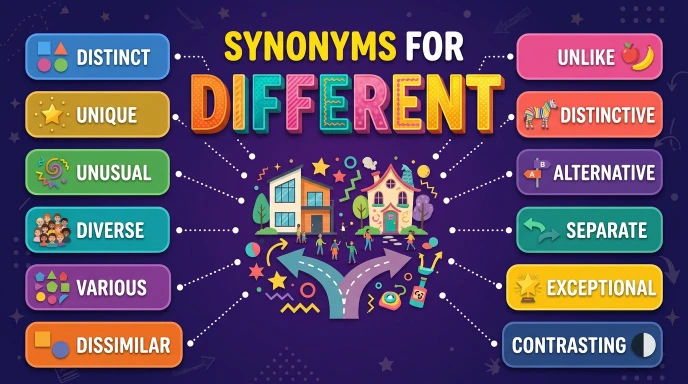
Synonyms for different include distinct, dissimilar, diverse, unlike, separate, varied, unique, and unusual.
These words describe people, places, things, ideas, or situations that are not the same. Some synonyms show a clear difference, while others describe something special, uncommon, or opposite. Learning these words can help you improve your English vocabulary and make your writing more interesting.
You can use them in school essays, emails, conversations, and professional writing. In this guide, you will find 50 useful alternatives to different, along with simple meanings and natural examples. You will also learn how to choose the right word for each situation.
50 Synonyms for Different
1. Distinct
Meaning: Clearly separate or not the same as something else.
Examples:
- The two ideas have distinct meanings.
- Each room has a distinct style.
2. Dissimilar
Meaning: Not alike in appearance, nature, or quality.
Examples:
- The two paintings look dissimilar.
- Their opinions are dissimilar.
3. Diverse
Meaning: Including many different types or kinds.
Examples:
- Our school has a diverse group of students.
- The city has a diverse culture.
4. Unlike
Meaning: Not similar to someone or something.
Examples:
- This design is unlike the old one.
- Unlike his brother, Ali enjoys reading.
5. Unalike
Meaning: Not similar to each other.
Examples:
- The two sisters have unalike personalities.
- These shapes are unalike.
6. Separate
Meaning: Not joined or kept apart from something else.
Examples:
- We have separate rooms.
- The teacher gave us separate tasks.
7. Varied
Meaning: Including several different types or forms.
Examples:
- The restaurant offers varied meals.
- She has varied interests.
8. Unique
Meaning: Very special or unlike anything else.
Examples:
- She has a unique way of thinking.
- This shop sells unique gifts.
9. Unusual
Meaning: Not common or expected.
Examples:
- He wore an unusual jacket.
- We saw an unusual bird.
10. Disparate
Meaning: Very different in kind or nature.
Examples:
- The report covers disparate topics.
- They came from disparate backgrounds.
11. Individual
Meaning: Belonging to one person or thing rather than a group.
Examples:
- Every student has an individual learning style.
- Each artist has an individual approach.
12. Alternative
Meaning: Another choice that is different from the first one.
Examples:
- We need an alternative plan.
- She chose an alternative route.
13. Divergent
Meaning: Developing or moving in different directions.
Examples:
- They have divergent views.
- The two paths follow divergent routes.
14. Contrasting
Meaning: Showing clear differences.
Examples:
- The room has contrasting colors.
- Their styles are contrasting.
15. Varying
Meaning: Changing or not staying the same.
Examples:
- Students have varying needs.
- The products come in varying sizes.
16. Unrelated
Meaning: Having no clear connection with something else.
Examples:
- These are unrelated questions.
- The two events are unrelated.
17. Independent
Meaning: Separate and not controlled by another person or thing.
Examples:
- The team made an independent choice.
- Each unit works as an independent part.
18. Uncommon
Meaning: Not often seen, found, or experienced.
Examples:
- This flower is uncommon in our area.
- He has an uncommon talent.
19. Novel
Meaning: New or different from what is usual.
Examples:
- The team suggested a novel idea.
- She tried a novel approach.
20. Distinctive
Meaning: Having a special quality that makes something easy to recognize.
Examples:
- The singer has a distinctive voice.
- The building has a distinctive design.
21. Special
Meaning: Not ordinary or common.
Examples:
- This day is special to me.
- She has a special talent.
22. Nonidentical
Meaning: Not exactly the same.
Examples:
- The twins are nonidentical.
- These copies are nonidentical.
23. Inconsistent
Meaning: Not staying the same in quality, behavior, or results.
Examples:
- His answers were inconsistent.
- The service has been inconsistent.
24. Contrary
Meaning: Opposite or very different in nature.
Examples:
- She holds a contrary opinion.
- His actions were contrary to his words.
25. Opposing
Meaning: Against another idea, opinion, or position.
Examples:
- The groups have opposing views.
- They presented opposing arguments.
26. Incompatible
Meaning: Unable to work or exist well together.
Examples:
- These two devices are incompatible.
- Their goals seem incompatible.
27. Disconnected
Meaning: Not linked or connected.
Examples:
- The story has disconnected parts.
- These ideas seem disconnected.
28. Unconventional
Meaning: Not following common ways or traditions.
Examples:
- He has an unconventional style.
- They chose an unconventional method.
29. Exceptional
Meaning: Much better or greater than what is usual.
Examples:
- She has exceptional skills.
- The team gave an exceptional performance.
30. Out of the ordinary
Meaning: Not usual or expected.
Examples:
- Nothing was out of the ordinary.
- Her idea was out of the ordinary.
31. Differing
Meaning: Not being the same as something else.
Examples:
- They have differing views.
- The report includes differing opinions.
32. Another
Meaning: A different person or thing of the same general kind.
Examples:
- Can you show me another option?
- Let’s try another way.
33. Various
Meaning: Several different types or kinds.
Examples:
- The store sells various products.
- We discussed various topics.
34. Assorted
Meaning: Made up of different types or items.
Examples:
- She bought an assorted box of chocolates.
- The shop sells assorted snacks.
35. Mixed
Meaning: Made up of different kinds or elements.
Examples:
- The class has a mixed group of students.
- We received mixed responses.
36. Multifarious
Meaning: Having many different parts, types, or features.
Examples:
- The project has multifarious goals.
- The city offers multifarious activities.
37. Heterogeneous
Meaning: Made up of different kinds of people or things.
Examples:
- The sample was heterogeneous.
- The city has a heterogeneous population.
38. Variegated
Meaning: Having different colors or patterns.
Examples:
- The garden has variegated leaves.
- She wore a variegated scarf.
39. Multifaceted
Meaning: Having many different parts or aspects.
Examples:
- The issue is multifaceted.
- She has a multifaceted career.
40. Discrepant
Meaning: Not matching or agreeing with something else.
Examples:
- The reports contain discrepant details.
- We found discrepant figures.
41. Incongruent
Meaning: Not suitable or not in agreement with something.
Examples:
- His words seemed incongruent with his actions.
- The colors looked incongruent together.
42. Polar
Meaning: Completely opposite or very different.
Examples:
- They have polar opinions.
- The two groups hold polar views.
43. Worlds apart
Meaning: Extremely different from each other.
Examples:
- Their lifestyles are worlds apart.
- The two designs are worlds apart.
44. Poles apart
Meaning: Completely different or opposite.
Examples:
- Their views are poles apart.
- The two teams have poles apart strategies.
45. Not the same
Meaning: Different from another person or thing.
Examples:
- These two answers are not the same.
- Our plans are not the same.
46. Not alike
Meaning: Having different features or qualities.
Examples:
- The two brothers are not alike.
- These products are not alike.
47. Of another kind
Meaning: Belonging to a different type or group.
Examples:
- This challenge is of another kind.
- Her work is of another kind.
48. Of a different sort
Meaning: Different in type, style, or nature.
Examples:
- We need a solution of a different sort.
- This is a problem of a different sort.
49. Set apart
Meaning: Different in a way that makes someone or something stand out.
Examples:
- Her talent sets her apart from others.
- The design sets this product apart.
50. One of a kind
Meaning: Completely unique or unlike anything else.
Examples:
- Her artwork is one of a kind.
- This handmade gift is one of a kind.
How to Choose the Right Synonym for Different
Choose a synonym based on the meaning of your sentence:
- Use distinct when two things are clearly separate.
- Use dissimilar when comparing things that are not alike.
- Use diverse when a group includes many types.
- Use unique when something is special or one of a kind.
- Use unusual when something is not common.
- Use opposing when two ideas disagree.
- Use alternative when you mean another choice.
- Use varied when something includes different types or forms.
Different Synonyms in Different Contexts
| Context | Useful Synonyms | Example |
| People | Diverse, individual, dissimilar | We have diverse interests. |
| Ideas | Distinct, divergent, opposing | They shared opposing views. |
| Things | Separate, unlike, varied | The shop sells varied products. |
| Styles | Unique, distinctive, unconventional | She has a distinctive style. |
| Choices | Alternative, another, various | We need an alternative plan. |
| Results | Discrepant, inconsistent, varying | The reports show discrepant results. |
Exercise: Fill in the Blanks
Choose the best synonym for different from the words in brackets.
- The two sisters have ______ personalities. (dissimilar / common)
- Our school has a ______ group of students. (diverse / identical)
- She has a ______ way of solving problems. (unique / ordinary)
- We need an ______ plan for the event. (alternative / similar)
- Their opinions are ______. (opposing / equal)
- This flower is ______ in our area. (uncommon / usual)
- The two colors look ______ together. (contrasting / identical)
- Each student has an ______ learning style. (individual / shared)
Answers:
- Dissimilar
- Diverse
- Unique
- Alternative
- Opposing
- Uncommon
- Contrasting
- Individual
Context Based MCQs
1. Which word means “not similar”?
A. Dissimilar
B. Identical
C. Common
D. Equal
Answer: A. Dissimilar
2. Which word describes something that is not common?
A. Usual
B. Unusual
C. Regular
D. Normal
Answer: B. Unusual
3. Which word means “made up of many types”?
A. Separate
B. Unique
C. Diverse
D. Single
Answer: C. Diverse
4. Which word means “another choice”?
A. Alternative
B. Identical
C. Similar
D. Equal
Answer: A. Alternative
5. Which word describes two ideas that are against each other?
A. Related
B. Opposing
C. Common
D. Alike
Answer: B. Opposing
FAQs About Synonyms for Different
1. What are the most common synonyms for different?
The most common synonyms include distinct, dissimilar, diverse, unlike, separate, varied, unique, and unusual.
2. What is a simple word for different?
Unlike is a simple alternative to different. It means that two people or things are not similar.
3. What is a formal synonym for different?
Disparate, divergent, distinct, and dissimilar are formal alternatives to different.
4. What is another word for different in writing?
You can use distinct, varied, diverse, unique, or unconventional, depending on your sentence.
5. What is the opposite of different?
Common opposites include same, similar, alike, identical, and equal.
Conclusion
Learning synonyms for different can make your English writing clearer and more interesting. Words like distinct, diverse, dissimilar, unique, and unusual help you describe differences in many ways.
Choose each word based on its meaning and the context of your sentence. With regular practice, you can use these words with more confidence in schoolwork, daily conversations, and professional writing.
Discover More Articles:

Hi, I’m Emma Wilson, an English vocabulary writer helping learners improve their word skills with synonyms, meanings, examples, and quizzes. I create simple resources to make English learning easier.