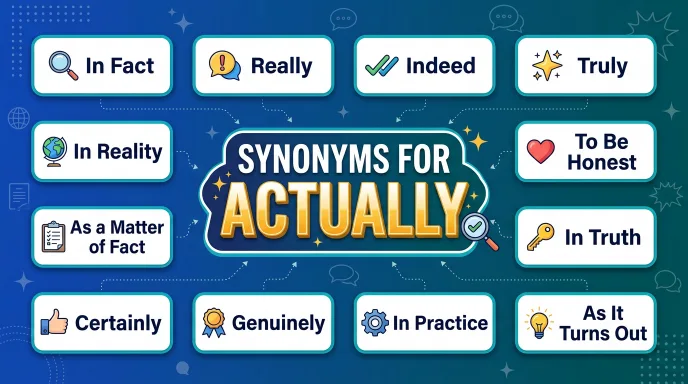
Synonyms for actually include really, truly, in fact, indeed, genuinely, literally, and in reality. The best alternative depends on how you use the word in a sentence. Actually can show that something is true, correct a misunderstanding, or add an important fact.
For example, “I actually enjoyed the movie” means you really enjoyed it, while “Actually, the store is closed” corrects what someone believes. Students, writers, and English learners can use these alternatives to make their sentences clearer and more natural.
Learning these 25 synonyms for actually will help you express facts, correct mistakes politely, and improve your everyday English vocabulary.
What Are Synonyms for Actually?
Common synonyms for actually include really, truly, in fact, indeed, genuinely, in reality, and as a matter of fact. These words and phrases can emphasize truth, provide clarification, or correct a misunderstanding. The best choice depends on the sentence because some alternatives are more formal or have slightly different meanings.
Meaning of Actually
Definition
Actually is an adverb used to show what is true or real. It can also introduce a correction, clarify information, or express surprise when reality differs from expectations.
Examples
- I actually liked the book.
- Actually, the meeting starts at nine.
- She is actually much older than I thought.
- The answer is actually quite simple.
Connotative Meaning
The word actually is often neutral, but its tone depends on how it is used. It can emphasize a fact, show surprise, or correct another person’s statement.
For example, “Actually, I already finished” may sound helpful and informative. In a sharp tone, it may sound like a correction or disagreement.
Etymology
Actually comes from actual plus the adverb-forming suffix -ly. Actual entered English through French from Latin actualis, related to action or something that exists in reality.
Pronunciation: US and UK IPA
- US English: /ˈæk.tʃu.ə.li/
- UK English: /ˈæk.tʃu.ə.li/
In casual speech, some speakers pronounce it more like “ak-shuh-lee.”
Syllables
Actually is commonly divided into four syllables: ac-tu-al-ly. In everyday speech, the middle sounds may be reduced.
Affixation Pattern
- Base adjective: actual
- Adverb: actually
- Suffix: -ly
Examples:
- The actual cost was lower than expected.
- The product actually works.
- We checked the actual results.
Related Concepts
- Truth
- Reality
- Accuracy
- Clarification
- Emphasis
- Correction
- Genuine information
- Factual statements
Complete Synonyms List for Actually
These alternatives can express truth, emphasis, or clarification. They are not interchangeable in every sentence.
| No. | Synonym or Alternative | Simple Meaning | Formality |
| 1 | Really | Truly or in fact | Neutral |
| 2 | Truly | In a genuine or truthful way | Neutral |
| 3 | In fact | Used to add or correct information | Neutral |
| 4 | Indeed | Certainly or truly | Formal |
| 5 | Genuinely | Honestly or sincerely | Neutral |
| 6 | In reality | In the real situation | Neutral |
| 7 | As a matter of fact | Used to emphasize a fact or correction | Neutral |
| 8 | Certainly | Without doubt | Neutral |
| 9 | Definitely | Without uncertainty | Neutral |
| 10 | Honestly | In an honest or sincere way | Neutral |
| 11 | Literally | In the exact sense of the words | Neutral |
| 12 | In truth | In reality or truthfully | Formal |
| 13 | To be precise | Used to make information exact | Neutral |
| 14 | To tell the truth | Used to introduce an honest statement | Neutral |
| 15 | In practice | In real use or real situations | Formal |
| 16 | As it happens | Used to introduce a relevant fact | Neutral |
| 17 | As it turns out | Used to describe what was discovered | Neutral |
| 18 | In point of fact | Used to emphasize a fact | Very formal |
| 19 | For real | Genuinely or seriously | Informal |
| 20 | No kidding | Used to show surprise or emphasize truth | Informal |
| 21 | In actuality | In reality | Formal |
| 22 | Really and truly | With strong emphasis on truth | Informal |
| 23 | To be honest | Used to introduce a sincere opinion | Neutral |
| 24 | Correctly | In an accurate or right way | Neutral |
| 25 | Factually | According to facts | Formal |
Important: Some alternatives have specific uses. Literally means in the exact sense, correctly means accurately, and to be honest introduces a sincere statement. They cannot replace actually in every context.
Formality Comparison
Formal alternatives
- Indeed
- In truth
- In actuality
- In point of fact
- Factually
Neutral alternatives
- Really
- Truly
- In fact
- Genuinely
- In reality
- Certainly
Informal alternatives
- For real
- No kidding
- Really and truly
Choose an alternative that fits your sentence and the tone you want.
Detailed Synonyms for Actually
1. Really
Part of speech: Adverb
US IPA: /ˈriː.ə.li/
UK IPA: /ˈrɪə.li/
Meaning: Truly or to a significant degree.
Formality: Neutral
- Formal example: The results really support the original conclusion.
- Informal example: I really like your new shoes.
2. Truly
Part of speech: Adverb
US IPA: /ˈtruː.li/
UK IPA: /ˈtruː.li/
Meaning: In a truthful, genuine, or sincere way.
Formality: Neutral
- Formal example: The discovery was truly significant.
- Informal example: I truly appreciate your help.
3. In Fact
Part of speech: Adverbial phrase
Pronunciation: /ɪn fækt/
Meaning: Used to add a fact or correct a mistaken idea.
Formality: Neutral
- Formal example: The report was not delayed; in fact, it arrived early.
- Informal example: I thought he was busy. In fact, he was waiting for us.
4. Indeed
Part of speech: Adverb
US IPA: /ɪnˈdiːd/
UK IPA: /ɪnˈdiːd/
Meaning: Certainly, truly, or as a way to emphasize a statement.
Formality: Formal
- Formal example: The findings are indeed important.
- Informal example: That was indeed a great meal.
5. Genuinely
Part of speech: Adverb
US IPA: /ˈdʒen.ju.ɪn.li/
UK IPA: /ˈdʒen.ju.ɪn.li/
Meaning: In a sincere or real way.
Formality: Neutral
- Formal example: The organization is genuinely committed to improving access.
- Informal example: I am genuinely happy for you.
6. In Reality
Part of speech: Adverbial phrase
Pronunciation: /ɪn riˈæl.ə.ti/
Meaning: In the real situation, rather than how something appears.
Formality: Neutral
- Formal example: In reality, the project required more funding than expected.
- Informal example: It looks easy, but in reality, it takes practice.
7. As a Matter of Fact
Part of speech: Adverbial phrase
Pronunciation: /æz ə ˌmæt̬.ɚ əv ˈfækt/ (US), /æz ə ˌmæt.ər əv ˈfækt/ (UK)
Meaning: Used to emphasize a fact or correct a belief.
Formality: Neutral
- Formal example: As a matter of fact, the figures confirm the opposite conclusion.
- Informal example: As a matter of fact, I have already seen that movie.
8. Certainly
Part of speech: Adverb
US IPA: /ˈsɝː.tən.li/
UK IPA: /ˈsɜː.tən.li/
Meaning: Without doubt or with confidence.
Formality: Neutral
- Formal example: The new policy will certainly affect the results.
- Informal example: I can certainly help you with that.
9. Definitely
Part of speech: Adverb
US IPA: /ˈdef.ɪ.nət.li/
UK IPA: /ˈdef.ɪ.nət.li/
Meaning: Without uncertainty or doubt.
Formality: Neutral
- Formal example: The evidence definitely supports further investigation.
- Informal example: I will definitely call you tonight.
10. Honestly
Part of speech: Adverb
US IPA: /ˈɑː.nəst.li/
UK IPA: /ˈɒn.ɪst.li/
Meaning: In an honest or sincere way.
Formality: Neutral
- Formal example: Honestly, the available evidence is not sufficient to support that claim.
- Informal example: Honestly, I thought the movie was boring.
11. Literally
Part of speech: Adverb
US IPA: /ˈlɪt̬.ɚ.ə.li/
UK IPA: /ˈlɪt.ər.ə.li/
Meaning: In the exact or original sense of the words.
Formality: Neutral
- Formal example: The phrase should be interpreted literally in this passage.
- Informal example: I literally walked five miles to get here.
Usage note: Avoid using literally just to mean “very” when you want precise formal writing.
12. In Truth
Part of speech: Adverbial phrase
Pronunciation: /ɪn truːθ/
Meaning: In reality or according to the truth.
Formality: Formal
- Formal example: In truth, the proposal had several serious weaknesses.
- Informal example: In truth, I was nervous about the interview.
13. To Be Precise
Part of speech: Phrase
Pronunciation: /tə biː prɪˈsaɪs/
Meaning: Used to give exact or more accurate information.
Formality: Neutral
- Formal example: The sample contained 48 items, to be precise.
- Informal example: I arrived at eight, to be precise.
14. To Tell the Truth
Part of speech: Phrase
Pronunciation: /tə tel ðə truːθ/
Meaning: Used to introduce an honest statement.
Formality: Neutral
- Formal example: To tell the truth, the evidence remains inconclusive.
- Informal example: To tell the truth, I forgot about the appointment.
15. In Practice
Part of speech: Adverbial phrase
Pronunciation: /ɪn ˈpræk.tɪs/
Meaning: In real situations rather than only in theory.
Formality: Formal
- Formal example: The plan appears effective, but in practice, it is difficult to apply.
- Informal example: The recipe sounds simple, but in practice, it takes time.
16. As It Happens
Part of speech: Phrase
Pronunciation: /æz ɪt ˈhæp.ənz/
Meaning: Used to introduce a relevant or unexpected fact.
Formality: Neutral
- Formal example: As it happens, the data support the earlier prediction.
- Informal example: As it happens, I know her brother.
17. As It Turns Out
Part of speech: Phrase
Pronunciation: /æz ɪt tɝːnz aʊt/ (US), /æz ɪt tɜːnz aʊt/ (UK)
Meaning: Used to introduce what was discovered later.
Formality: Neutral
- Formal example: As it turns out, the initial estimate was accurate.
- Informal example: As it turns out, we were at the right address.
18. In Point of Fact
Part of speech: Adverbial phrase
Pronunciation: /ɪn pɔɪnt əv fækt/
Meaning: Used to emphasize what is factually true.
Formality: Very formal
- Formal example: In point of fact, the contract was signed before the deadline.
- Informal example: In point of fact, I never agreed to that plan.
19. For Real
Part of speech: Adverbial phrase
Pronunciation: /fɔːr riːl/ (US), /fə riːl/ (UK)
Meaning: Genuinely or seriously; often used in casual speech.
Formality: Informal
- Formal example: The participants were asked to confirm that the offer was genuine.
- Informal example: Are you for real? That is amazing!
20. No Kidding
Part of speech: Phrase
Pronunciation: /noʊ ˈkɪd.ɪŋ/
Meaning: Used to express surprise or emphasize that something is true.
Formality: Informal
- Formal example: The statement was verified rather than accepted without evidence.
- Informal example: No kidding! You met the singer?
Usage note: No kidding often expresses surprise. It is not a general replacement for actually.
21. In Actuality
Part of speech: Adverbial phrase
Pronunciation: /ɪn ˌæk.tʃuˈæl.ə.ti/
Meaning: In the real situation or in fact.
Formality: Formal
- Formal example: In actuality, the process was more complex than the report suggested.
- Informal example: In actuality, the trip was shorter than we expected.
22. Really and Truly
Part of speech: Adverbial phrase
Pronunciation: /ˈriː.ə.li ənd ˈtruː.li/
Meaning: Used to add strong emphasis to a statement.
Formality: Informal
- Formal example: The team was sincerely committed to the project’s success.
- Informal example: I really and truly appreciate what you did.
23. To Be Honest
Part of speech: Phrase
Pronunciation: /tə bi ˈɑː.nɪst/ (US), /tə bi ˈɒn.ɪst/ (UK)
Meaning: Used to introduce a sincere opinion or admission.
Formality: Neutral
- Formal example: To be honest, the available evidence does not support the conclusion.
- Informal example: To be honest, I do not like that color.
24. Correctly
Part of speech: Adverb
US IPA: /kəˈrekt.li/
UK IPA: /kəˈrekt.li/
Meaning: In an accurate or right way.
Formality: Neutral
- Formal example: The figures were correctly reported in the final document.
- Informal example: You guessed correctly; the answer is seven.
Usage note: Correctly focuses on accuracy, not simply on emphasizing that something is real.
25. Factually
Part of speech: Adverb
US IPA: /ˈfæk.tʃu.ə.li/
UK IPA: /ˈfæk.tʃu.ə.li/
Meaning: In a way that is based on facts or is factually accurate.
Formality: Formal
- Formal example: The article was factually accurate and carefully reviewed.
- Informal example: Factually, that is not what happened.
Prototype Meaning of Actually
The central meaning of actually is in reality or in fact. It helps show what is true, especially when the truth differs from what someone expects or believes.
Examples:
- Emphasis: “I actually enjoyed the lesson.”
- Correction: “Actually, the shop closes at six.”
- Clarification: “The trip takes two hours, actually.”
- Surprise: “She actually won the competition!”
Choose a synonym based on the purpose. Really often works for emphasis, in fact is useful for corrections, and in reality highlights the difference between appearances and facts.
Synonyms for Actually by Category
1. Synonyms for Actually Meaning “Really”
- Really
- Truly
- Genuinely
- Indeed
- Really and truly
Example: I genuinely enjoyed the event.
2. Synonyms for Actually Used to Correct Someone
- In fact
- As a matter of fact
- In truth
- In actuality
- In point of fact
Example: In fact, the meeting was moved to Friday.
3. Synonyms for Actually Meaning “In Reality”
- In reality
- In actuality
- In truth
- As it turns out
Example: In reality, the task was easier than it looked.
4. Synonyms for Actually in Casual Conversation
- Really
- Honestly
- For real
- No kidding
- To tell the truth
Example: Honestly, I did not expect that result.
5. Alternatives for Precision and Accuracy
- To be precise
- Correctly
- Factually
- In practice
Example: To be precise, the event begins at 9:30 a.m.
Antonyms of Actually
Actually does not have one perfect antonym for every context. Depending on the meaning, these words and phrases may express contrast.
| Antonym or Contrast | Meaning | Example |
| Apparently | As something seems or appears | Apparently, the shop is open. |
| Supposedly | According to a claim that may not be confirmed | Supposedly, the package arrived. |
| Theoretically | In theory, not necessarily in practice | Theoretically, the plan should work. |
| Hypothetically | In an imagined situation | Hypothetically, we could leave early. |
| Falsely | In an untrue or incorrect way | The information was falsely reported. |
| Imaginatively | In a creative or invented way | She imaginatively described a fictional world. |
These are contextual contrasts rather than exact antonyms. For example, apparently refers to how something seems, while actually often emphasizes what is true.
Quiz: Test Your Knowledge of Actually Synonyms
1. Which phrase is commonly used to correct a misunderstanding?
A. In fact
B. Beautifully
C. Slowly
D. Rarely
2. Which word means “in a genuine or sincere way”?
A. Genuinely
B. Hypothetically
C. Apparently
D. Falsely
3. Which phrase is best for giving exact information?
A. No kidding
B. To be precise
C. For real
D. Really and truly
4. Which word means “in the exact sense of the words”?
A. Honestly
B. Literally
C. Certainly
D. Indeed
5. Which phrase is informal and can express surprise?
A. In actuality
B. In point of fact
C. No kidding
D. Factually
6. Which alternative emphasizes how something works in real situations rather than in theory?
A. In practice
B. Supposedly
C. Hypothetically
D. Apparently
Answer Key
- A — In fact
- A — Genuinely
- B — To be precise
- B — Literally
- C — No kidding
- A — In practice
Usage Tips for Actually and Its Synonyms
- Use really to add emphasis in everyday speech.
- Use in fact to introduce a fact or correct a mistaken idea.
- Use indeed in more formal writing to emphasize a point.
- Use genuinely when you want to stress that a feeling or action is sincere.
- Use in reality when the truth differs from appearances or expectations.
- Use to be precise when giving an exact detail, number, or time.
- Use honestly or to be honest to introduce a sincere opinion.
- Use literally only when you mean the exact sense, especially in formal writing.
- Do not use certainly or definitely as automatic replacements for actually. They express confidence rather than simply stating what is real.
- Avoid starting every correction with actually, as it can sound abrupt if used too often. Try in fact or state the correct information directly.
Frequently Asked Questions About Synonyms for Actually
1. What are the most common synonyms for actually?
Common alternatives include really, truly, in fact, indeed, genuinely, and in reality. The best choice depends on the sentence and the meaning you want to express.
2. What is a simple synonym for actually?
Really is a simple, common alternative. For example, “I actually like it” can become “I really like it,” although the emphasis may change slightly.
3. What is a formal synonym for actually?
Indeed, in actuality, and in point of fact can work in formal contexts. In many cases, in fact is clearer and more natural.
4. What is the difference between actually and really?
Both can emphasize truth or a fact. Actually often corrects an assumption or highlights a surprising fact, while really often adds emphasis or expresses degree.
5. Can I use literally instead of actually?
Sometimes, but the words have different meanings. Literally means in the exact sense of the words, while actually means in reality or in fact.
6. What is the opposite of actually?
There is no single exact opposite. Words such as apparently, supposedly, and hypothetically can contrast with actually in some contexts.
7. How can I use actually in a sentence?
Use actually to emphasize a fact or correct information. For example: “Actually, I have already completed the assignment.”
Conclusion
Learning synonyms for actually can make your English clearer and more natural. Words and phrases such as really, truly, in fact, indeed, genuinely, and in reality are useful in conversations, essays, and professional writing.
Each alternative has a slightly different purpose. Really adds emphasis, in fact often introduces a correction, and to be precise helps you give exact information.
Remember that not every alternative fits every sentence. Literally refers to an exact meaning, while definitely expresses certainty. Choose the word that best matches your intention and the tone of your writing. With regular practice, you can use these alternatives confidently and avoid repeating actually too often.
Discover More Articles:

Hi, I’m Nabeel Hassan, an English vocabulary writer helping learners improve their word skills with easy synonyms, meanings, examples, and quizzes. I create simple resources to make English learning easier and more effective.