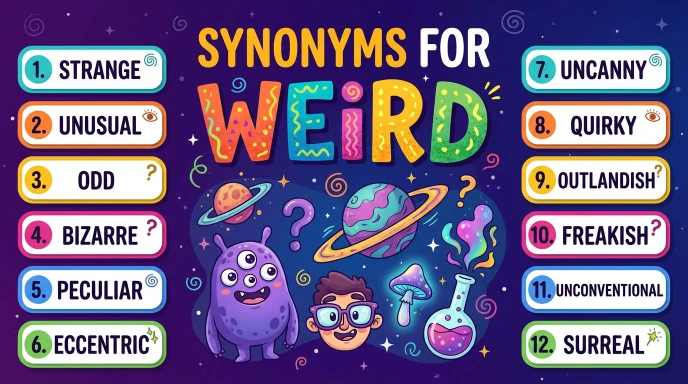
Synonyms for weird include strange, unusual, odd, bizarre, peculiar, quirky, eccentric, and unconventional.
These words describe people, places, objects, or situations that seem different from what we normally expect. However, each word has its own meaning. For example, bizarre describes something extremely strange, while quirky often describes something unusual in a charming or interesting way.
Learning these alternatives can help students, English learners, bloggers, and content writers express their ideas more clearly. In this guide, you will discover 25 useful synonyms for weird, along with simple definitions, pronunciation, natural examples, and tips for choosing the right word.
Meaning of Weird
Definition
Weird is an adjective that describes something strange, unusual, or different from what people normally expect. It can describe a person, behavior, experience, object, or situation.
Examples
- I heard a weird noise outside my window.
- He has a weird sense of humor.
Connotative Meaning
The word weird can have a negative, neutral, or positive meaning depending on the situation. It may describe something frightening or confusing, but it can also describe something creative, unusual, or interesting.
Etymology
The word weird comes from Old English wyrd, meaning fate or destiny. Its meaning later developed to describe something supernatural, strange, or unusual.
Pronunciation
- US IPA: /wɪrd/
- UK IPA: /wɪəd/
Syllables
Weird — 1 syllable.
Affixation Pattern
Weird is a base adjective with no productive prefix or suffix in its basic form.
Related forms include weirdly (adverb) and weirdness (noun).
Related Concepts
- Strangeness: The quality of being unusual.
- Unusual: Different from what is common.
- Oddity: Something strange or uncommon.
- Eccentricity: Unusual behavior or personality.
- Normality: The state of being usual or expected.
Complete Synonyms List
Here are 25 synonyms for weird, with their meanings and formality levels.
| Synonym | Meaning | Formality Level |
| 1. Strange | Different from what is normal | Neutral |
| 2. Unusual | Not common or ordinary | Neutral |
| 3. Odd | Strange or unexpected | Neutral |
| 4. Bizarre | Extremely strange | Neutral |
| 5. Peculiar | Unusual or distinctive | Neutral |
| 6. Eccentric | Unconventional, especially in behavior | Neutral |
| 7. Quirky | Unusual in an interesting or charming way | Informal |
| 8. Unconventional | Different from accepted practices | Formal |
| 9. Outlandish | Extremely unusual or surprising | Neutral |
| 10. Curious | Strange or unusual enough to attract attention | Neutral |
| 11. Uncanny | Strange in a mysterious or unsettling way | Formal |
| 12. Surreal | Strange in a dreamlike way | Formal |
| 13. Abnormal | Different from what is considered normal | Formal |
| 14. Atypical | Not typical or usual | Formal |
| 15. Extraordinary | Very unusual or remarkable | Neutral |
| 16. Offbeat | Unusual and different from conventional ideas | Informal |
| 17. Wacky | Funny or strangely unusual | Informal |
| 18. Zany | Unusual in a funny or amusing way | Informal |
| 19. Kooky | Odd in an amusing or playful way | Informal |
| 20. Freakish | Extremely strange or unnatural | Neutral |
| 21. Grotesque | Disturbingly strange or distorted | Formal |
| 22. Otherworldly | Seeming to belong to another world | Neutral |
| 23. Unnatural | Not normal or not found in nature | Neutral |
| 24. Unorthodox | Different from traditional methods or beliefs | Formal |
| 25. Unfamiliar | Not known or recognized | Neutral |
Note: These words are not interchangeable in every sentence. For example, quirky often has a positive tone, while grotesque usually suggests something disturbing or unpleasant.
Formality Comparison
Different synonyms for weird are useful in different situations.
| Formality | Useful Words |
| Formal | Unconventional, abnormal, atypical, uncanny, unorthodox |
| Neutral | Strange, unusual, peculiar, bizarre, extraordinary |
| Informal | Quirky, wacky, zany, kooky, offbeat |
Tip: Use unusual in professional writing and quirky in friendly conversations.
Detailed Synonyms for Weird
1. Strange
Part of Speech: Adjective
US IPA: /streɪndʒ/
UK IPA: /streɪndʒ/
Meaning: Different from what is normal, familiar, or expected.
Formality: Neutral
- Formal: The investigation revealed a strange pattern in the data.
- Informal: That is a strange thing to say.
2. Unusual
Part of Speech: Adjective
US IPA: /ʌnˈjuː.ʒu.əl/
UK IPA: /ʌnˈjuː.ʒu.əl/
Meaning: Not common or different from what normally happens.
Formality: Neutral
- Formal: The researchers observed an unusual change in the results.
- Informal: It is unusual to see him arrive so early.
3. Odd
Part of Speech: Adjective
US IPA: /ɑːd/
UK IPA: /ɒd/
Meaning: Strange, unexpected, or different from what is usual.
Formality: Neutral
- Formal: The report identified an odd inconsistency.
- Informal: That sounds a little odd.
4. Bizarre
Part of Speech: Adjective
US IPA: /bɪˈzɑːr/
UK IPA: /bɪˈzɑː/
Meaning: Extremely strange or unusual, often in a surprising way.
Formality: Neutral
- Formal: The investigation uncovered a bizarre sequence of events.
- Informal: That was a bizarre dream!
5. Peculiar
Part of Speech: Adjective
US IPA: /pɪˈkjuː.li.ɚ/
UK IPA: /pɪˈkjuː.li.ə/
Meaning: Strange or unusual, sometimes in a distinctive way.
Formality: Neutral
- Formal: The scientist noticed a peculiar feature in the sample.
- Informal: This place has a peculiar smell.
6. Eccentric
Part of Speech: Adjective
US IPA: /ɪkˈsen.trɪk/
UK IPA: /ɪkˈsen.trɪk/
Meaning: Unusual or unconventional, especially in someone’s personality or behavior.
Formality: Neutral
- Formal: The artist was known for his eccentric style.
- Informal: My uncle is a little eccentric, but everyone likes him.
7. Quirky
Part of Speech: Adjective
US IPA: /ˈkwɝː.ki/
UK IPA: /ˈkwɜː.ki/
Meaning: Unusual in an interesting, amusing, or charming way.
Formality: Informal
- Formal: The brand uses a quirky design to appeal to younger customers.
- Informal: I love her quirky sense of humor.
8. Unconventional
Part of Speech: Adjective
US IPA: /ˌʌn.kənˈven.ʃən.əl/
UK IPA: /ˌʌn.kənˈven.ʃən.əl/
Meaning: Different from traditional or commonly accepted ways of doing things.
Formality: Formal
- Formal: The company adopted an unconventional approach to problem solving.
- Informal: She has an unconventional way of decorating her room.
9. Outlandish
Part of Speech: Adjective
US IPA: /aʊtˈlæn.dɪʃ/
UK IPA: /aʊtˈlæn.dɪʃ/
Meaning: Extremely unusual, strange, or difficult to believe.
Formality: Neutral
- Formal: The proposal included several outlandish suggestions.
- Informal: He wore an outlandish costume to the party.
10. Curious
Part of Speech: Adjective
US IPA: /ˈkjʊr.i.əs/
UK IPA: /ˈkjʊə.ri.əs/
Meaning: Strange or unusual in a way that attracts attention.
Formality: Neutral
- Formal: The report described a curious pattern in the findings.
- Informal: That is a curious little habit.
11. Uncanny
Part of Speech: Adjective
US IPA: /ʌnˈkæn.i/
UK IPA: /ʌnˈkæn.i/
Meaning: Strange or mysterious in a way that makes you feel uneasy.
Formality: Formal
- Formal: The experiment produced an uncanny resemblance between the two images.
- Informal: There is something uncanny about that empty house.
12. Surreal
Part of Speech: Adjective
US IPA: /səˈriː.əl/
UK IPA: /səˈrɪəl/
Meaning: Strange or dreamlike, as if it is not part of ordinary reality.
Formality: Formal
- Formal: The film creates a surreal atmosphere through unusual imagery.
- Informal: Seeing snow in the desert felt surreal.
13. Abnormal
Part of Speech: Adjective
US IPA: /æbˈnɔːr.məl/
UK IPA: /æbˈnɔː.məl/
Meaning: Different from what is considered normal or typical.
Formality: Formal
- Formal: The test detected an abnormal reading.
- Informal: The machine is making an abnormal noise.
14. Atypical
Part of Speech: Adjective
US IPA: /eɪˈtɪp.ɪ.kəl/
UK IPA: /eɪˈtɪp.ɪ.kəl/
Meaning: Not typical or representative of what usually happens.
Formality: Formal
- Formal: The study examined an atypical case.
- Informal: This is an atypical day for our family.
15. Extraordinary
Part of Speech: Adjective
US IPA: /ɪkˈstrɔːr.də.ner.i/
UK IPA: /ɪkˈstrɔː.dɪ.nər.i/
Meaning: Very unusual or remarkable, often in an impressive way.
Formality: Neutral
- Formal: The discovery revealed an extraordinary feature of the ancient structure.
- Informal: That was an extraordinary experience!
16. Offbeat
Part of Speech: Adjective
US IPA: /ˌɔːfˈbiːt/
UK IPA: /ˌɒfˈbiːt/
Meaning: Unusual and different from traditional or expected styles.
Formality: Informal
- Formal: The magazine is known for its offbeat editorial style.
- Informal: I enjoy offbeat comedy shows.
17. Wacky
Part of Speech: Adjective
US IPA: /ˈwæk.i/
UK IPA: /ˈwæk.i/
Meaning: Very unusual or silly in a funny way.
Formality: Informal
- Formal: The campaign used a wacky concept to attract attention.
- Informal: He always comes up with wacky ideas.
18. Zany
Part of Speech: Adjective
US IPA: /ˈzeɪ.ni/
UK IPA: /ˈzeɪ.ni/
Meaning: Amusingly strange, silly, or unconventional.
Formality: Informal
- Formal: The performance combined zany humor with creative storytelling.
- Informal: Her zany jokes make everyone laugh.
19. Kooky
Part of Speech: Adjective
US IPA: /ˈkuː.ki/
UK IPA: /ˈkuː.ki/
Meaning: Strange or unusual in an amusing and playful way.
Formality: Informal
- Formal: The character is presented as a kooky but lovable individual.
- Informal: My friend has some kooky ideas.
20. Freakish
Part of Speech: Adjective
US IPA: /ˈfriː.kɪʃ/
UK IPA: /ˈfriː.kɪʃ/
Meaning: Extremely unusual or unnatural, sometimes in a disturbing way.
Formality: Neutral
- Formal: The region experienced a freakish weather event.
- Informal: That was a freakish coincidence!
21. Grotesque
Part of Speech: Adjective
US IPA: /ɡroʊˈtesk/
UK IPA: /ɡrəʊˈtesk/
Meaning: Very strange, ugly, or disturbing in appearance or character.
Formality: Formal
- Formal: The artist created a grotesque figure for the exhibition.
- Informal: The creature in that movie looked grotesque.
22. Otherworldly
Part of Speech: Adjective
US IPA: /ˌʌð.ɚˈwɝːld.li/
UK IPA: /ˌʌð.əˈwɜːld.li/
Meaning: Seeming to belong to another world rather than ordinary life.
Formality: Neutral
- Formal: The landscape had an otherworldly appearance.
- Informal: The glowing lights looked otherworldly.
23. Unnatural
Part of Speech: Adjective
US IPA: /ʌnˈnætʃ.ɚ.əl/
UK IPA: /ʌnˈnætʃ.ər.əl/
Meaning: Different from what is natural or normal; sometimes artificial or forced.
Formality: Neutral
- Formal: The experiment produced an unnatural color change.
- Informal: His smile looked unnatural.
24. Unorthodox
Part of Speech: Adjective
US IPA: /ʌnˈɔːr.θə.dɑːks/
UK IPA: /ʌnˈɔː.θə.dɒks/
Meaning: Different from traditional beliefs, rules, or accepted methods.
Formality: Formal
- Formal: The researcher used an unorthodox method to solve the problem.
- Informal: She has an unorthodox way of organizing her desk.
25. Unfamiliar
Part of Speech: Adjective
US IPA: /ˌʌn.fəˈmɪl.jɚ/
UK IPA: /ˌʌn.fəˈmɪl.i.ə/
Meaning: Not known, recognized, or experienced before.
Formality: Neutral
- Formal: The researchers encountered an unfamiliar pattern.
- Informal: This place feels unfamiliar to me.
Prototype Meaning of Weird
A prototype meaning is the central idea people usually connect with a word.
The prototype meaning of weird is something that seems strange, unusual, or different from what people normally expect.
Common examples include:
- A strange sound coming from an empty room.
- A person with an unusual way of speaking.
- An unexpected event that is difficult to explain.
- A mysterious place with an unusual atmosphere.
- A creative idea that is completely different from common ideas.
These examples show the central meaning of weird.
Synonyms for Weird by Category
Different situations need different alternatives. Use these categories to find the best word.
For a Weird Person
- Eccentric
- Quirky
- Unconventional
- Kooky
- Offbeat
For a Weird Situation
- Strange
- Bizarre
- Unusual
- Uncanny
- Surreal
A Weird Behavior
- Odd
- Peculiar
- Eccentric
- Unorthodox
- Abnormal
Weird Object or Appearance
- Grotesque
- Unnatural
- Freakish
- Outlandish
- Otherworldly
For Something Weird but Funny
- Wacky
- Zany
- Kooky
- Quirky
- Offbeat
Antonyms of Weird
Antonyms are words with opposite meanings. Here are some useful opposites of weird.
| Antonym | Meaning |
| Normal | Usual or expected |
| Ordinary | Common and not special |
| Typical | Having the usual qualities |
| Regular | Following a normal pattern |
| Familiar | Known or recognized |
| Common | Found or happening often |
| Conventional | Following accepted traditions |
| Standard | Meeting usual requirements |
| Ordinary looking | Having a familiar appearance |
| Natural | Existing or happening normally |
Quiz: Test Your Knowledge of Weird Synonyms
Choose the correct answer for each question.
1. Which word means extremely strange or unusual?
A. Ordinary
B. Bizarre
C. Familiar
D. Typical
2. Which synonym describes someone who behaves in an unusual way?
A. Eccentric
B. Standard
C. Regular
D. Common
3. What does quirky mean?
A. Completely normal
B. Unusual in an interesting or charming way
C. Very common
D. Extremely boring
4. Which word describes something mysterious and unsettling?
A. Familiar
B. Uncanny
C. Ordinary
D. Typical
5. Which synonym means different from traditional methods?
A. Unorthodox
B. Regular
C. Common
D. Standard
6. Which word describes something strange and dreamlike?
A. Natural
B. Surreal
C. Familiar
D. Ordinary
Answer Key
- B. Bizarre
- A. Eccentric
- B. Unusual in an interesting or charming way
- B. Uncanny
- A. Unorthodox
- B. Surreal
Usage Tips: How to Use Synonyms for Weird
Choosing the right synonym can make your writing more accurate and natural.
- Use strange for something different from what you expect.
- Use bizarre for something extremely unusual or surprising.
- Use peculiar for something unusual or distinctive.
- Use quirky for unusual qualities that seem charming or amusing.
- Use eccentric when describing an unusual personality or lifestyle.
- Use uncanny for something mysterious or unsettling.
- Use surreal for experiences that feel dreamlike or unreal.
- Use unorthodox for methods or ideas that differ from traditional practices.
Remember: Some synonyms have positive meanings, while others sound negative. Choose a word that matches the feeling you want to express.
FAQs About Synonyms for Weird
1. What are the best synonyms for weird?
Some of the best synonyms for weird are strange, unusual, odd, bizarre, peculiar, quirky, and eccentric. These words describe different kinds of unusual people, objects, and situations.
2. What is a formal word for weird?
Unconventional, atypical, abnormal, unorthodox, and uncanny are useful formal alternatives. They work well in academic and professional writing.
3. What is a simple word for weird?
Strange is one of the simplest alternatives to weird. You can use it in everyday conversations and general writing.
4. What is another word for very weird?
Bizarre, freakish, uncanny, and outlandish are strong alternatives for very weird. They describe things that are extremely unusual or surprising.
5. What is the difference between weird and quirky?
Weird can describe anything strange or unusual. Quirky usually describes unusual qualities in a charming, playful, or interesting way.
6. What is the opposite of weird?
The opposite of weird includes normal, ordinary, typical, familiar, and conventional. These words describe things that are common or expected.
7. How can I avoid repeating the word weird?
Use alternatives such as strange, peculiar, bizarre, unusual, eccentric, and unconventional. Choose the word that best matches the situation and tone of your writing.
Conclusion
Learning synonyms for weird can help you describe unusual people, objects, ideas, and experiences more clearly. Words such as strange, bizarre, peculiar, eccentric, and unconventional give you different ways to express something that does not seem normal or expected.
Some alternatives, like quirky and zany, have a playful meaning, while uncanny and grotesque can create a more unsettling impression. Remember that every synonym has its own tone and meaning. Practice using these words in conversations, school assignments, and blog posts to improve your English vocabulary and make your writing more expressive.
Discover More Articles:

Hi, I’m Emma Collins, and I enjoy creating simple English vocabulary resources that make learning easier for everyone. I write about synonyms, antonyms, word meanings, vocabulary lists, and writing tips using clear, everyday language. My goal is to help students, writers, teachers, and English learners build their vocabulary, improve their writing, and feel more confident using English. I take time to research every article carefully so the information is accurate, practical, and easy to understand.