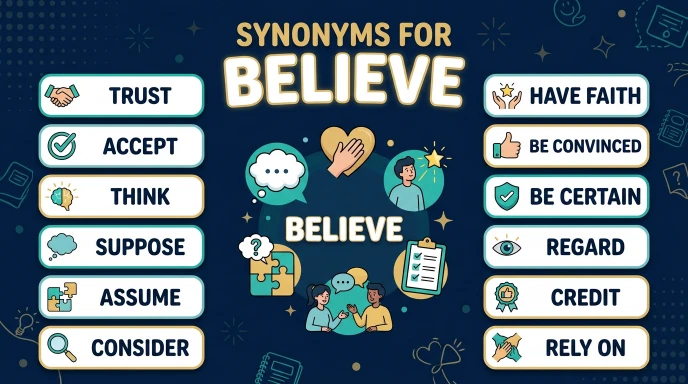
Synonyms for believe include think, trust, accept, suppose, assume, consider, feel, presume, and be convinced.
These words express confidence, opinions, trust, or acceptance of an idea. However, each alternative has a slightly different meaning. Some describe having faith in someone, while others express an opinion or accept something as true.
Learning different ways to say believe can make your English more natural and expressive. Students, English learners, bloggers, and content writers can use these alternatives in essays, conversations, emails, and professional writing. This guide explains 25 useful synonyms with simple meanings, pronunciation, and practical examples.
Meaning of Believe
Definition
Believe is a verb that means accepting something as true, having confidence in an idea, or trusting someone or something. It can also describe having faith in a person, statement, or possibility.
Examples
- I believe that hard work leads to success.
- She believes her friend will keep the promise.
Connotative Meaning
The word believe usually expresses trust, confidence, or acceptance. It can show a strong personal opinion, faith in someone, or an understanding that something is true. Its meaning depends on the situation and the level of certainty.
Etymology
The word believe comes from Old English belȳfan or belēfan, meaning to believe or trust. It developed from an older Germanic root associated with holding something dear or trusting it.
Pronunciation
- US IPA: /bɪˈliːv/
- UK IPA: /bɪˈliːv/
Syllables
Be lieve: 2 syllables.
Affixation Pattern
Believe is a base verb in modern English. It forms several related words:
- Belief: Believe → belief (noun form)
- Believable: Believe + able
- Believer: Believe + er
- Unbelievable: Un + believable
- Disbelief: Dis + belief
Related Concepts
- Faith: Strong trust or confidence in someone or something.
- Trust: Confidence in someone’s honesty or reliability.
- Opinion: A personal view about something.
- Conviction: A firmly held belief.
- Acceptance: Agreement that something is true or valid.
Complete Synonyms List for Believe
Here are useful alternatives for believe.
| Synonym | Meaning | Formality Level |
| 1. Think | To have an opinion or idea | Neutral |
| 2. Trust | To have confidence in someone or something | Neutral |
| 3. Accept | To regard something as true or valid | Neutral |
| 4. Suppose | To think something is probably true | Neutral |
| 5. Assume | To accept something as true without proof | Neutral |
| 6. Consider | To regard something in a particular way | Neutral |
| 7. Feel | To have a personal opinion or impression | Informal |
| 8. Presume | To accept something as likely or true | Formal |
| 9. Be convinced | To feel certain that something is true | Neutral |
| 10. Have faith | To trust or feel confident in someone or something | Neutral |
| 11. Have confidence | To feel sure about someone or something | Neutral |
| 12. Rely on | To trust someone or something for support | Neutral |
| 13. Count on | To trust someone to do something | Informal |
| 14. Credit | To accept something as true or give someone recognition | Formal |
| 15. Regard | To think of someone or something in a particular way | Formal |
| 16. Deem | To consider something to be a certain way | Formal |
| 17. Hold | To maintain an opinion or belief | Formal |
| 18. Maintain | To continue stating that something is true | Formal |
| 19. Suspect | To think something may be true | Neutral |
| 20. Imagine | To form an idea or possibility in your mind | Neutral |
| 21. Infer | To reach a conclusion from available information | Formal |
| 22. Conclude | To decide something is true after thinking | Neutral |
| 23. Be sure | To feel certain about something | Neutral |
| 24. Be of the opinion | To hold a particular view | Formal |
| 25. Be under the impression | To believe something based on your understanding | Neutral |
Note: These alternatives have different meanings. For example, trust often takes a person or thing as object, while assume can introduce an idea without proof.
Formality Comparison of Believe Synonyms
Different alternatives to believe are suitable for different writing situations.
| Formality | Synonyms | Common Use |
| Formal | Presume, deem, regard, maintain, infer | Academic and professional writing |
| Neutral | Think, trust, accept, suppose, assume, consider | Everyday writing and conversation |
| Informal | Feel, count on, be sure | Casual conversations |
Writing tip: Use think to express an opinion, trust to show confidence in someone, and assume when accepting something as true without proof.
Detailed Synonyms for Believe
1. Think
Part of Speech: Verb
US IPA: /θɪŋk/
UK IPA: /θɪŋk/
Meaning: To have an opinion or idea about something.
Formality: Neutral
Formal Example: Researchers think that regular exercise can improve mental well being.
Informal Example: I think this movie is really interesting.
2. Trust
Part of Speech: Verb
US IPA: /trʌst/
UK IPA: /trʌst/
Meaning: To have confidence in someone’s honesty, ability, or reliability.
Formality: Neutral
Formal Example: Customers trust the company because of its consistent service.
Informal Example: I trust my best friend with my secrets.
3. Accept
Part of Speech: Verb
US IPA: /əkˈsept/
UK IPA: /əkˈsept/
Meaning: To regard something as true, valid, or correct.
Formality: Neutral
Formal Example: The committee accepted the findings presented in the report.
Informal Example: I accept that I made a mistake.
4. Suppose
Part of Speech: Verb
US IPA: /səˈpoʊz/
UK IPA: /səˈpəʊz/
Meaning: To think something is probably true without having complete information.
Formality: Neutral
Formal Example: Experts suppose that the new policy will improve public services.
Informal Example: I suppose you’re right about that.
5. Assume
Part of Speech: Verb
US IPA: /əˈsuːm/
UK IPA: /əˈsjuːm/
Meaning: To accept something as true without having proof.
Formality: Neutral
Formal Example: Researchers should not assume that every participant has the same experience.
Informal Example: I assumed you were already at home.
6. Consider
Part of Speech: Verb
US IPA: /kənˈsɪdər/
UK IPA: /kənˈsɪdə/
Meaning: To regard someone or something as having a particular quality or status.
Formality: Neutral
Formal Example: Many experts consider education essential for social development.
Informal Example: I consider her one of my closest friends.
7. Feel
Part of Speech: Verb
US IPA: /fiːl/
UK IPA: /fiːl/
Meaning: To have a personal opinion, impression, or conviction about something.
Formality: Informal
Formal Example: Many employees feel that flexible working improves productivity.
Informal Example: I feel this is the right decision.
8. Presume
Part of Speech: Verb
US IPA: /prɪˈzuːm/
UK IPA: /prɪˈzjuːm/
Meaning: To accept something as likely or true based on available information.
Formality: Formal
Formal Example: The investigators presume that the missing documents were removed accidentally.
Informal Example: I presume you’re coming to the meeting tomorrow.
9. Be Convinced
Part of Speech: Verb phrase
US IPA: /bi kənˈvɪnst/
UK IPA: /bi kənˈvɪnst/
Meaning: To feel certain that something is true.
Formality: Neutral
Formal Example: The committee is convinced that the proposed changes will improve efficiency.
Informal Example: I’m convinced that we’ll win the game.
10. Have Faith
Part of Speech: Verb phrase
US IPA: /hæv feɪθ/
UK IPA: /hæv feɪθ/
Meaning: To trust or feel confident in someone or something.
Formality: Neutral
Formal Example: The organization continues to have faith in its long term development plan.
Informal Example: I have faith in your ability to solve this problem.
11. Have Confidence
Part of Speech: Verb phrase
US IPA: /hæv ˈkɑːnfɪdəns/
UK IPA: /hæv ˈkɒnfɪdəns/
Meaning: To feel sure about someone’s ability, reliability, or success.
Formality: Neutral
Formal Example: The board has confidence in the new leadership team.
Informal Example: I have confidence that you can finish this project.
12. Rely On
Part of Speech: Phrasal verb
US IPA: /rɪˈlaɪ ɑːn/
UK IPA: /rɪˈlaɪ ɒn/
Meaning: To trust someone or something for help, support, or assistance.
Formality: Neutral
Formal Example: Many communities rely on local organizations for essential services.
Informal Example: I rely on my brother when I need advice.
13. Count On
Part of Speech: Phrasal verb
US IPA: /kaʊnt ɑːn/
UK IPA: /kaʊnt ɒn/
Meaning: To trust someone to do something or provide support.
Formality: Informal
Formal Example: The project manager can count on the team to complete the work.
Informal Example: You can count on me whenever you need help.
14. Credit
Part of Speech: Verb
US IPA: /ˈkredɪt/
UK IPA: /ˈkredɪt/
Meaning: To believe that something is true or that someone is responsible for an achievement.
Formality: Formal
Formal Example: The researchers credit the new method with improving the accuracy of the results.
Informal Example: I credit my success to the support of my family.
15. Regard
Part of Speech: Verb
US IPA: /rɪˈɡɑːrd/
UK IPA: /rɪˈɡɑːd/
Meaning: To think of or consider someone or something in a particular way.
Formality: Formal
Formal Example: Many scholars regard the discovery as a major scientific achievement.
Informal Example: I regard him as a very honest person.
16. Deem
Part of Speech: Verb
US IPA: /diːm/
UK IPA: /diːm/
Meaning: To consider or judge something to be a particular way.
Formality: Formal
Formal Example: The panel deemed the proposal suitable for further review.
Informal Example: I deem this a good opportunity to learn.
17. Hold
Part of Speech: Verb
US IPA: /hoʊld/
UK IPA: /həʊld/
Meaning: To maintain or have a particular opinion or belief.
Formality: Formal
Formal Example: Many researchers hold the view that early education is essential.
Informal Example: I hold the opinion that everyone deserves a fair chance.
18. Maintain
Part of Speech: Verb
US IPA: /meɪnˈteɪn/
UK IPA: /meɪnˈteɪn/
Meaning: To continue stating that something is true, especially when others disagree.
Formality: Formal
Formal Example: The author maintains that education can reduce social inequality.
Informal Example: She maintains that she saw the entire event.
19. Suspect
Part of Speech: Verb
US IPA: /səˈspekt/
UK IPA: /səˈspekt/
Meaning: To think something may be true without being completely certain.
Formality: Neutral
Formal Example: Investigators suspect that the incident was caused by a technical fault.
Informal Example: I suspect he forgot about our plans.
20. Imagine
Part of Speech: Verb
US IPA: /ɪˈmædʒɪn/
UK IPA: /ɪˈmædʒɪn/
Meaning: To form an idea or possibility in your mind.
Formality: Neutral
Formal Example: Some economists imagine that the industry will experience significant growth.
Informal Example: I imagine you’re tired after such a long journey.
21. Infer
Part of Speech: Verb
US IPA: /ɪnˈfɜːr/
UK IPA: /ɪnˈfɜː/
Meaning: To reach a conclusion based on evidence, facts, or available information.
Formality: Formal
Formal Example: Researchers infer that the treatment was effective from the study results.
Informal Example: I infer from your smile that you enjoyed the surprise.
22. Conclude
Part of Speech: Verb
US IPA: /kənˈkluːd/
UK IPA: /kənˈkluːd/
Meaning: To decide that something is true after considering information or evidence.
Formality: Neutral
Formal Example: The investigators concluded that the equipment had failed.
Informal Example: I conclude that we should leave early.
23. Be Sure
Part of Speech: Adjective phrase
US IPA: /bi ʃʊr/
UK IPA: /bi ʃɔː/
Meaning: To feel certain that something is true or will happen.
Formality: Neutral
Formal Example: The research team is sure that the results are accurate.
Informal Example: I’m sure she will enjoy the gift.
24. Be of the Opinion
Part of Speech: Verb phrase
US IPA: /bi əv ði əˈpɪnjən/
UK IPA: /bi əv ði əˈpɪnjən/
Meaning: To have or express a particular view about something.
Formality: Formal
Formal Example: The committee is of the opinion that further research is necessary.
Informal Example: I’m of the opinion that this restaurant serves the best pizza.
25. Be Under the Impression
Part of Speech: Verb phrase
US IPA: /bi ˈʌndər ði ɪmˈpreʃən/
UK IPA: /bi ˈʌndə ði ɪmˈpreʃən/
Meaning: To believe something based on the information or understanding you have.
Formality: Neutral
Formal Example: The manager was under the impression that the revised report had been submitted.
Informal Example: I was under the impression that you had already left.
Prototype Meaning of Believe
The prototype meaning of believe is accepting something as true or having confidence in a person, idea, or statement.
For example:
- Statement: A student says that regular practice improves English.
- Belief: Another student accepts that statement as true.
- Trust: A person has confidence in a friend’s honesty.
- Opinion: Someone thinks that reading is a useful daily habit.
These examples show that believe can express an opinion, acceptance, trust, or confidence. The exact meaning depends on the sentence.
Synonyms for Believe by Category
Having an Opinion
- Think
- Consider
- Feel
- Be of the opinion
- Hold
Trust and Confidence
- Trust
- Have faith
- Have confidence
- Rely on
- Count on
Synonyms for Accepting Something as True
- Accept
- Assume
- Presume
- Be convinced
- Be sure
For Reaching a Conclusion
- Infer
- Conclude
- Suspect
- Suppose
- Imagine
Formal Synonyms for Believe
- Deem
- Regard
- Maintain
- Presume
- Be of the opinion
Antonyms of Believe
Antonyms are words with opposite meanings. The best opposite of believe depends on the context.
| Antonym | Meaning |
| Doubt | To feel uncertain about something |
| Disbelieve | To refuse to accept something as true |
| Distrust | To lack confidence in someone or something |
| Reject | To refuse to accept an idea or statement |
| Question | To express uncertainty about something |
| Deny | To state that something is not true |
| Dispute | To disagree with or challenge a statement |
| Doubtful | Feeling uncertain about something |
Examples:
- Believe the story → Doubt the story
- Trust someone → Distrust someone
- Accept a claim → Reject a claim
Quiz: Test Your Knowledge of Believe Synonyms
Choose the correct answer for each question.
1. Which word means to have confidence in someone?
A. Doubt
B. Trust
C. Reject
D. Deny
2. Which synonym means to accept something as true without proof?
A. Assume
B. Dispute
C. Refuse
D. Question
3. What does presume mean?
A. Forget something
B. To Accept something as likely or true
C. Reject an idea
D. To create a story
4. Which word means to reach a conclusion based on evidence?
A. Imagine
B. Trust
C. Infer
D. Feel
5. Which phrase means to feel certain about something?
A. Be sure
B. Be doubtful
C. Disbelieve
D. Reject
6. Which word means to continue stating that something is true?
A. Maintain
B. Distrust
C. Deny
D. Ignore
Answer Key
- B. Trust
- A. Assume
- B. To accept something as likely or true
- C. Infer
- A. Be sure
- A. Maintain
Usage Tips for Believe Synonyms
- Use think when expressing a personal opinion or idea.
- Choose trust when showing confidence in someone’s honesty or ability.
- Use assume when accepting something as true without proof.
- Choose suppose when expressing an uncertain opinion.
- Use presume in formal situations when something is considered likely.
- Choose infer when reaching a conclusion from evidence.
- Use maintain when someone continues to defend a statement or opinion.
- Choose deem in formal writing when expressing a judgment.
- Use count on when trusting someone to provide help or support.
- Avoid treating every synonym as an exact replacement. Check the sentence structure and intended meaning before choosing an alternative.
Important: Believe, trust, assume, and think are related words, but they do not mean exactly the same thing. Use each one carefully to express your intended message.
FAQs About Synonyms for Believe
1. What are the best synonyms for believe?
Some common synonyms for believe are think, trust, accept, suppose, assume, consider, and presume. The best choice depends on the meaning and context of your sentence.
2. What is a formal word for believe?
Presume, deem, regard, maintain, and infer are useful formal alternatives. They are commonly used in academic, professional, and analytical writing.
3. What is another word for believe in someone?
You can use trust, have faith in, have confidence in, or count on. These expressions show confidence in someone’s honesty, abilities, or decisions.
4. What is the opposite of believe?
Common antonyms of believe include doubt, disbelieve, distrust, reject, and deny. These words express uncertainty or refusal to accept something as true.
5. What is the difference between believe and assume?
Believe means accepting something as true or having confidence in it. Assume means accepting something as true without having enough proof or confirmation.
6. Can think be used as a synonym for believe?
Yes, think can replace believe when expressing an opinion or personal judgment. However, believe can sometimes express stronger confidence or acceptance.
7. How can I use believe synonyms in an essay?
Use words such as consider, maintain, presume, infer, and regard to make your writing more varied. Choose alternatives that fit your intended meaning and sentence structure.
Conclusion
Learning synonyms for believe can help you express opinions, trust, confidence, and acceptance in more precise ways. Words such as think, trust, accept, assume, presume, and consider are useful in everyday conversations and professional writing.
Other expressions, including be convinced, have faith, and be of the opinion, help communicate stronger feelings or personal views. Understanding the differences between these alternatives will improve your vocabulary and make your sentences more natural.
Practice using these words in essays, emails, discussions, and daily conversations. Choose the synonym that best matches your meaning instead of replacing believe with the same word every time.
Discover More Articles:

Hi, I’m Emma Wilson, an English vocabulary writer helping learners improve their word skills with synonyms, meanings, examples, and quizzes. I create simple resources to make English learning easier.